
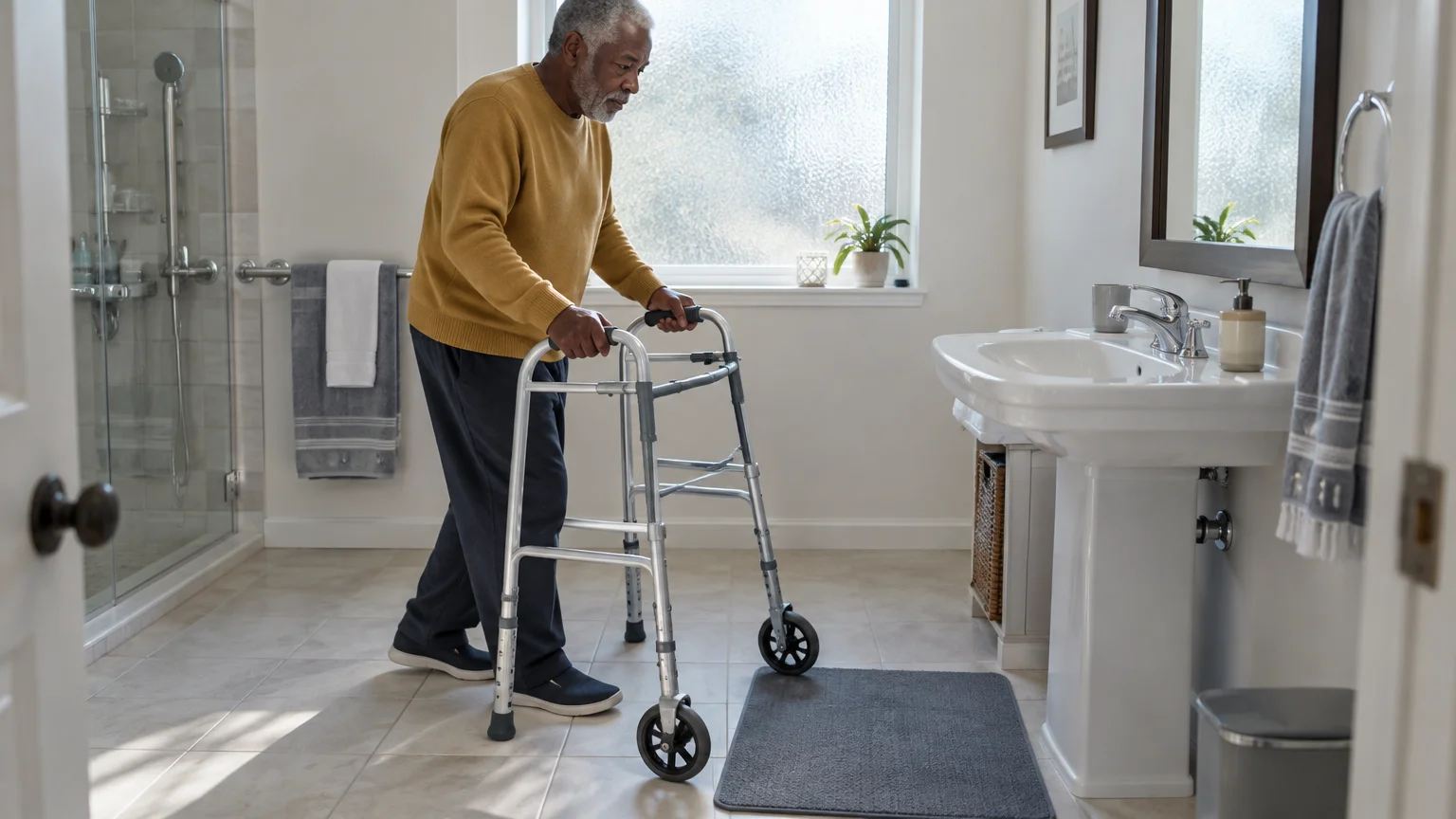
If you use a four-wheeled rolling walker, standard bathroom throw rugs threaten your stability every time you step toward the sink. Your front caster wheels need an unblocked path rather than plush fabric that bunches into a physical barrier.
Along with securing high-risk rooms, setting up daily senior check-in calls provides vital peace of mind for older adults managing home safety independently.
Choosing the right floor covering depends entirely on your walker wheel diameter and mat transition angles. Matching these dimensions keeps your rollator moving smoothly while preventing moisture slips on slick tile.
Ultra-low-profile rubberized mats with beveled thresholds eliminate wheel entrapment far better than thick memory foam, but bare-floor anti-slip coatings remain the superior choice for compact casters under six inches.
In this guide9 sections
- Wheel Diameter and Caster Physics on Bathroom Floors
- ADA Transition Standards Applied to Rollator Wheel Clearance
- Ultra-Low-Profile Rubberized Mats Versus Bare-Floor Coatings
- Worked Scenario: Outfitting a 74-Year-Old Rollator User’s Bathroom
- Essential Criteria for Walker Safe Bathroom Floor Mats
- When to Skip Rugs: High-Traction Bare-Floor Treatments
- Medicare Coverage Rules and Out-of-Pocket Costs
- Step-by-Step Installation and Testing Checklist
- Frequently Asked Questions
Wheel Diameter and Caster Physics on Bathroom Floors
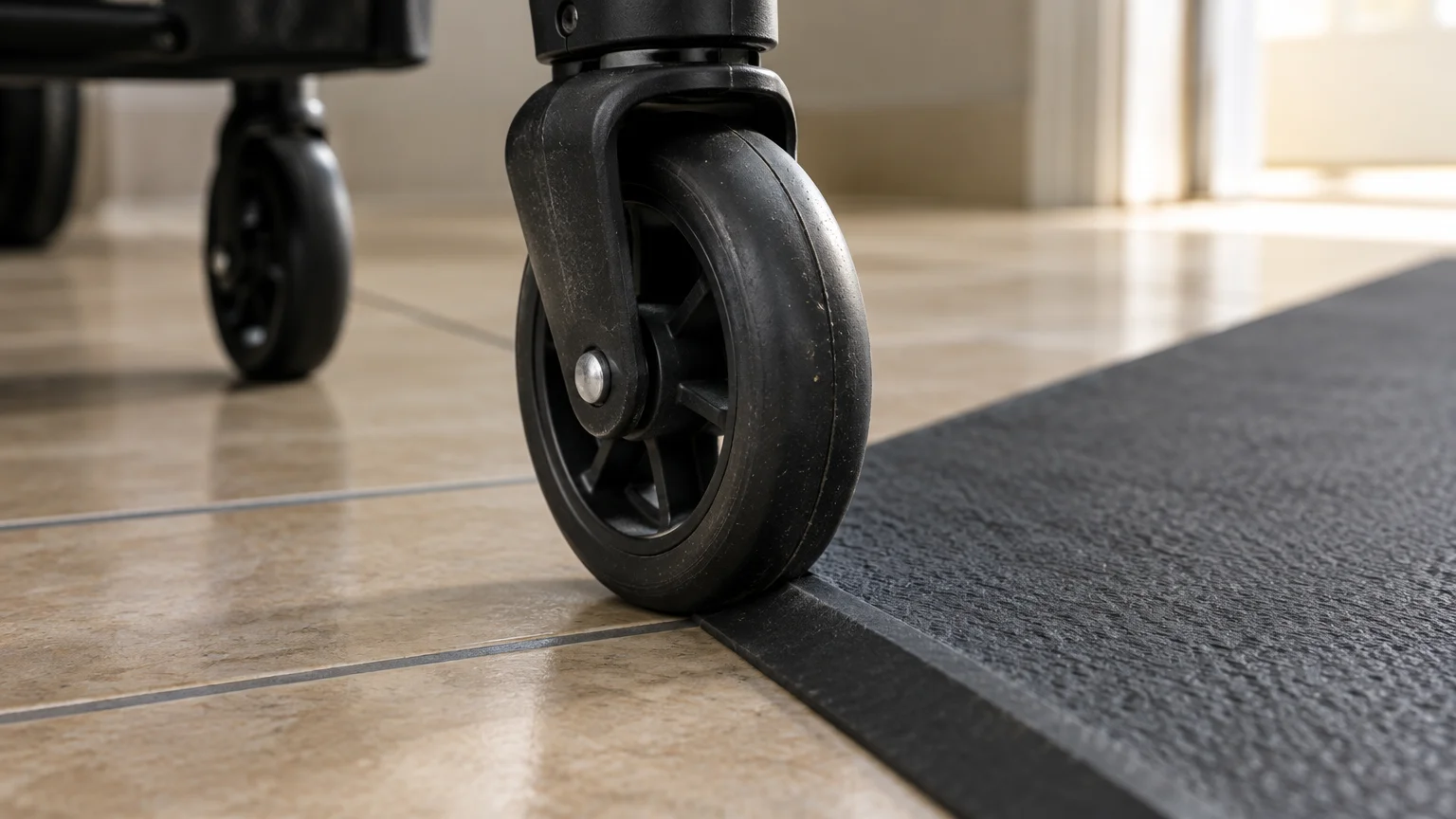
Rolling walkers rely on front caster wheels that pivot 360 degrees. Most standard rollators use either 6-inch or 8-inch polyurethane wheels to move across household surfaces.
Maintaining leg strength and balance through low-impact exercises for retirees provides essential physical support when maneuvering rollators over unexpected floor resistance.
When a rolling wheel strikes an abrupt vertical lip, forward momentum transforms into rotational resistance. If the floor obstacle exceeds the radius clearance of the caster, the wheel halts immediately.
That sudden stop creates rapid forward tipping momentum. For an older adult, unexpected resistance forces the walker frame away from the body, compromising stability on wet tile.
Six-inch wheels suffer from this mechanical stop far more frequently than eight-inch models. A six-inch wheel strikes a rug border at a steeper angle, requiring twice the pushing force to overcome the edge.
Plush bathroom rugs also compress under walker weight. The tire sinks into dense synthetic fibers, trapping the caster fork mechanism and stalling forward motion.
Rubberized floor coverings prevent this sinkage by offering a firm, unyielding surface. A dense substrate allows swivel casters to pivot smoothly without snagging the wheel fork housing.
ADA Transition Standards Applied to Rollator Wheel Clearance
Federal accessibility standards provide measurable guidelines for floor transitions. The Americans with Disabilities Act establishes exact thresholds for rolling mobility devices under ADA Section 303.
If mobility changes require gait reassessment or personalized balance training, review when Medicare covers physical therapy at home to explore available coverage options.
Addressing floor thresholds is a vital part of conducting broader essential home safety checks throughout your living space.
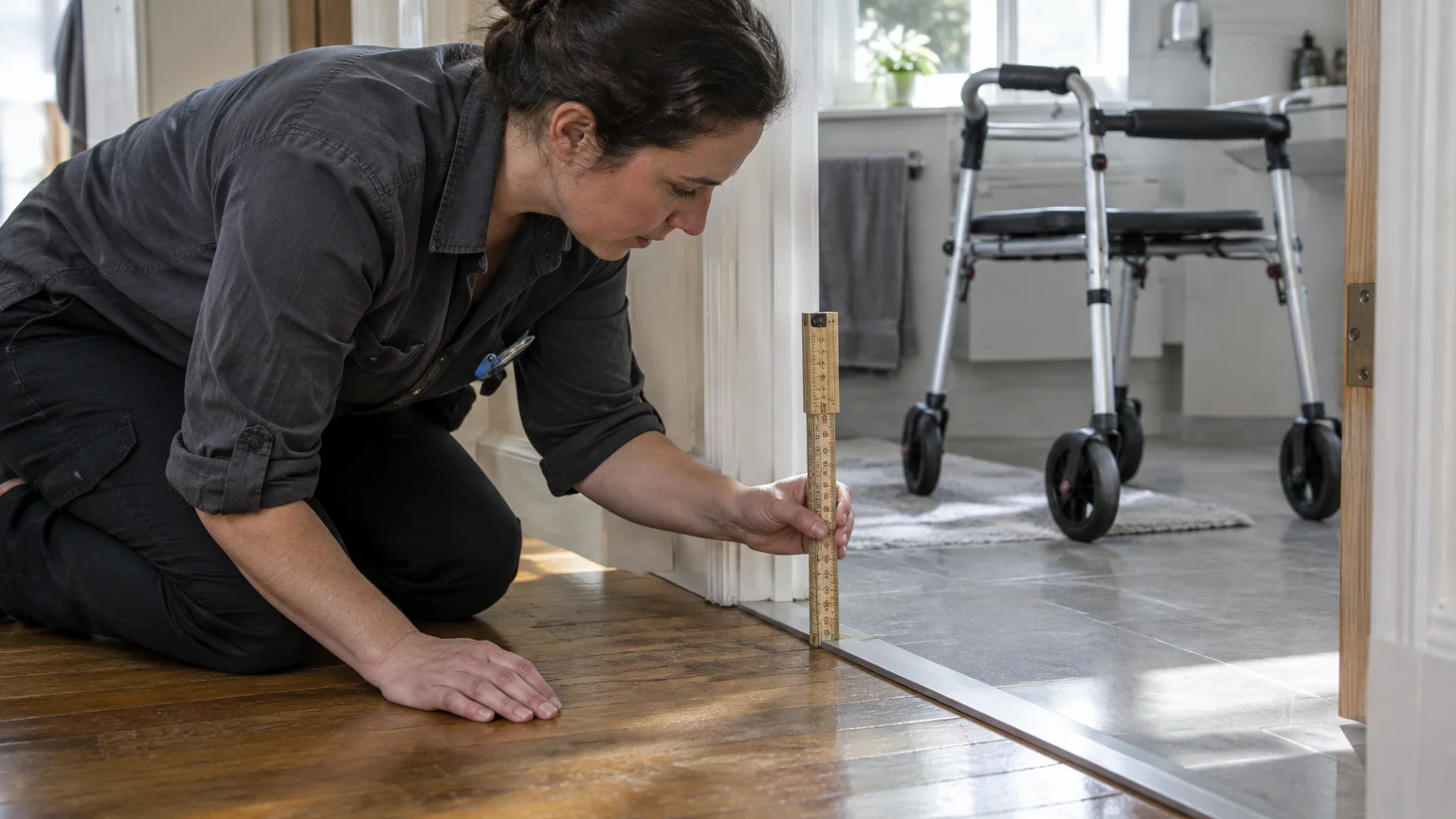
Under ADA Section 303 guidelines, vertical level changes must not exceed 1/4 inch (6.4 mm). Any transition between 1/4 inch and 1/2 inch requires a beveled edge with a slope no steeper than 1:2.
ADA Section 302.2 further requires floor covering pile heights to remain under 1/2 inch (13 mm) with a firm backing. Most plush bath rugs violate these standards by measuring between 0.75 and 1.5 inches thick.
Traditional department store bath rugs create vertical, unbeveled ledges. These thick lips act as chocks against rolling mobility equipment, making bathroom rugs for rolling walkers a structural safety issue.
Data from the Centers for Disease Control and Prevention indicates that over 234,000 emergency department visits occur annually from bathroom injuries. Over 80 percent of those injuries stem directly from falls.
“An ounce of prevention is worth a pound of cure.” — Benjamin Franklin
Investing in compliant floor transitions prevents emergency visits before mobility issues escalate. Proper beveling keeps rollator tires moving across floor surfaces without unexpected resistance.
Ultra-Low-Profile Rubberized Mats Versus Bare-Floor Coatings
When securing bathroom floors, you must choose between physical floor coverings and direct surface treatments. Both options aim to balance wheel rollability with slip prevention on wet porcelain tile.
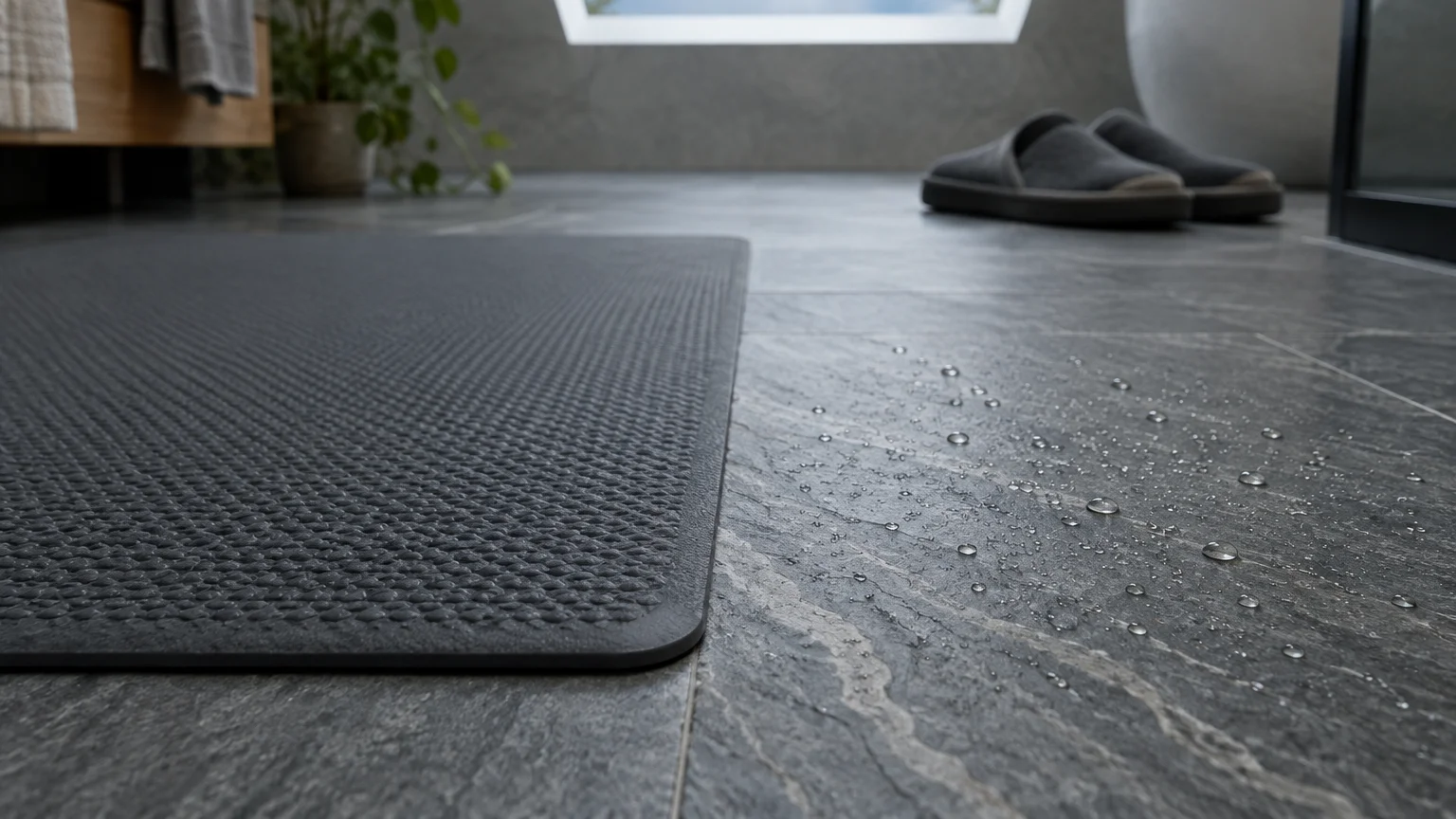
A low profile non slip bath mat senior homeowners choose features vulcanized nitrile rubber backing and beveled borders. In contrast, bare-floor treatments apply chemical etching or transparent abrasive coatings directly to tile.
The following comparison details how these floor options perform against critical mechanical and safety benchmarks:
| Solution Type | Profile Thickness | Wheel Transition Profile | Wet Dynamic Friction (DCOF) | Typical Cost |
|---|---|---|---|---|
| Commercial Nitrile Runner | 1/8 inch (3.2 mm) | Molded 1:2 beveled edge | 0.65 – 0.75 | $25 – $45 |
| Diatomaceous Composite Mat | 1/6 inch (4.0 mm) | Tapered rubber perimeter | 0.60 – 0.70 | $20 – $35 |
| Direct Anti-Slip Chemical Etch | 0 inches (Flush surface) | None (zero transition lip) | 0.60 – 0.68 | $35 – $60 per kit |
| Clear Textured Epoxy Coating | 0.02 inches (0.5 mm) | None (zero transition lip) | 0.70 – 0.85 | $40 – $75 per quart |
| Standard Memory Foam Bath Rug | 0.75 to 1.25 inches | Vertical 90-degree lip | 0.25 – 0.40 (edges slip) | $15 – $30 |
Commercial nitrile mats absorb water quickly while presenting less than a 1/8-inch obstacle to rolling wheels. However, they still introduce a perimeter seam that requires routine inspection.
Bare-floor coatings eliminate vertical thresholds entirely. While they remove wheel obstruction risks, they do not collect excess water puddles outside the shower basin.
Combining a single beveled runner outside the shower with bare-floor etching across the vanity path often provides the safest layout. This approach controls moisture while keeping turning zones clear.

Worked Scenario: Outfitting a 74-Year-Old Rollator User’s Bathroom
Consider Arthur, a 74-year-old retiree living in a single-level home with a 5-foot by 8-foot master bathroom. Arthur uses a Drive Medical four-wheel rollator equipped with 6-inch caster wheels.
Low-cost safety upgrades illustrate how simple lifestyle adjustments can eliminate major household hazards while keeping living expenses manageable.
Strategically replacing high-pile mats represents one of many effective home modifications for accessibility that allow retirees to age in place safely.
Arthur’s bathroom features smooth 12-inch glazed ceramic tiles. He previously used two 1-inch thick memory foam rugs in front of the vanity and shower, which cost $22 each.
Arthur experienced repeated wheel lockups when approaching the vanity. His 6-inch wheels hit the 1-inch vertical rug edge, forcing him to lift the 17-pound walker frame to clear the lip.
Lifting the walker compromised Arthur’s balance and increased his fall risk on slick surfaces. The modification team measured Arthur’s bathroom dimensions and replaced both rugs with a single engineered system:
- Removed both 1-inch thick memory foam rugs, eliminating a major vertical trip hazard.
- Installed one 24-inch by 60-inch commercial nitrile runner with a 1/8-inch thickness along the vanity path ($32.00).
- Verified the molded 1:2 beveled edge, reducing caster rolling resistance from 8.5 pounds to under 1.5 pounds of force.
- Treated the 9-square-foot shower exit zone with a slip-resistant tile chemical etch ($38.50), raising wet friction from 0.32 to 0.64 DCOF.
The entire modification cost $70.50 and took 45 minutes to implement. Arthur’s 6-inch caster wheels now roll seamlessly across the threshold without catching, eliminating lifting maneuvers completely.
Essential Criteria for Walker Safe Bathroom Floor Mats
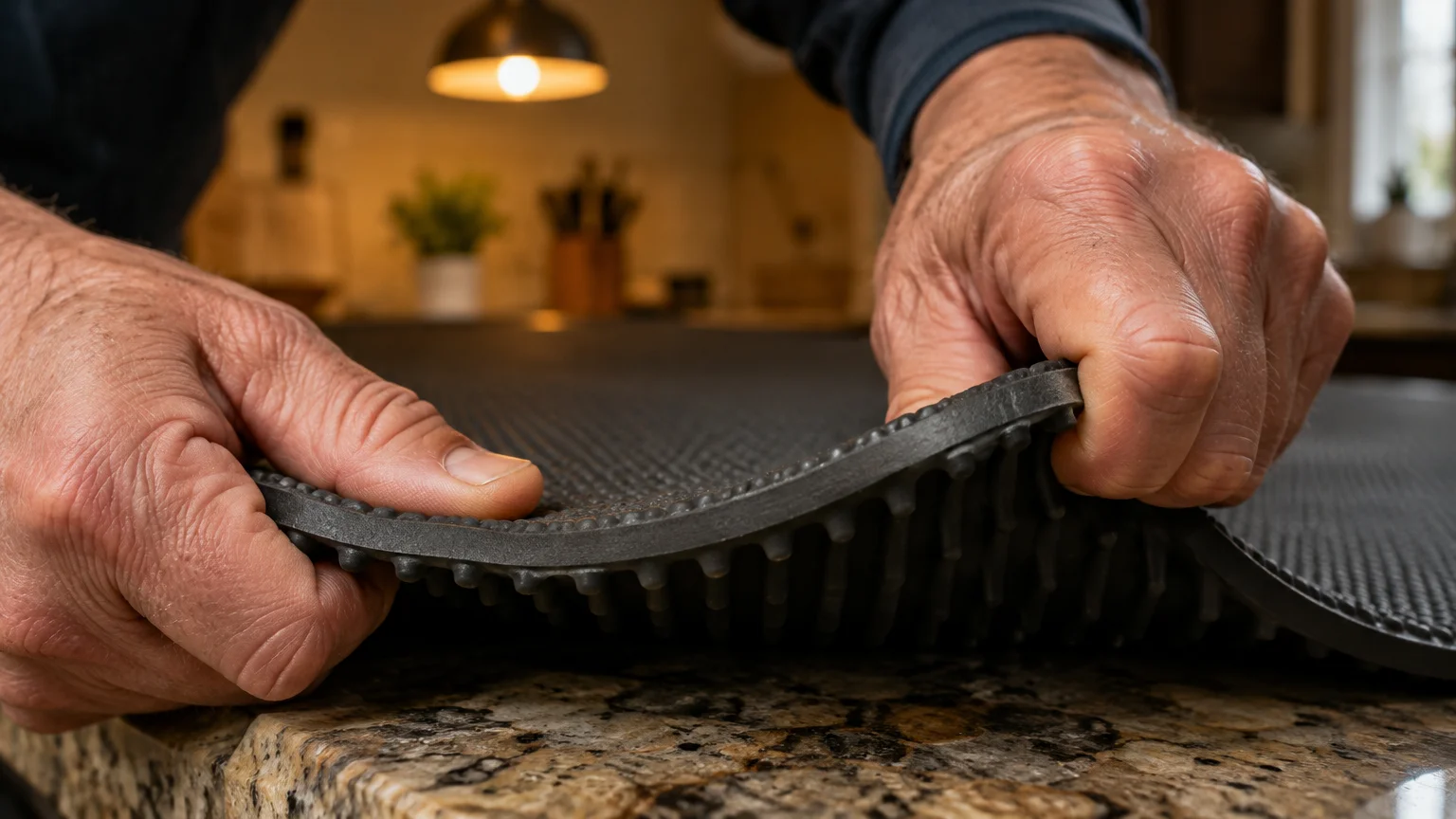
Selecting walker safe bathroom floor mats requires checking four core construction specifications. Inspecting these details before buying prevents hazardous wheel collisions.
Much like choosing adaptive kitchen tools for arthritis to reduce joint stress, selecting mats with low rolling resistance minimizes wrist strain during daily walker use.
Much like planning for stair lift installations on multi-story layouts, eliminating floor hazards ensures consistent independence on single-level walking paths.
- Profile height under 1/4 inch: Choose mats that do not exceed 0.25 inches in total uncompressed thickness.
- Tapered or beveled edges: Verify that the perimeter slopes down flush to the floor at a 1:2 grade.
- Vulcanized nitrile rubber backing: Avoid PVC or cheap latex backings that peel and slide on damp porcelain.
- Dense, low-pile or smooth absorbent surfaces: Select tight-weave microfibers or absorbent mineral composites that do not sink under caster weight.
- Adequate floor grip rating: Ensure the mat base achieves a high coefficient of friction against polished stone or tile.
Avoid looped yarn rugs under all circumstances. Looped fibers catch on caster axles, hairpins, and wheel brake hardware, creating sudden rolling jams.
Choose open-cell rubber backings that create suction against smooth tile. Mats that shift even two inches under rollator tires create loose fabric ridges that trip users.
Weight also matters when choosing runner mats. Heavier rubber bases stay rooted to the floor when wheels push against their leading borders during sharp turns.
When to Skip Rugs: High-Traction Bare-Floor Treatments
In small bathrooms with tight turning spaces, mats often create more problems than they solve. When walker turning radiuses measure under 36 inches, wheels constantly pivot across mat borders.
Evaluating turning clearance in compact bathrooms applies the same spatial planning guidelines used when learning how to measure furniture when downsizing space.
Pairing bare-floor treatments with adequate walkway lighting to prevent nighttime falls creates a clear, visible path between the bedroom and bathroom.
Pivoting rollator casters exert sideways rotational shear on rug corners. This lateral force causes even high-grip mats to curl or bunch upward over time.
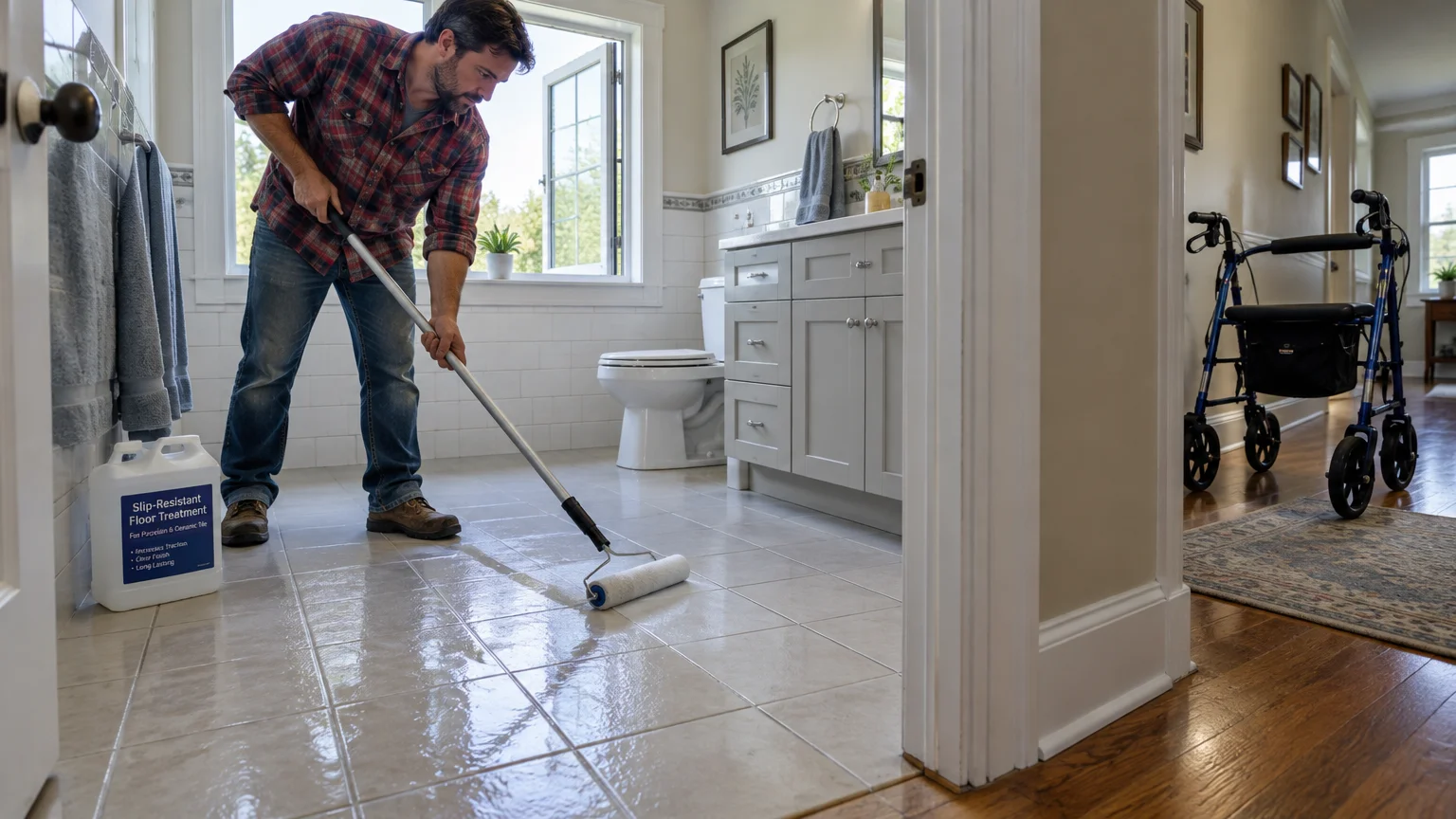
Applying high-traction bare-floor treatments directly to bathroom tiles removes the need for floor mats. Consider these three dependable bare-floor options:
- Micro-etching chemical treatments: Acid-based solutions create microscopic suction pores in porcelain and ceramic tile without altering appearance.
- Clear textured anti-slip coatings: Water-based polyurethane coatings infused with soft aggregate provide aggressive wet traction across all floor areas.
- Self-adhesive abrasive safety strips: Low-profile textured tread strips placed directly at shower exits offer targeted traction without floor-wide chemical application.
According to home safety guidance from AARP, removing floor clutter and stabilizing walking paths represents the most cost-effective way to prevent catastrophic falls.
Bare-floor treatments let your walker casters roll smoothly without any transition obstacles. They also simplify weekly cleaning, as you mop directly across the treated surface without washing rugs.
Medicare Coverage Rules and Out-of-Pocket Costs
Many older adults assume Medicare covers bathroom safety modifications and non-slip mats. However, federal coverage guidelines draw strict lines between clinical equipment and home adaptations.
Original Medicare Parts A and B do not cover bathroom rugs, non-slip mats, or bare-floor treatments. As outlined by Medicare.gov, these products are categorized as personal convenience items rather than Durable Medical Equipment.
To qualify as Durable Medical Equipment, an item must withstand repeated use, serve a primarily medical purpose, and operate outside general comfort. Rollators qualify for coverage, but floor accessories do not.
Fortunately, many private Medicare Advantage plans offer supplemental allowances for home safety modifications. These allowances often provide between $100 and $500 per calendar year for qualifying safety items.
You can verify local utility assistance and independent living support through the Eldercare Locator, a public service of the Administration for Community Living.
Low-profile safety mats remain accessible on modest fixed retirement budgets. High-grade commercial nitrile runners typically retail between $20 and $45, while DIY chemical floor etch kits cost $30 to $55.
Step-by-Step Installation and Testing Checklist
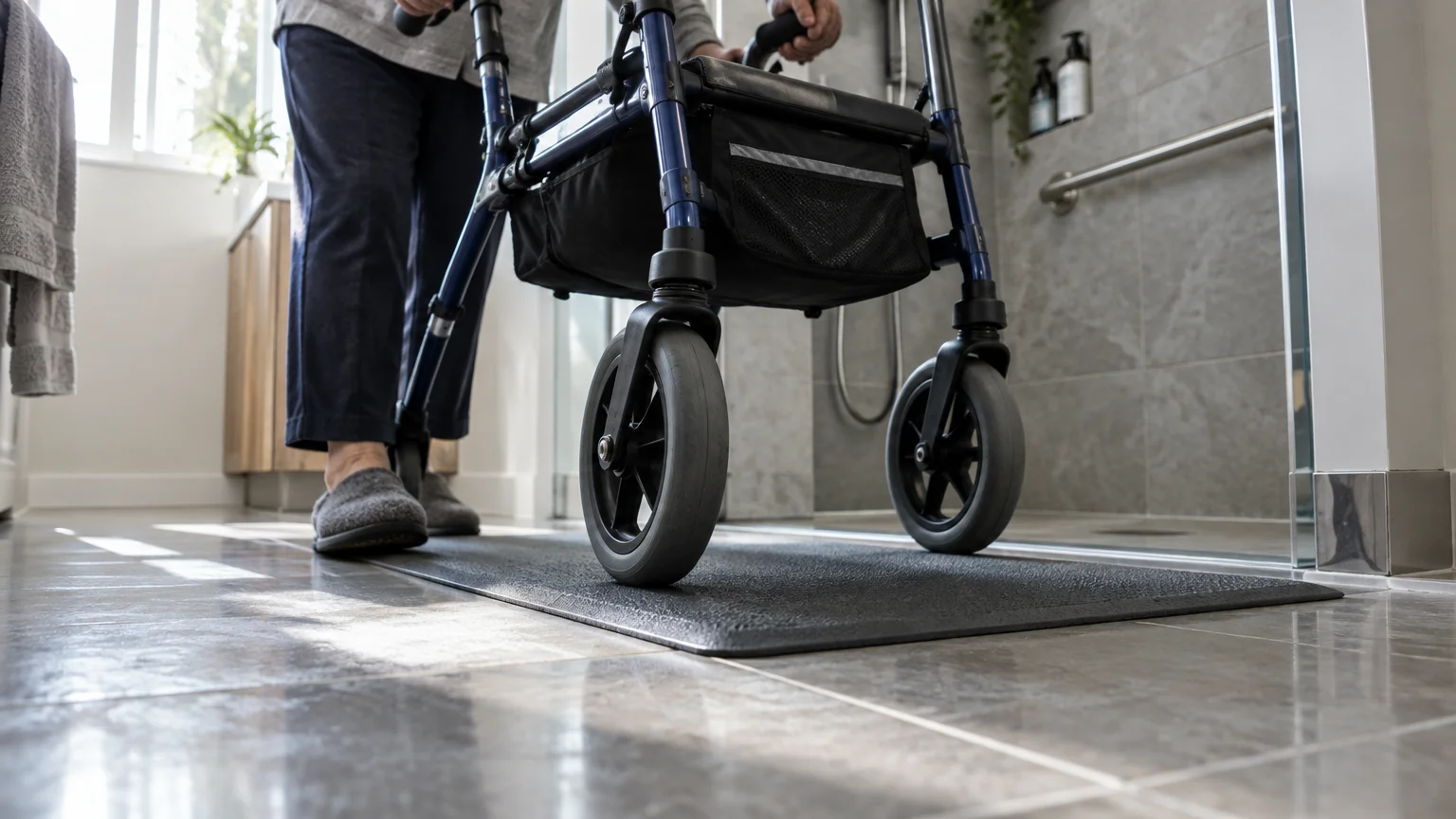
Installing a walker-safe floor mat requires methodical placement and testing. Follow this sequential protocol to verify that your new mat accommodates your walker safely:
- Clean the tile surface thoroughly: Strip all existing soap scum, wax, and floor cleaner residues using a 50/50 water and white vinegar solution.
- Dry the substrate completely: Allow the floor to dry for at least two hours before placing any rubber-backed matting.
- Align the mat along natural roll paths: Position runner mats parallel to your walking line between the door, sink, and toilet rather than diagonally.
- Perform an unweighted roll test: Push your empty rollator straight over the mat threshold to check if front wheels track without catching.
- Perform a weighted pivot test: Place your full body weight on the walker handles and complete a 90-degree turn directly on the mat border.
- Inspect for border lift: Confirm that the edges lay completely flat against the floor without curling or buckling under turning pressure.
If the mat corners lift during turns, anchor them immediately with double-sided acrylic flooring tape. Inspect mat edges weekly to ensure continuous adhesion to your bathroom tile.
Wash rubber-backed runners on gentle cycles without fabric softener. Heat breaks down rubber backing, so always air-dry your safety mats flat to prevent edge curling.
Frequently Asked Questions
What is the safest rug thickness for a rolling walker?
The safest rug thickness is 1/8 inch to 1/4 inch (3 to 6 mm) with a beveled perimeter edge. Rugs exceeding 1/4 inch create vertical barriers that catch front rollator casters.
Can I use regular non-slip rug pads under my current bathroom rugs?
No, adding rug pads under traditional rugs increases total pile height and worsens wheel obstruction. Pads do not prevent plush rugs from bunching under rolling walker tires.
Are diatomaceous earth stone bath mats safe for walkers?
Hard stone mats are safe only if they feature beveled rubber borders and do not exceed 1/4 inch in height. Rigid unbeveled stone edges can chip or halt small 6-inch walker wheels.
How do I stop bathroom rugs from curling at the corners?
Secure curled corners using heavy-duty silicone rug grippers or moisture-resistant double-sided flooring tape. Replace any mat whose vulcanized backing has warped from heat or detergent washing.
Does Medicare pay for non-slip bathroom mats?
Original Medicare does not cover bathroom mats or rugs because they are classified as personal convenience items. Some Medicare Advantage plans offer supplemental allowances that reimburse safety products.
Disclaimer: This article is for informational purposes only. Benefits, programs, and regulations can change.
We encourage readers to verify current information with official government sources and consult with qualified professionals for personalized advice.



1 Comment