

Renting an RV for a fall road trip allows you to test the mobile lifestyle before spending six figures of your hard-earned retirement nest egg on an outright motorhome purchase.
While peer-to-peer platforms advertise attractive daily base rates, basic rental policies frequently exclude overhead branch strikes and rear tail-swing scrapes on unfamiliar wide wheelbases.
Auditing supplemental insurance options and selecting interior layouts with walk-around beds ensures your autumn foliage trial run delivers practical clarity rather than costly vehicle repair liabilities.
In this guide8 sections
- Evaluating Peer-to-Peer Rental Insurance Tiers
- Wheelbase Dimensions and Turning Dynamics for Beginners
- Floor Plan Usability: Bed Access and Living Ergonomics
- Comparing Platform Protection and Vehicle Configurations
- Worked Financial Example: A 7-Night Pennsylvania Foliage Route
- Campground Reservations and Utility Hookup Fundamentals
- The Stationary Drop-Off Alternative: Zero-Driving Trials
- Frequently Asked Questions
Evaluating Peer-to-Peer Rental Insurance Tiers
Personal auto insurance policies rarely cover recreational vehicles rented through peer-to-peer networks. Most passenger vehicle insurers explicitly exclude commercial peer platforms and motorhomes exceeding 10,000 pounds Gross Vehicle Weight Rating (GVWR).
When booking destinations, remember that leveraging state park senior camping discounts can dramatically offset your nightly stopover expenses.
If this temporary rental inspires you to adopt life on the road permanently, you will also want to review Medicare coverage for full-time RVers to maintain comprehensive healthcare access nationwide.
Relying on your everyday auto policy creates immense financial exposure. You must purchase commercial coverage directly through the rental platform before departing on your trip.
Outdoorsy and RVshare structure their supplemental policies in tiers. Base packages typically offer state statutory minimum liability alongside collision coverage carrying high deductibles between $1,500 and $4,000.
Opting for mid-tier or premium coverage lowers your deductible to $500 or $1,000 per incident. Premium tiers also increase third-party liability protection up to $1,000,000, shielding your retirement assets from catastrophic legal claims.
Carefully audit policy exclusions before confirming your booking. Rental platforms frequently exclude damage occurring above the roofline or below the chassis axle plane from standard collision protections.
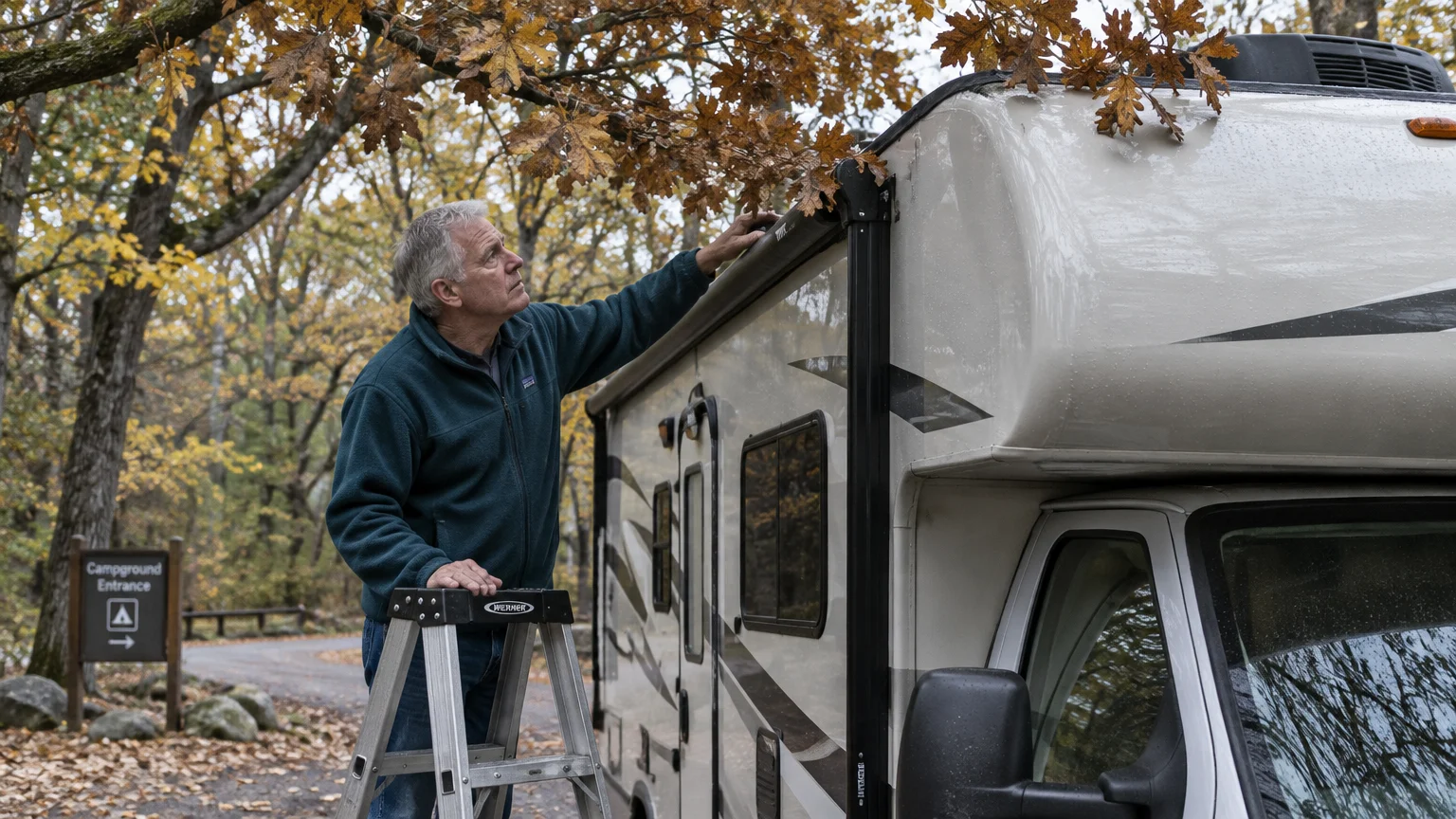
Low-hanging tree branches along winding northeastern corridors present a severe risk in October. Striking an overhead branch at a wooded campground can crack a fiberglass roof cap or puncture a rubber roof membrane.
Repairing an air conditioner shroud or punctured rubber roof can easily cost between $2,500 and $7,000 out of pocket. Verifying that your supplemental policy includes roof impact riders prevents unexpected drain on your personal savings.
According to consumer guidance published by the Consumer Financial Protection Bureau, reviewing binding contract terms and understanding your liability limits protects long-term family assets from unexpected debt collection.
Review these critical policy gaps when selecting supplemental insurance packages:
- Overhead damage caused by bridge underpasses, low gas station canopies, or falling forest limbs
- Undercarriage damage from scraping high curbs, bottoming out on campground dips, or hitting road debris
- Interior accidental damage, such as broken cabinet latches, stained upholstery, or cracked cooktops
- Unlisted driver liability if your spouse takes the steering wheel without platform credential approval
- Towing and winching caps that limit roadside recovery in rural mountain passes
Wheelbase Dimensions and Turning Dynamics for Beginners
Driving a motorhome requires adjusting your spatial awareness. The wheelbase—measured as the distance between the center of the front wheels and the center of the rear axle—determines how the vehicle tracks through turns.
A passenger sedan turns almost instantaneously when you rotate the steering wheel. A motorized RV requires you to pull forward deeper into an intersection before initiating your turn.
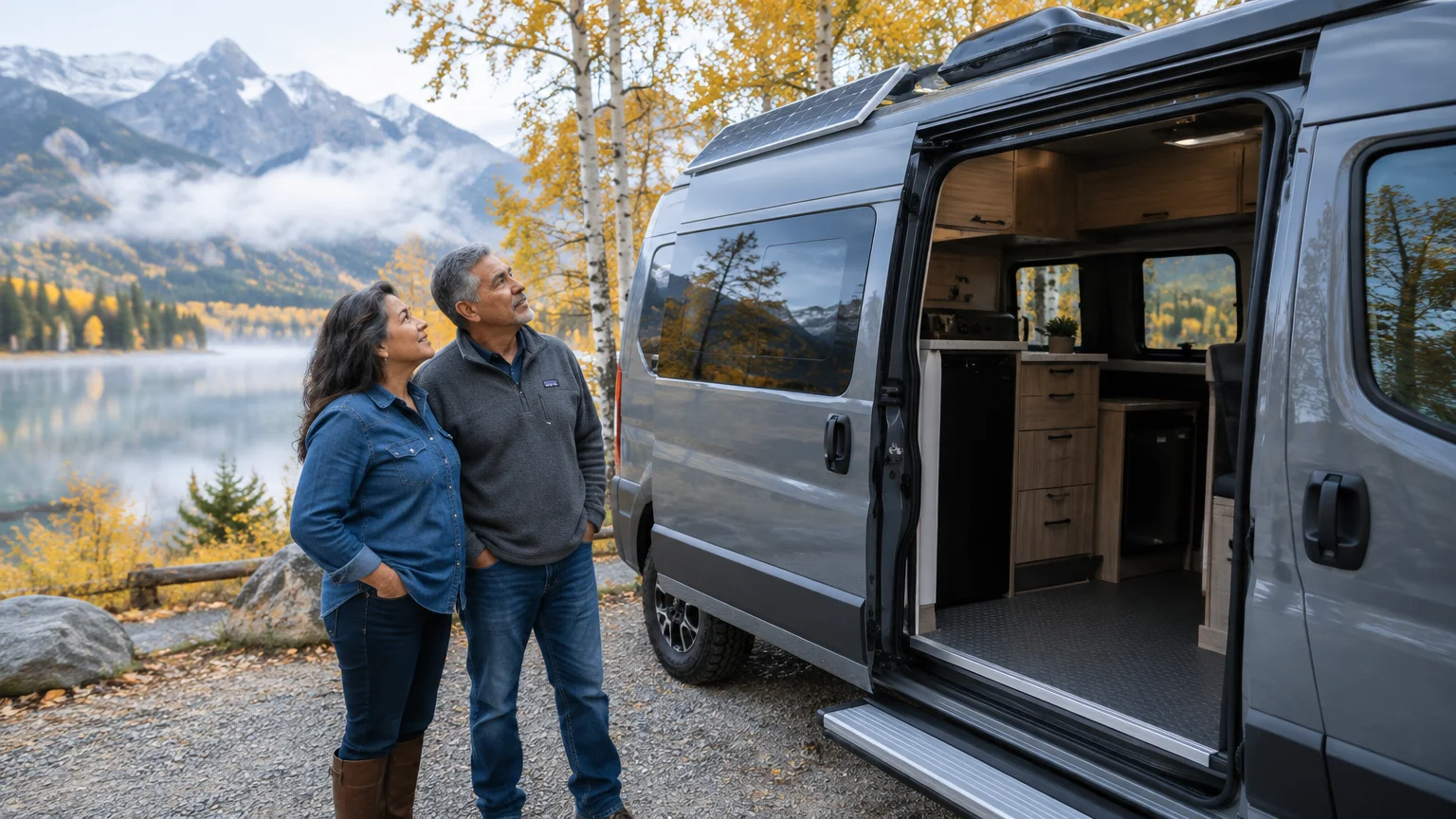
Class B campervans built on Mercedes-Benz Sprinter or Ram ProMaster chassis typically feature wheelbases between 136 and 170 inches. These compact vans handle identically to full-size passenger vans, making them accessible for beginners.
Class C motorhomes built on Ford E-350 or E-450 chassis present a distinct mechanical challenge. These vehicles carry wheelbases ranging from 158 to 220 inches, paired with an extended rear frame overhang behind the axle.
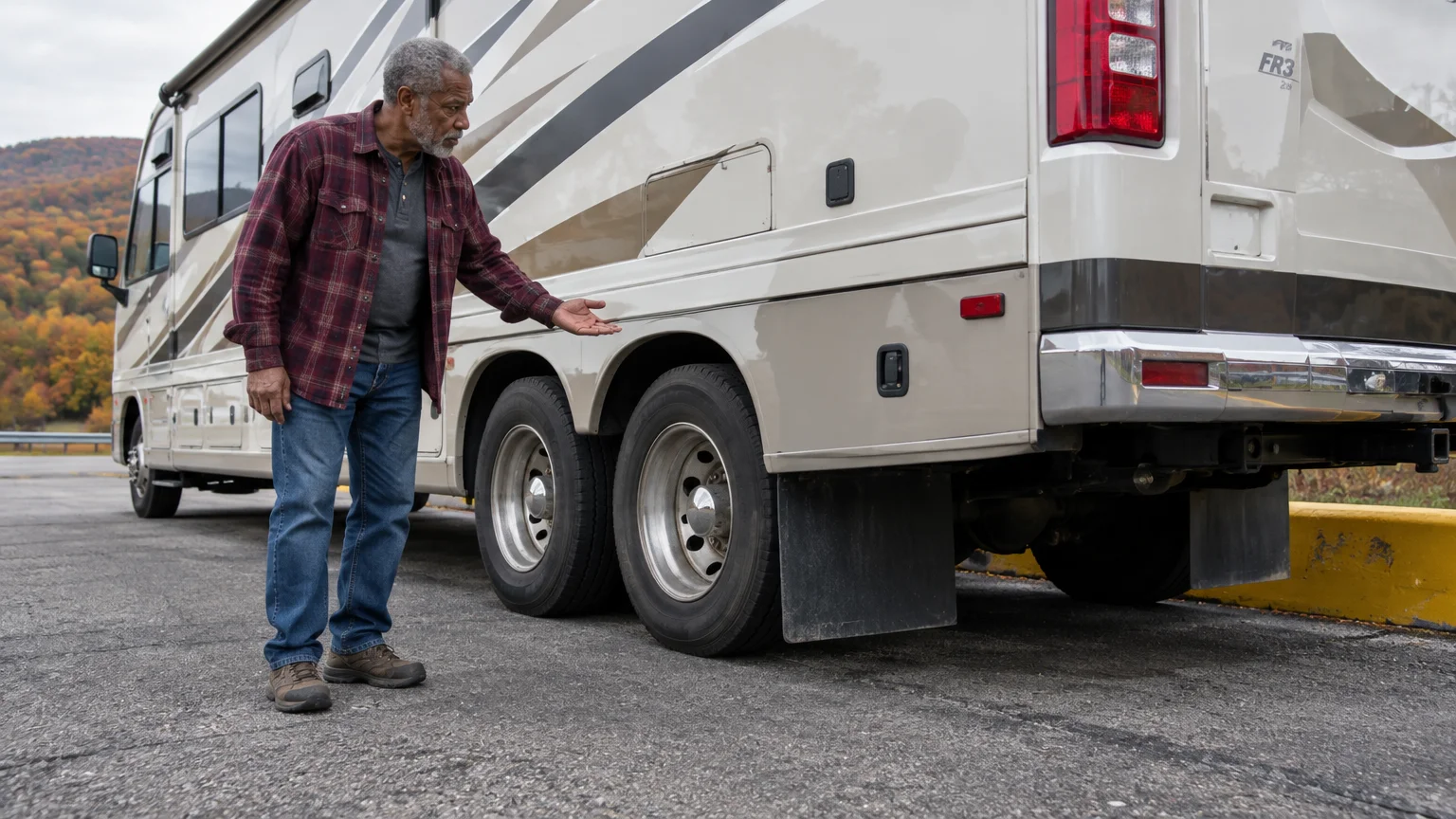
This rear overhang causes tail swing. When you make a sharp right turn, the rear section of the motorhome swings outward up to three feet to the left.
Failing to account for tail swing can cause the rear bumper to strike fuel pump bollards, roadside signs, or parked vehicles. You must monitor both your side mirrors throughout every low-speed maneuver.
Follow these essential turning and positioning rules behind the wheel:
- Square off your turns by pulling forward until your hip aligns with the corner curb before turning the wheel.
- Check the outside convex mirror during turns to ensure the rear overhang does not hit adjacent objects.
- Maintain an eight-second following distance behind lead vehicles to accommodate heavier stopping weights.
- Assign your traveling partner to act as an external ground guide whenever shifting into reverse.
- Choose outer diesel or unleaded fuel lanes at commercial travel plazas to maximize turning clearance.
Floor Plan Usability: Bed Access and Living Ergonomics
Rental listings look spacious in wide-angle photos, but poor layout ergonomics can ruin daily comfort. Newly retired travelers must evaluate interior layouts based on practical mobility needs rather than aesthetic appeal.
Corner beds—frequently called “French beds” in compact Class C floor plans—force one partner against the exterior wall. The trapped sleeper must crawl over their partner during nighttime bathroom trips, creating sleep disruptions and fall hazards.
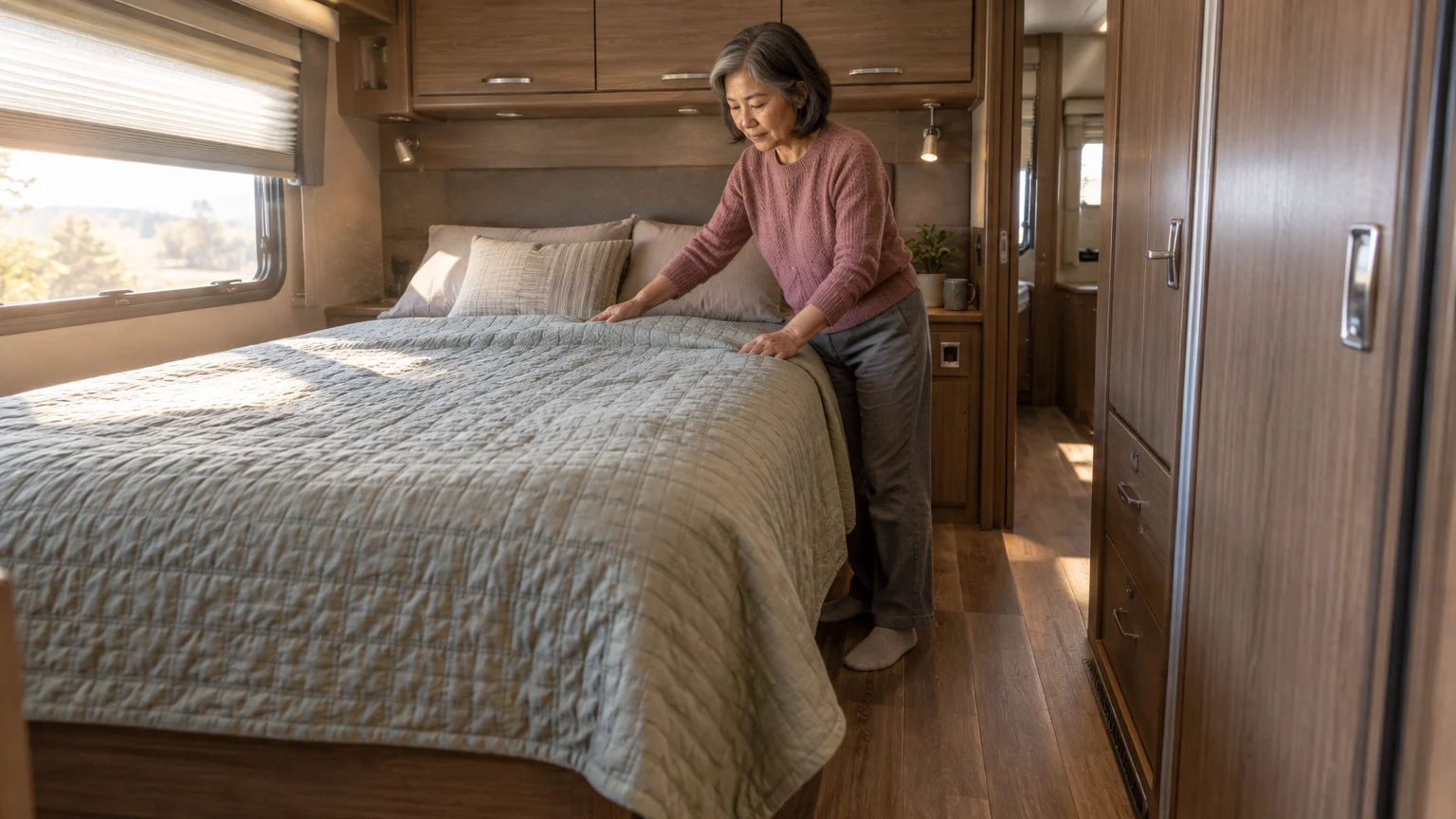
Look for motorhomes featuring dedicated “walk-around” island queen beds. These layouts provide unobstructed walking paths on both sides of the mattress, offering comfortable living conditions identical to home bedrooms.
Bathroom configurations also vary significantly between vehicle classes. Class B campervans usually feature “wet baths,” where the shower, toilet, and sink share a single waterproof compartment measuring under twelve square feet.
Showering in a wet bath requires wiping down the entire toilet and surrounding walls after every use. A Class C motorhome typically features a “dry bath,” which separates the shower stall from the toilet commode.
Dry baths provide dedicated counter space, solid privacy doors, and room to maneuver dressing aids. If you experience knee or hip stiffness, a dry bath prevents painful physical strain throughout your journey.
Interior layout considerations to verify before booking include:
- Walk-around bed clearance measuring at least eighteen inches on each side
- Solid privacy partitions separating the primary bedroom from common living spaces
- Step-well depth and sturdy assist grab handles at the primary entrance door
- Overhead cabinet latch tension and ease of opening without excessive wrist torque
- Dinette seating cushion firmness and ergonomic lumbar support during meal times
Comparing Platform Protection and Vehicle Configurations
Choosing between Outdoorsy and RVshare requires balancing platform insurance structures against specific vehicle handling characteristics. Both platforms host private owners, but their default insurance partners and coverage options differ.
Comparing these options early is a smart strategy when budgeting for travel in retirement without overspending on trial runs.
Testing these different chassis layouts on a short autumn getaway provides valuable experience if you later plan on budgeting for an RV snowbird season heading south for the winter.
RVshare utilizes commercial policies backed by DigiSure, whereas Outdoorsy partners with Assurant. Both platforms charge daily insurance surcharges based on the vehicle value, model year, and selected tier.
The following comparison table details measurable physical dimensions, insurance details, and ergonomics across standard rental options:
| Platform & Model | Wheelbase & Length | Tail Swing Clearance | Insurance Surcharge & Deductible | Bed Access & Bathroom Type |
|---|---|---|---|---|
| Outdoorsy: Winnebago Solis 59P (Class B) | 159 in. Wheelbase / 19 ft. 9 in. Length | Zero swing; tracks inside turn | $34 to $48/day; $500 to $1,500 deductible | Rear Murphy bed (crawl-in); compact wet bath |
| Outdoorsy: Coachmen Freelander 22XG (Class C) | 158 in. Wheelbase / 24 ft. 3 in. Length | 18 to 24 in. lateral swing | $38 to $56/day; $500 to $1,000 deductible | Corner bed (crawl-over); split dry bath |
| RVshare: Thor Four Winds 28A (Class C) | 212 in. Wheelbase / 29 ft. 9 in. Length | 30 to 36 in. lateral swing | $42 to $65/day; $750 to $1,500 deductible | Walk-around island queen; private dry bath |
| RVshare: Jayco Jay Flight 24RBS (Delivered Trailer) | Stationary delivery (no driving required) | None (parked on site) | $22 to $35/day; $500 deductible | Walk-around island queen; spacious rear dry bath |
The Winnebago Solis eliminates tail swing and handles narrow country roads with ease. However, the compact wet bath and crawl-in bed require physical agility that may not suit every retiree.
The Thor Four Winds provides an optimal residential layout with a walk-around bed and spacious bathroom. However, its 212-inch wheelbase and heavy tail swing demand heightened driving attention in tight spaces.
The Coachmen Freelander balances exterior maneuverability with adequate living space. It offers a shorter turning radius while preserving full dry-bath functionality for week-long trips.

Worked Financial Example: A 7-Night Pennsylvania Foliage Route
To understand the true cost of renting an RV in retirement, consider a realistic travel scenario. Jim and Brenda, a newly retired couple from Lancaster, Pennsylvania, want to test RV travel during peak October foliage.
To prevent these variable rental fees from disrupting your monthly living budget, consider building a retirement travel sinking fund well before scheduling your route.
They book a 24-foot Class C motorhome on Outdoorsy for seven nights, departing October 8 and returning October 15. Their route heads north through the Susquehanna Valley to the Pennsylvania Grand Canyon near Wellsboro.
The total driving distance is 460 highway miles round trip, plus 60 local scenic miles, totaling 520 miles. The rental contract includes 100 free miles per day, providing a 700-mile allotment.
Here is their comprehensive, itemized financial breakdown:
- Base vehicle rental: 7 nights at $175.00 per night = $1,225.00
- Platform service fee: 13% of base rate = $159.25
- Supplemental insurance: Preferred tier at $42.00 per day ($500 deductible) = $294.00
- Cleaning and vehicle prep deposit: Flat host fee = $100.00
- Mileage overage charge: 520 miles driven within 700-mile allowance = $0.00
- Gasoline consumption: 520 miles at 9.5 MPG = 54.7 gallons of regular unleaded at $3.65 per gallon = $199.66
- Generator usage: 4 hours at $3.00 per hour above free daily allowance = $12.00
- Campground lodging: 3 nights at Leonard Harrison State Park ($35.00/night) plus 4 nights at a private resort in Wellsboro ($65.00/night) = $365.00
- Propane refilling fee: 4.2 gallons consumed for space heating = $16.80
The total cost for this seven-night trial run equals $2,371.71, representing an all-in daily expense of $338.82. Comparing this expense against annual depreciation on an owned rig demonstrates the financial wisdom of renting first.
A new Class C motorhome depreciates by roughly $12,000 to $18,000 during its initial year of ownership. Spending $2,372 to test your driving comfort and living compatibility protects your nest egg from costly buyer’s remorse.
Retirees age 62 and older can secure additional campground savings through the America the Beautiful Senior Pass program. According to federal recreation guidelines listed on Benefits.gov, pass holders receive a 50 percent discount on standard campsite fees across federal facilities.
Campground Reservations and Utility Hookup Fundamentals
Fall foliage attracts thousands of travelers to scenic mountain highways throughout October. Campground reservations in premier foliage destinations fill up months before the leaves change color.
Those looking to bypass organized campgrounds altogether can explore off-grid public lands using a guide to Quartzsite BLM boondocking.
If your itinerary includes iconic public lands, learning how to visit national parks on a budget will help keep overall entrance and camping costs predictable.
Federal campgrounds managed through Recreation.gov release standard campsite inventory on a rolling six-month window at 10:00 a.m. Eastern time. Booking an October reservation requires securing your reservation in April.
Private RV parks typically accept reservations nine to twelve months in advance. When selecting a campsite, you must confirm that the site dimensions and utility connections match your rental vehicle.
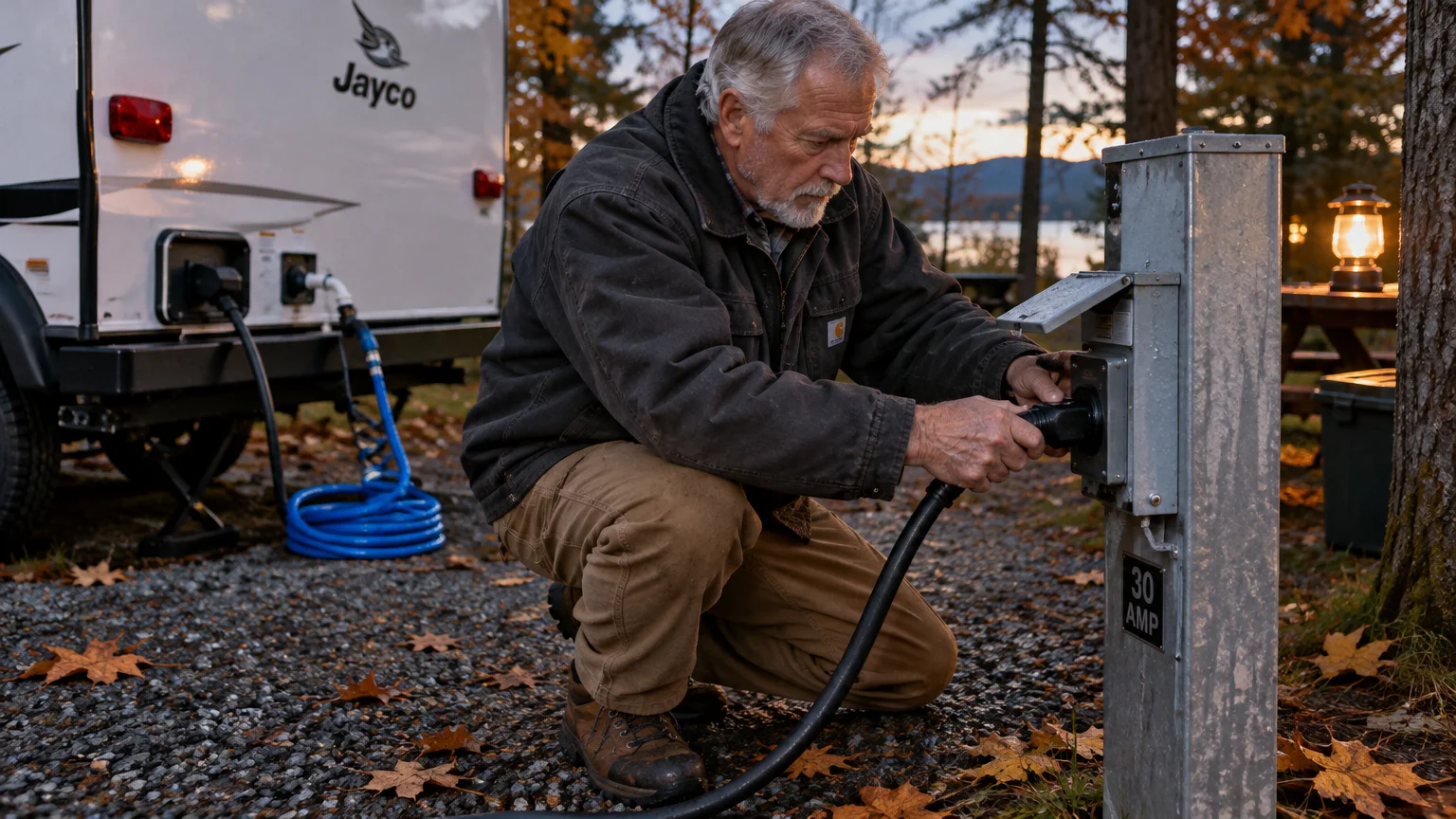
Campgrounds offer partial hookups with water and electricity, or full hookups that add direct sewer access. Connecting your motorhome utilities follows a straightforward mechanical order.
Follow this exact step-by-step connection sequence at every campground:
- Park the RV level, engage the parking brake, and insert wheel chocks against both rear tires.
- Connect your surge protector to the campground electrical pedestal before plugging in the RV power cord.
- Inspect the pedestal breaker switch to confirm the power is turned off before inserting your power plug.
- Flip the pedestal breaker switch on, verifying that the surge protector displays green diagnostic lights.
- Attach an inline brass water pressure regulator to the campground spigot before attaching your drinking hose.
- Connect your ribbed sewer hose to the waste outlet, securing the bayonet fitting with a clockwise twist.
Proper tank management ensures a sanitary experience inside the cabin. Never leave your black water tank drain valve open while connected to a full-hookup campsite sewer tap.
Leaving the black tank valve open allows liquid to drain away while solid waste accumulates beneath the commode, causing an expensive blockage. Keep the valve closed until the tank reaches two-thirds capacity before discharging.
Drivers can refresh their highway knowledge and review defensive driving habits through specialized senior safety courses. The educational resources provided by AARP offer valuable refreshers on managing vehicle reaction times and heavy traffic.

The Stationary Drop-Off Alternative: Zero-Driving Trials
If operating a wide-wheelbase motorhome on mountain roads causes anxiety, you have an accessible alternative. Both Outdoorsy and RVshare allow renters to filter search results for host delivery and campsite setup.
If you decide an RV stay feels too confined, exploring home exchange vacations in retirement offers a comfortable, zero-driving lodging alternative.
Under a stationary rental agreement, the vehicle owner tows a travel trailer directly to your reserved campsite. The host levels the rig, connects all utility hookups, and tests the climate systems before you arrive.
When your road trip concludes, the host returns to disconnect the utilities, empty the waste holding tanks, and tow the rig away. You never sit behind the wheel or operate a trailer hitch.
This stationary option creates an ideal trial environment for prospective retirees. You experience interior living spaces, kitchen layouts, and tank capacities without any on-road stress.
Delivery fees typically range from a flat charge of $150 to $250, or $2.50 to $4.00 per mile from the host’s primary storage facility. This delivery surcharge often costs less than the fuel and supplemental road insurance required for self-driven motorhomes.
Verify that your host completes the following tasks during the arrival walkthrough:
- Demonstrating the digital control panel for water pump switches, tank level monitors, and slide-outs
- Explaining thermostat operation for both the propane furnace and overhead air conditioning unit
- Locating the primary 12-volt fuse panel and 120-volt circuit breaker box inside the cabin
- Testing hot water heater ignition on both propane and electric modes
- Providing emergency contact numbers and host response times for evening mechanical issues
Frequently Asked Questions
Do I need a commercial driver’s license to drive a rental RV?
No, a standard Class D passenger vehicle driver’s license is legally sufficient to drive rental motorhomes in almost all states. Special endorsements or commercial licenses apply only to private vehicles exceeding 26,000 pounds GVWR.
Unplanned travel fees and unexpected rental deductibles are prime examples of the hidden expenses that can derail a retirement budget.
Does my personal auto insurance cover peer-to-peer RV rentals?
Most personal auto insurance policies exclude peer-to-peer recreational vehicle rentals under commercial use clauses. You must purchase supplemental liability and collision coverage directly through Outdoorsy or RVshare during checkout.
What is the America the Beautiful Senior Pass campsite discount?
The America the Beautiful Senior Pass provides U.S. citizens age 62 and older with a 50 percent discount on standard campsite amenity fees at participating federal recreation areas managed by the National Park Service and Forest Service.
How does tail swing impact driving a Class C motorhome?
Class C motorhomes have an extended body section behind the rear axle that pivots outward up to three feet in the opposite direction of a turn. Drivers must check mirrors to avoid striking fuel pumps or obstacles.
What happens if a tree branch damages the rental RV roof?
Base peer-to-peer insurance policies frequently exclude overhead roof damage from standard collision coverage. You should select premium supplemental tiers that include overhead protection to avoid paying out of pocket for repairs.
Disclaimer: This article is for informational purposes only. Benefits, programs, and regulations can change.
We encourage readers to verify current information with official government sources and consult with qualified professionals for personalized advice.



1 Comment