Planning a cross-country tent camping route from Michigan across the western states cuts your nightly lodging expenses significantly. Knowing which state park networks extend discounts to out-of-state seniors ensures you never overpay at the check-in booth.
Most outdoor travel guides treat senior camping passes as universal benefits. The reality is that state park systems operate under separate laws, frequently reserving premier 50 percent discounts strictly for their own resident taxpayers.
Before packing your tent in Michigan, you must know where your driver’s license unlocks genuine savings and where non-residents pay standard rates.
In this guide8 sections
- The Residency Trap: In-State vs. Out-of-State Senior Rules
- Federal Passes vs. State Systems: Clearing Up Common Confusion
- Midwestern State Parks: State-by-State Rules for Non-Resident Campers
- Western Cross-Country Route: State Park Rules from the Plains to the Pacific
- Campsite Cost Comparison: 21-Night Cross-Country Tent Camping Budget
- Essential Booking Tactics for Solo and Tent Campers Age 60 and Older
- Hidden Fees, Utility Charges, and Day-Use Permit Loopholes
- Frequently Asked Questions
The Residency Trap: In-State vs. Out-of-State Senior Rules
State park funding relies heavily on local tax revenues and dedicated state appropriations. Because of this structure, state legislatures protect resident taxpayers by restricting discounted camping programs to in-state drivers.
Many road trippers adapt by trying budget camper van travel to avoid strict tent site utility surcharges and rigid booking rules.
If you live in Michigan, your state driver’s license proves your residency at home. The moment you cross the border into Wisconsin, your status converts immediately to a non-resident visitor.
Park reservation portals often allow you to select a senior rate during checkout. However, gate attendants will examine your identification upon arrival to confirm your home address.
Presenting an out-of-state identification card for a resident-only discount leads to immediate price adjustments. Park rangers will retroactively bill your credit card for the full nightly difference.
Some states take a welcoming approach by extending discounts to any visiting senior regardless of legal residency. Distinguishing between these two operational models prevents unexpected cash outlays during a long summer trip.
Federal Passes vs. State Systems: Clearing Up Common Confusion
Many retirees purchase the federal America the Beautiful Senior Pass when they reach age 62. This lifetime pass costs $80 and covers entry across 2,000 federal recreation sites nationwide.
A common mistake among travelers is assuming this federal card works at state-managed campgrounds. State park systems operate independently and receive zero financial support from federal recreation pass sales.
Federal recreation discounts apply exclusively to lands managed by agencies like the U.S. Forest Service, Bureau of Land Management, and National Park Service. For program rules, explore USA.gov Benefits to understand federal resource programs.
You cannot use a federal card to secure discounted campsite fees at state parks in Michigan, Wisconsin, or Wyoming. Budgeting for state park camping requires studying individual state policies before reserving your site.
Midwestern State Parks: State-by-State Rules for Non-Resident Campers
Departing west from Michigan requires crossing several midwestern states with contrasting fee structures. Examining each state system prevents expensive booking surprises.
- Michigan: The resident Recreation Passport costs $14 at annual vehicle license renewal versus $40 for non-resident annual vehicle stickers. Michigan offers no broad senior percentage discount on standard state park campsites.
- Ohio: The Golden Buckeye card offers Ohio residents age 60 and older 50 percent off camping Sunday through Thursday and 10 percent on weekends. Non-resident seniors pay full camping fees, though park day entry is free for everyone.
- Wisconsin: State-administered senior camping discounts apply strictly to Wisconsin residents age 65 and older. Non-resident seniors pay standard campsite rates between $20 and $35 per night, plus an out-of-state vehicle admission sticker costing $11 per day or $38 annually.
- Indiana: The Golden Hoosier Permit grants discounted annual entry to Indiana residents age 65 and older. Visiting non-resident seniors must pay standard gate admission of $9 per vehicle alongside standard camping fees.
- Minnesota: The state offers no senior discount on overnight camping fees to anyone, regardless of home state residency. All adult campers pay full price for nightly campsites and vehicle entry permits.
Notice how few midwestern park systems grant price breaks to out-of-state travelers. Tent campers moving across the Midwest should expect to pay full nightly rates at almost every state park facility.
Western Cross-Country Route: State Park Rules from the Plains to the Pacific
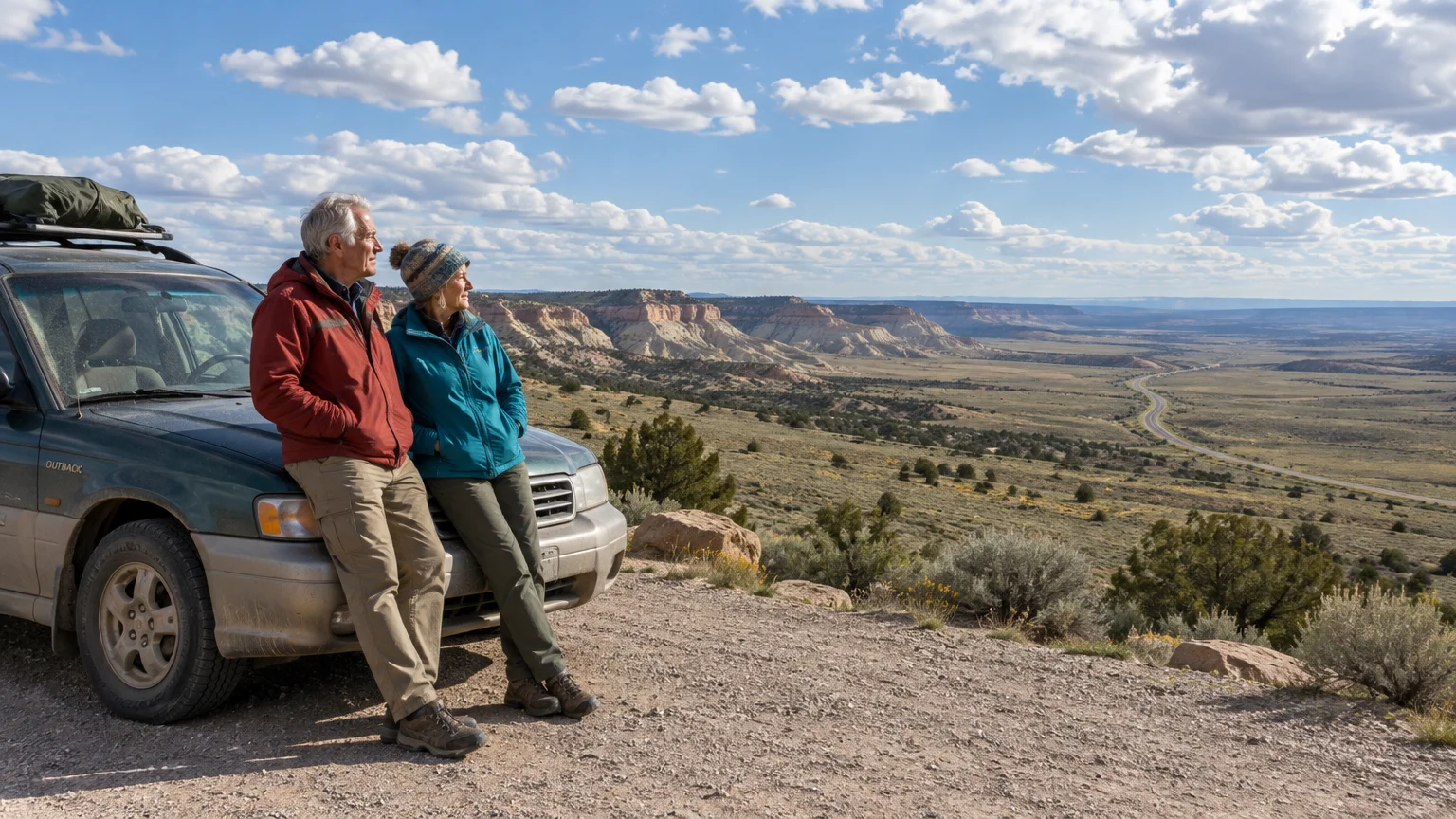
Heading farther west across the Great Plains and the Rocky Mountains reveals similar residency barriers. Most western states heavily subsidize their own seniors while assessing non-resident surcharges on visitors.
For scenic long-distance journeys without the stress of driving and campground fees, look into budgeting a cross-country train trip as a comfortable alternative.
- South Dakota: State parks do not offer senior camping discounts to out-of-state visitors. Standard non-resident camping fees range from $22 to $30 per night, plus a mandatory $20 temporary vehicle license.
- Wyoming: Wyoming residents age 65 and older receive discounted annual camping and daily use permits. Non-residents pay regular rates of $22 per night for primitive sites or $32 for electric, plus a $12 daily non-resident day-use fee.
- Montana: Residents enter all state parks for free without a permit. Non-resident seniors must pay an $8 day-use vehicle fee and standard campsite fees ranging between $18 and $34 nightly.
- Idaho: The Idaho Senior Passport lowers camping costs for in-state residents age 65 and older. Out-of-state campers pay standard site fees alongside an additional $3 to $5 nightly non-resident camping surcharge.
- Utah: Utah offers a discounted annual pass strictly for residents age 65 and older. Non-resident seniors must pay full camping fees ranging from $25 to $45 per night.
- California: California stands out by offering a $2 per night discount on family campsites to any camper age 62 and older. You qualify simply by presenting a valid government-issued photo ID at check-in, regardless of your home state.
Research from advocacy groups like AARP emphasizes that travel fees accumulate rapidly on fixed retirement budgets. Knowing that California welcomes all seniors—while Rocky Mountain states do not—helps you allocate your camping budget effectively.
Campsite Cost Comparison: 21-Night Cross-Country Tent Camping Budget
To evaluate how these rules influence your actual spending, consider a realistic road trip scenario. Pitching a tent across five state park systems over three weeks requires careful math.
If you are thinking about upgrading from a tent, consider renting an RV for a road trip to test your vehicle preferences before committing.
This worked example follows a 66-year-old Michigan resident driving a standard passenger vehicle west toward the Pacific Ocean. The 21-night itinerary includes stays in Wisconsin, South Dakota, Wyoming, Idaho, and California.
- Wisconsin (Nights 1 to 3 at Devil’s Lake): 3 nights at $25 per night equals $75. Adding the non-resident annual vehicle sticker at $38 brings the Wisconsin total to $113.
- South Dakota (Nights 4 to 7 at Custer State Park): 4 nights at $26 per night equals $104. Adding a 7-day vehicle license at $20 brings the South Dakota total to $124.
- Wyoming (Nights 8 to 11 at Boysen State Park): 4 nights at $22 per night primitive tent rate equals $88. Adding 4 days of non-resident entry at $12 per day ($48) brings the Wyoming total to $136.
- Idaho (Nights 12 to 16 at Massacre Rocks): 5 nights at $24 standard tent rate plus a $3 nightly non-resident surcharge equals $135. Total Idaho lodging expense equals $135.
- California (Nights 17 to 21 at Castle Crags): 5 nights at $35 per night minus the universal $2 senior nightly discount equals $165. Total California expense equals $165.
Across this 21-night journey, total state park lodging and vehicle entry expenses equal $673. Because out-of-state senior discounts were largely unavailable until reaching California, total savings amounted to just $10.
Comparing state policies directly highlights how fees and residency restrictions diverge across the country.
| State Park Agency | Eligible Age Threshold | Non-Resident Senior Camping Discount | Daily Vehicle Entry Fee | Standard Non-Resident Tent Rate |
|---|---|---|---|---|
| California State Parks | Age 62 and older | $2 per night discount | $8 to $10 per day | $35 per night |
| Ohio State Parks | Age 60 and older | None (in-state only) | Free for all visitors | $24 to $32 per night |
| Tennessee State Parks | Age 62 and older | 25% peak / 50% winter | Free for all visitors | $20 to $35 per night |
| Maryland State Parks | Age 62 and older | 50% Sun-Thu with pass | $3 to $5 per vehicle | $22 to $30 per night |
| Wisconsin State Parks | Age 65 and older | None (in-state only) | $11 per day or $38 annual | $20 to $35 per night |
| Wyoming State Parks | Age 65 and older | None (in-state only) | $12 per day non-resident | $22 to $32 per night |
This data reveals why cross-country road trippers must calculate vehicle entry fees alongside campsite nightly rates. In states like Wyoming and Wisconsin, vehicle stickers add substantial costs to overnight stays.

Essential Booking Tactics for Solo and Tent Campers Age 60 and Older
Planning an extended camping trip requires practical systems to keep your travel costs low. Applying reliable booking habits will protect your retirement funds from unnecessary administrative charges.
- Verify residency rules on the official state agency website before confirming any reservation. Check whether discounts apply exclusively to resident taxpayers or extend to all visitors.
- Review the public benefits catalog on Benefits.gov to check for related outdoor recreation assistance programs. State-level conservation benefits occasionally assist low-income retirees.
- Book primitive or standard tent sites rather than full-hookup RV sites. Most park reservation portals assess fixed utility fees on electrical loops even if you only pitch a tent.
- Arrive at the registration booth with your government identification card readily available. Rangers must physically verify your age and address before approving discounted check-in paperwork.
- Alternate state park stays with federal Bureau of Land Management or U.S. Forest Service campgrounds. Pairing state parks with federal sites maximizes the value of your federal lifetime pass.
Carrying backup paper confirmations ensures smooth registration when arriving at remote ranger stations without mobile reception. Always print your confirmation receipts before departing home.
“In every walk with nature one receives far more than he seeks.” — John Muir
Hidden Fees, Utility Charges, and Day-Use Permit Loopholes
Base campsite fees represent only a portion of your total overnight expenses. Ancillary fees frequently inflate your overall bill at state park campgrounds across the country.
Many state reservation systems charge non-refundable processing fees between $8 and $12 per transaction. Booking individual single-night stays separately will multiply these charges rapidly.
- Daily entrance fees charged per vehicle in addition to the base campsite rental price.
- Mandatory utility surcharges applied to all campsites equipped with electrical pedestals.
- Non-refundable reservation processing fees collected by third-party reservation management vendors.
- Out-of-state camper surcharges assessed automatically during online checkout.
- Cancellation and date-change penalties that forfeit your first night of lodging.
Consolidating your multi-night bookings into single transactions eliminates duplicate processing fees. Choosing primitive tent loops without electrical hookups also removes mandatory utility surcharges.
Frequently Asked Questions
Can I use my federal America the Beautiful pass at state parks?
No. The federal America the Beautiful Senior Pass applies exclusively to federal lands managed by agencies like the National Park Service, U.S. Forest Service, and BLM. State parks do not accept federal passes for admission or camping discounts.
Does California give camping discounts to out-of-state seniors?
Yes. California State Parks grants a $2 per night discount on family camping and $1 off day-use parking to any camper age 62 and older.
You only need to show a valid government-issued photo ID at check-in.
Which state parks offer free day-use entry for seniors?
Ohio and Tennessee provide free day-use park entry to all visitors, including seniors. New York grants free weekday vehicle entry to resident seniors age 62 and older, while Texas offers discounted day entry through its senior pass program.
What happens if I claim an in-state senior discount by mistake?
When you register at the campground booth, park staff will examine your driver’s license. If your identification shows an out-of-state address, the park will adjust your booking to the standard non-resident rate and charge the difference.
Are senior camping discounts valid on weekends and holidays?
Discount schedules vary by state. For example, Ohio limits its 50 percent Golden Buckeye camping discount to Sunday through Thursday nights, offering only 10 percent on weekends.
Always check specific state park calendar rules before booking.
Disclaimer: This article is for informational purposes only. Benefits, programs, and regulations can change.
We encourage readers to verify current information with official government sources and consult with qualified professionals for personalized advice.