
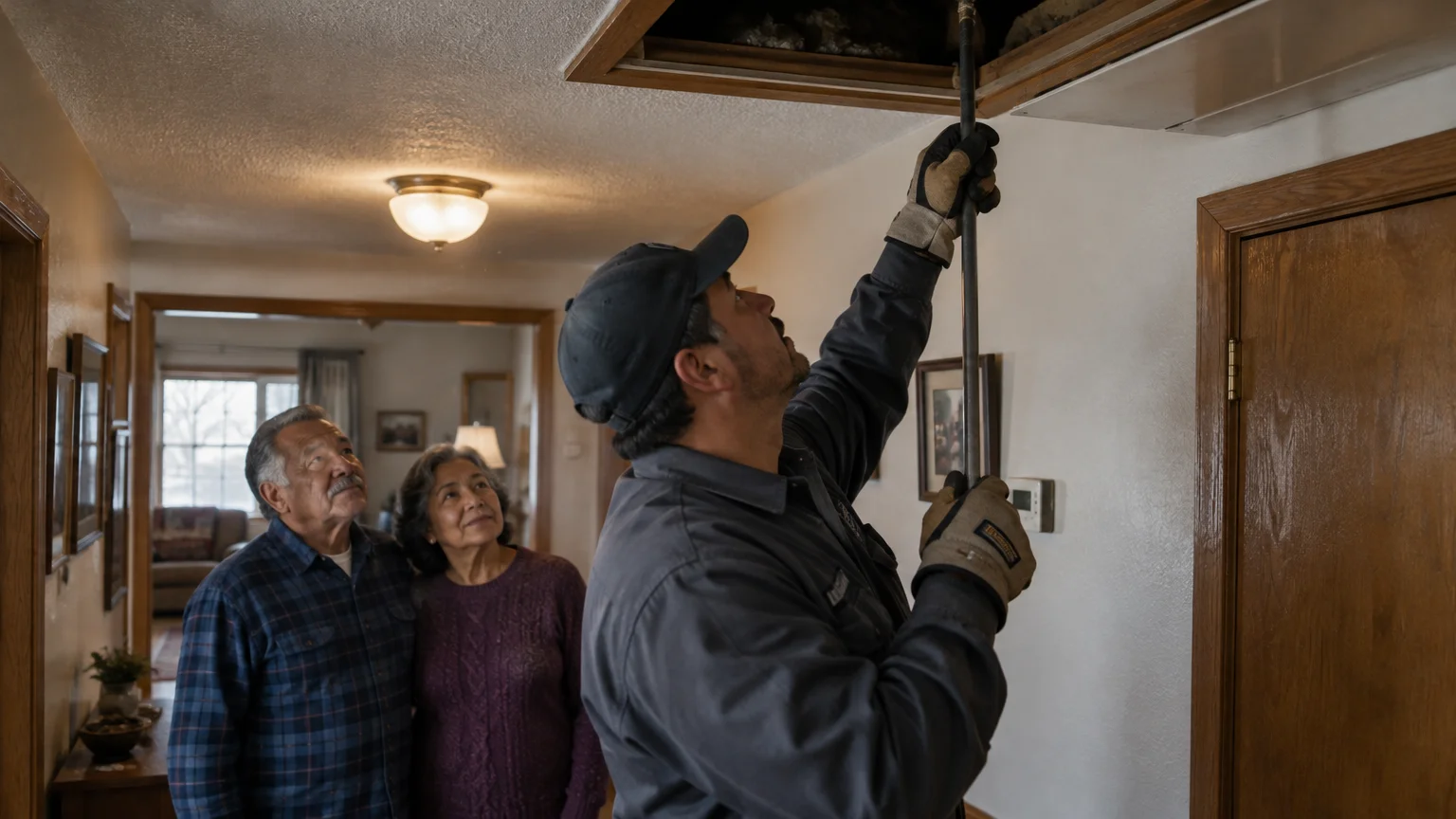
If you are 67 years old and spending over $350 every winter month to heat a drafty 1965 house, federal law provides complete relief at zero cost.
The U.S. Department of Energy does not make seniors wait behind general applicants. Federal statute requires local agencies to move households aged 60 and older straight to the front of program queues.
While general guides outline basic forms, this walkthrough details the exact point formula that elevates your file and explains the diagnostic air sealing crews install.
In this guide9 sections
- How Federal Law Fast-Tracks Seniors for Weatherization
- Income Limits and Automatic Categorical Eligibility
- Worked Example: Scoring and Energy Audit for a 1965 Home
- What Happens During the Diagnostic Blower-Door Audit
- The Full Scope of Free Home Upgrades You Can Receive
- Comparing Weatherization Materials and Efficiency Impacts
- Overcoming Deferrals With Weatherization Readiness Funds
- How to Prepare and Submit Your Application
- Frequently Asked Questions

How Federal Law Fast-Tracks Seniors for Weatherization
The Weatherization Assistance Program operates through state energy offices and local Community Action Agencies across every county in the country.
In addition to reducing winter utility bills, homeowners can combine utility upgrades with property tax exemptions for seniors to significantly lower total housing expenses.
Homeowners exploring broader residential support can also consult housing assistance programs for seniors to explore regional living and maintenance grants.
Under federal regulation 10 CFR § 440.3, the Department of Energy defines an elderly person as anyone aged 60 or older.
This statutory definition provides a powerful advantage when you submit an intake packet.
Federal regulation 10 CFR § 440.16(b) legally requires every local administering agency to implement a priority scoring system.
Agencies cannot process applications on a first-come, first-served basis. They must award priority points that advance older homeowners ahead of non-elderly applicants.
Under official wap priority scoring elderly guidelines, county intake officers assign numerical points that push older homeowners ahead of younger applicants.
Most local waiting lists contain dozens of open requests. Priority scoring ensures older adults receive on-site audits and physical improvements months ahead of the general public.
Every upgrade installed through the program is entirely free. You will never face an application fee, a copayment, or a future property lien.
Department of Energy national evaluations confirm that weatherized single-family residences save an average of $372 or more on heating and cooling bills annually.
- Elderly individuals aged 60 and older receive mandatory scoring preference under federal law.
- Persons with documented physical disabilities earn secondary priority points.
- Families with dependent children under 18 receive designated tier ranking.
- Households carrying a high home energy burden exceeding 6% of gross income gain additional weight.
- Properties with severe baseline fuel consumption move up the audit schedule.
Income Limits and Automatic Categorical Eligibility
To qualify for weatherization assistance, your gross household income must fall at or below 200% of the Federal Poverty Guidelines.
Enrolling in these qualifying safety-net programs can also unlock other household subsidies, such as discounted home internet services.
In addition to heating relief, eligible households can often qualify for cooling equipment upgrades by qualifying for free air conditioners through LIHEAP.
In 2026, that threshold equals roughly $31,920 annually for a single-person household in the 48 contiguous states.
For a two-person household, the 200% poverty limit sits at $43,280.
States also retain statutory authority to qualify households under 60% of State Median Income if that number is higher in your county.
Securing free home insulation low income seniors rely on does not require giving up homeownership rights or signing future financial liens.
You can bypass standard income recalculation entirely if you already participate in specific federal support programs.
Federal rules grant automatic categorical eligibility to applicants enrolled in certain needs-based benefit systems.
If you receive qualifying monthly payments, the intake office approves your financial status without inspecting bank accounts.
- Supplemental Security Income (SSI) administered by the federal government.
- Supplemental Nutrition Assistance Program (SNAP) food assistance benefits.
- Low-Income Home Energy Assistance Program (LIHEAP) utility grants.
- Temporary Assistance for Needy Families (TANF) monthly payments.
According to benefit standards outlined on Benefits.gov, categorical eligibility removes the need to prove ongoing asset balances.
Your accumulated home equity does not count against your income qualification. You can own your 1965 residence outright and still qualify for complete services.
Worked Example: Scoring and Energy Audit for a 1965 Home
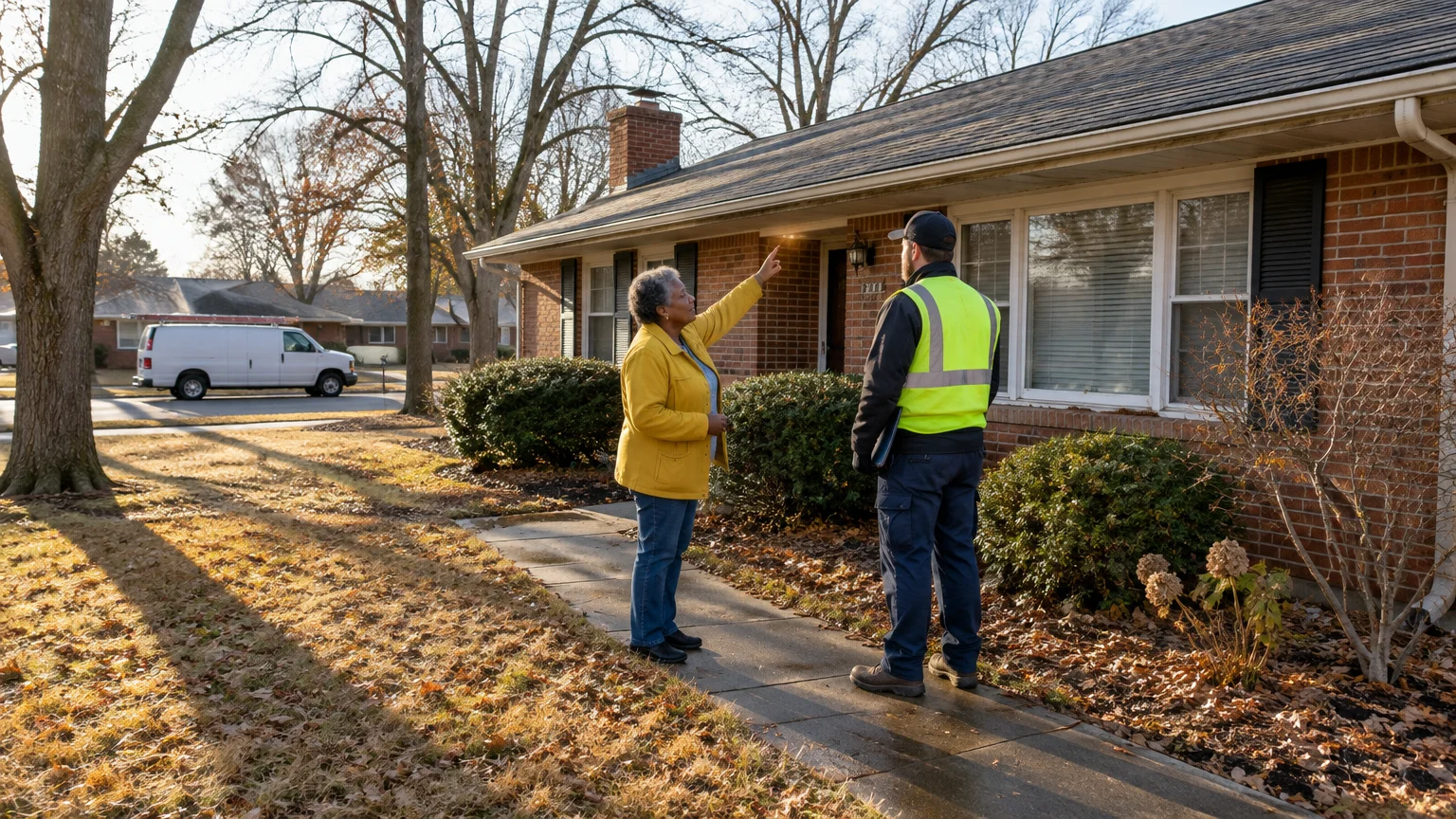
Consider Arthur, a 67-year-old homeowner living alone in a 1,450-square-foot ranch home built in 1965 in Peoria, Illinois.
Former service members should also explore veteran entitlements for senior citizens that provide supplemental grants for home retrofits and daily living costs.
Arthur receives $1,940 monthly from Social Security retirement, generating an annual gross income of $23,280.
His income sits well beneath the $31,920 single-person cap, satisfying all baseline financial standards.
Arthur heats his uninsulated house with a natural gas furnace installed in 1993 operating at 80% AFUE efficiency.
His winter gas bills average $340 per month across November, December, January, February, and March.
Arthur spends $2,040 annually on heating, which consumes 8.76% of his gross retirement income.
The federal government designates any household spending over 6% of income on residential power as bearing a high energy burden.
When intake officers review Arthur’s file, they score his application using a standard 100-point prioritization matrix.
- Age Score: 25 points for an applicant age 60 or older under 10 CFR § 440.3.
- Energy Burden Score: 20 points for utility costs exceeding 8% of gross household income.
- Structural Baseline: 15 points for an uninsulated pre-1976 stick-built frame.
- Income Tier: 10 points for earnings falling beneath 150% of the federal poverty line.
- Total Intake Score: 70 priority points out of 100.
Arthur’s 70-point score moves his file past 85 younger applicants who lack elderly and high-burden point multipliers.
The county agency contacts Arthur within 18 days of submission to schedule his comprehensive diagnostic assessment.
What Happens During the Diagnostic Blower-Door Audit
A certified home energy auditor arrives at your house with specialized diagnostic testing tools.
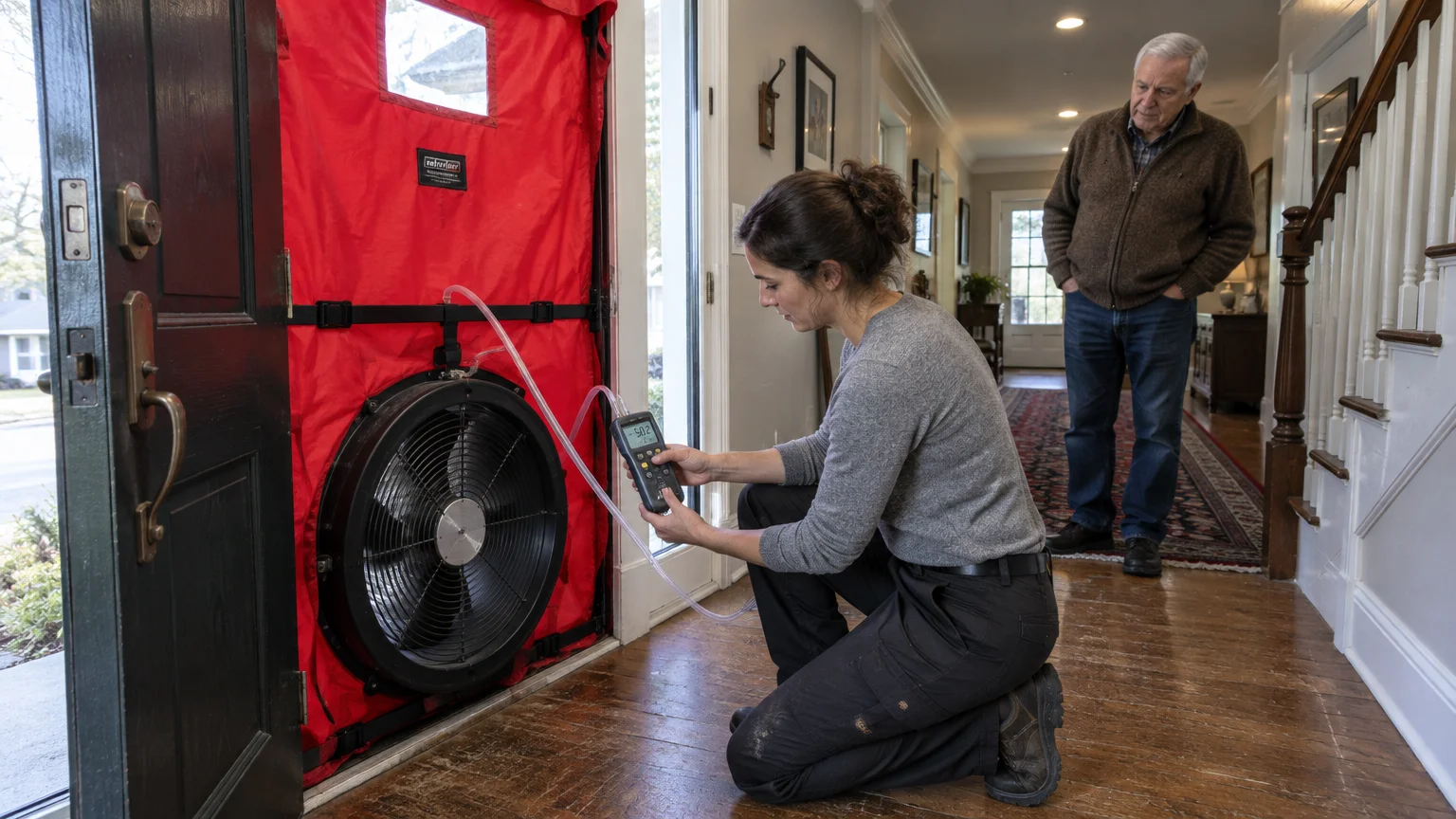
The primary diagnostic mechanism is a calibrated blower door system. The technician mounts an expandable aluminum frame and vinyl shroud inside your front door frame.
A high-output variable-speed fan sits inside the shroud, connected by pneumatic tubing to a dual-channel digital manometer.
The technician powers on the fan to depressurize your home to negative 50 Pascals relative to outside air pressure.
This artificial draft forces outside air through hidden framing cracks, unsealed wall cavities, and ceiling bypasses.
In Arthur’s 1965 ranch, the baseline depressurization test measures an air leakage rate of 4,250 Cubic Feet per Minute at 50 Pascals (CFM50).
A home of that footprint should measure below 1,800 CFM50 to maintain consistent indoor temperatures.
While the fan operates, the auditor conducts an interior sweep using a handheld infrared thermal imaging camera.
The infrared sensor displays dark blue thermal streaks where cold air infiltrates through baseboards, uninsulated wall cavities, and ceiling lighting fixtures.
- Blower door depressurization testing measures total air exchange volume across exterior building boundaries.
- Infrared thermographic scanning detects insulation voids inside exterior walls without tearing into plaster or drywall.
- Ambient carbon monoxide testing checks all gas ranges, water heaters, and furnace combustion chambers.
- Draft-spillage testing verifies that furnace exhaust flues vent dangerous combustion gases completely outdoors.
- Duct pressurization testing measures conditioned air leakage inside unheated attic and crawlspace distribution runs.
The Full Scope of Free Home Upgrades You Can Receive
Once diagnostic tests reveal your building’s thermal defects, contracted weatherization specialists complete extensive mechanical upgrades.
For households weighing broader heating upgrades, evaluating the cost to switch from natural gas to an electric heat pump can reveal additional seasonal efficiency opportunities.
Crews do not just roll out fiberglass batts. They perform specialized air sealing throughout the home prior to adding insulation.
Technicians access your attic space to seal open thermal bypasses where warm air escapes into unconditioned roof areas.
They spray expanding closed-cell polyurethane foam over wall framing plates, wiring holes, plumbing vents, and electrical ceiling boxes.
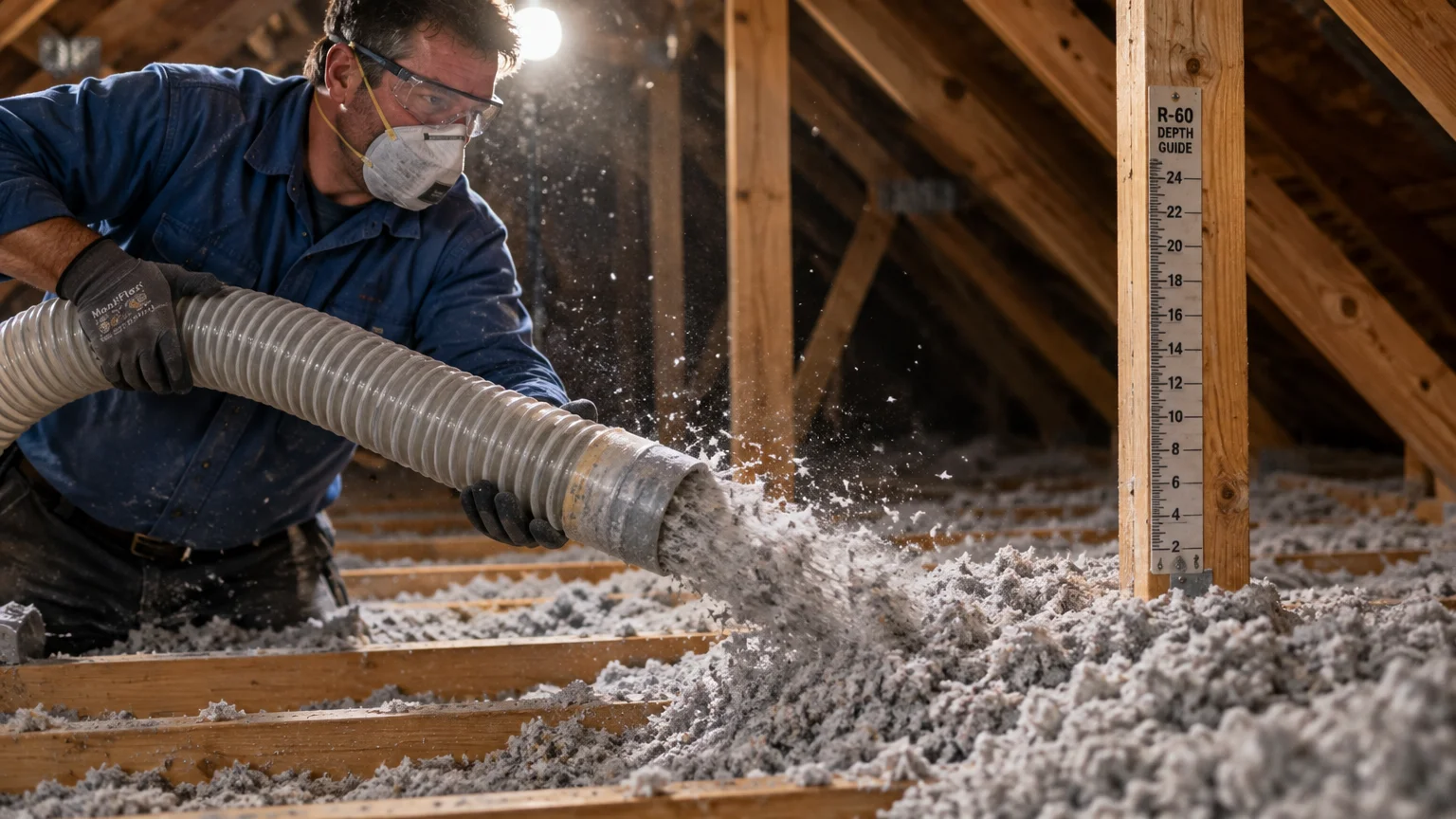
Following thermal air sealing, technicians blow loose-fill cellulose across the ceiling floor to establish an R-49 insulation depth.
To insulate empty 1965 exterior walls, technicians remove exterior siding strips and drill two-inch access ports between framing studs.
Workers insert long fill tubes to pack dense-pack cellulose at 3.5 pounds per cubic foot density into every stud cavity before sealing the holes.
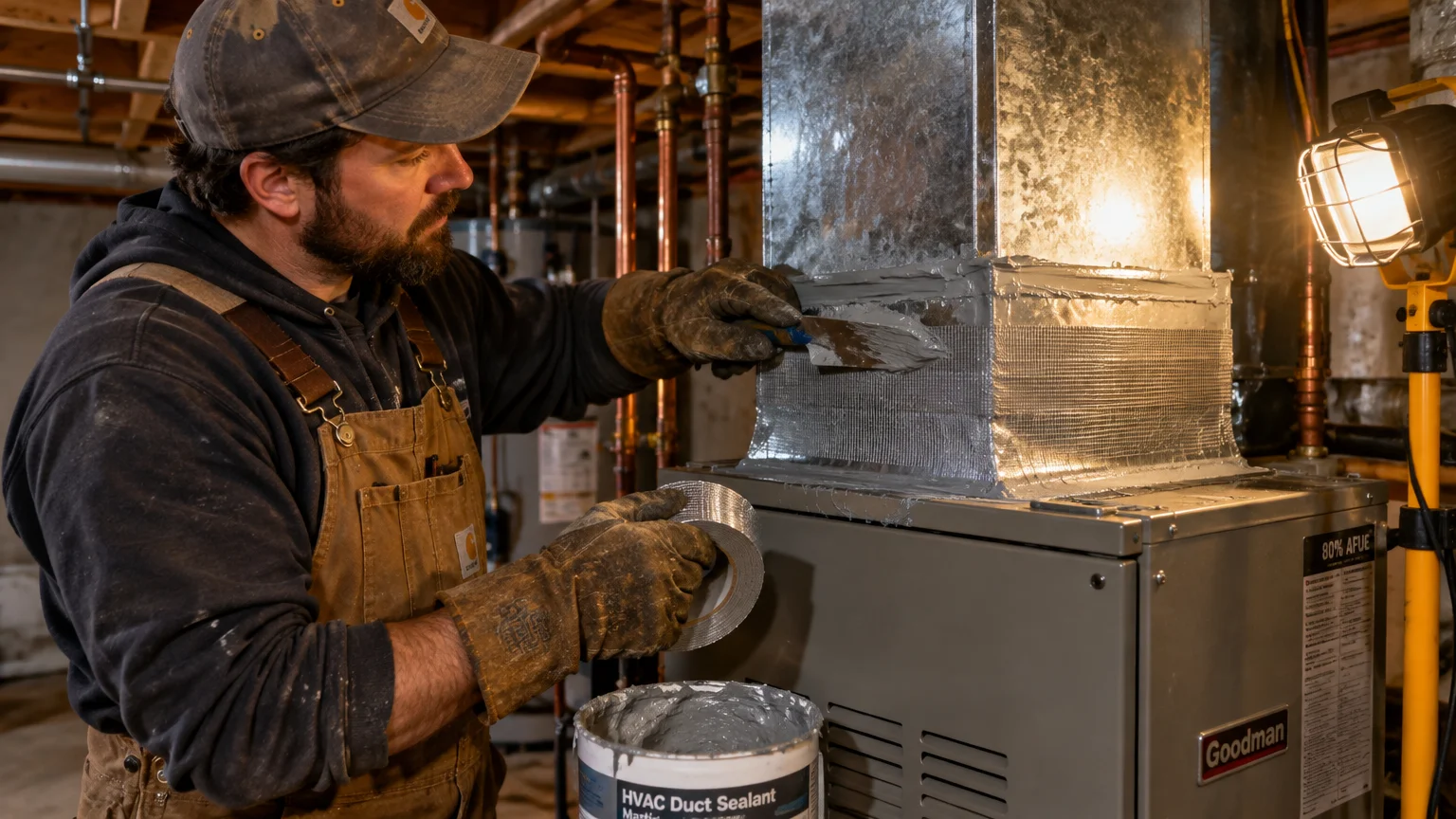
Technicians coat sheet metal seams on furnace ducts with fiber-reinforced mastic sealant to prevent heated air from escaping into crawlspaces.
If safety testing reveals a cracked heat exchanger or hazardous backdrafting on your furnace, the program replaces the unit entirely.
- Blown-in attic insulation upgraded from degraded wood shavings or thin fiberglass up to modern R-49 standards.
- Dense-pack cellulose injected into hollow exterior wall cavities to stop wind washing and draft transfer.
- Two-part expanding foam applied along basement rim joists and attic penetrations.
- Elastomeric mastic paste applied over heating and cooling plenum seams.
- Closed-cell foam pipe insulation sleeves installed on hot water distribution pipes.
- High-efficiency 96% AFUE gas furnace installation if existing heating equipment fails mechanical safety checks.
- Hardwired smoke alarms and digital carbon monoxide detectors placed on every living level.
Comparing Weatherization Materials and Efficiency Impacts
Different weatherization measures address separate heat-loss mechanics in older residential properties.
The table below summarizes the core materials, installation locations, and measured efficiency impacts delivered under the program.
| Weatherization Measure | Target Installation Location | Thermal / Air Barrier Metric | Average Airflow / Heat Loss Impact | Observed Material Lifespan |
|---|---|---|---|---|
| Loose-Fill Blown Cellulose | Attic floor plane and ceiling deck | R-3.7 per inch (installed to R-49 depth of 13.5 inches) | 18% to 24% reduction in seasonal heating fuel demand | 30+ years without settling |
| Dense-Pack Sidewall Cellulose | Exterior 2×4 framing stud cavities | R-13 to R-15 cavity thermal barrier (3.5 lbs/cu ft density) | 15% to 22% reduction in wall heat conduction | 30+ years in dry walls |
| Two-Part Closed-Cell Spray Foam | Basement rim joists and attic chases | R-6.2 per inch continuous vapor and air barrier | 20% to 35% reduction in whole-house CFM50 air leakage | Lifetime of the residential structure |
| Fiber-Reinforced Elastomeric Mastic | Forced-air supply and return duct joints | Class 1 airtight barrier rated to 25 Pascals pressure | 70% to 85% drop in distribution duct air leakage | 25+ years without drying or cracking |
In Arthur’s worked scenario, combined dense-pack wall insulation and attic air sealing lowered air infiltration from 4,250 CFM50 down to 2,650 CFM50.
That 37% air leakage reduction lowered his winter gas heating bills from $340 down to $243 per month.
Arthur saved $485 during his first winter season alone without spending a single dollar of his own retirement savings.
Overcoming Deferrals With Weatherization Readiness Funds
Approximately 15% to 20% of older properties initially encounter an administrative hurdle known as a weatherization deferral.
A deferral occurs when an energy auditor discovers an underlying structural or environmental defect that makes weatherization unsafe.
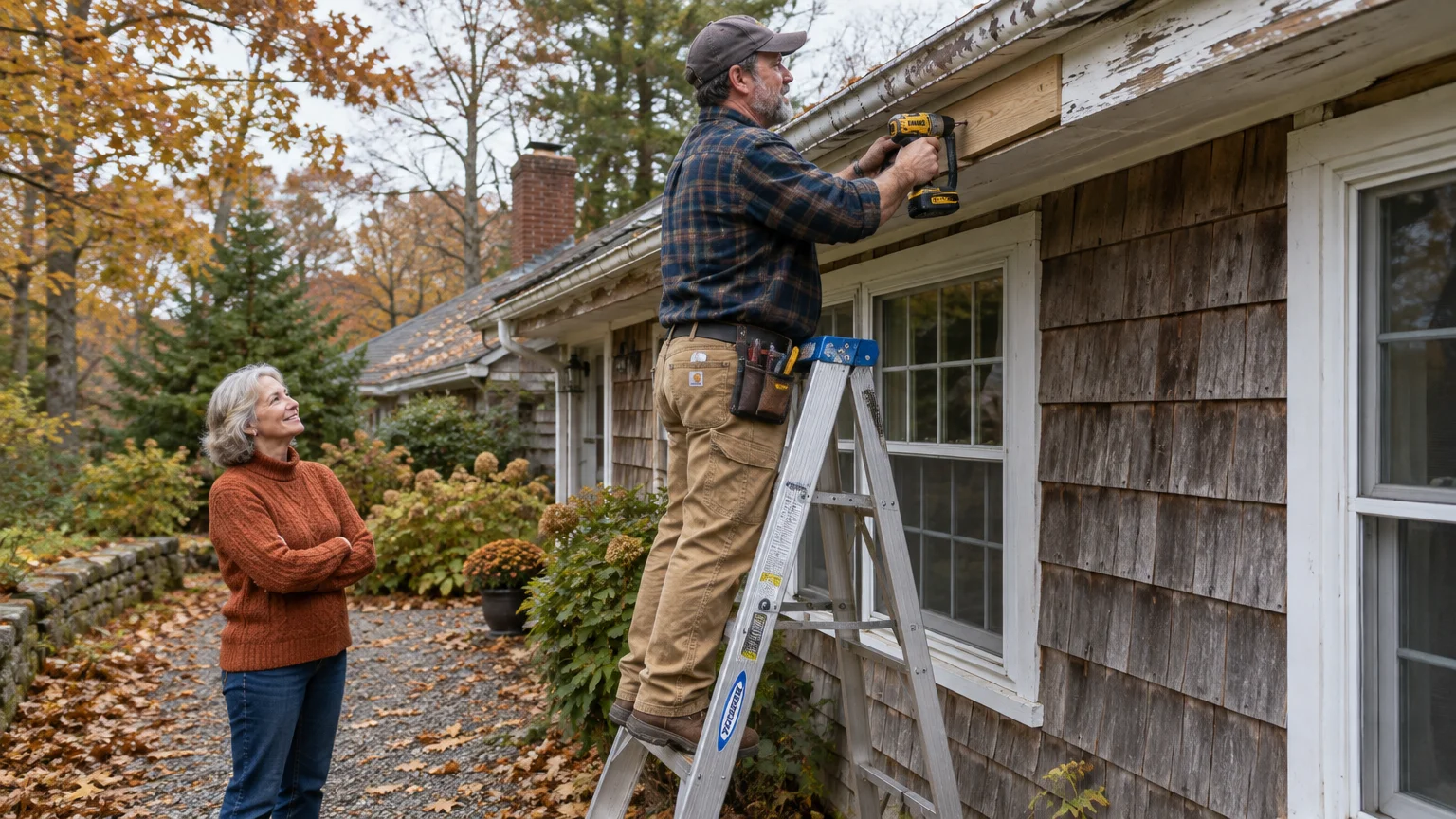
Common deferral causes include active roof leaks, standing water in crawlspaces, severe mold growth, or exposed knob-and-tube wiring.
Contractors cannot legally blow cellulose insulation over active knob-and-tube electrical circuits because trapped heat creates an immediate fire hazard.
In past years, receiving a deferral forced cash-strapped seniors to pay for costly repairs out of pocket or abandon the program entirely.
Today, local agencies utilize dedicated Weatherization Readiness Funds (WRF) authorized by federal energy legislation.
Weatherization Readiness Funds allow the agency to pay for essential electrical rewiring, minor roof repairs, and moisture remediation before insulation work begins.
If an auditor notes structural obstacles in your 1965 home, ask your assigned case manager if readiness dollars can resolve the repairs.

How to Prepare and Submit Your Application
Applying for weatherization requires submitting verification of household income, proof of homeownership, and 12 months of utility history.
You submit paperwork directly to your county Community Action Agency rather than the federal Department of Energy.
To identify your local operating agency, consult the Eldercare Locator supported by the U.S. Administration for Community Living.
Follow these concrete steps to organize your documentation and secure your priority position on the intake register.
- Locate your local Community Action Agency by contacting your county aging office or state energy department website.
- Request an official weatherization assistance application packet by phone or download it from your local provider portal.
- Contact your gas and electric utility providers to obtain official billing printouts detailing your usage history for the past 12 months.
- Assemble proof of homeownership by locating your recorded property deed, current real estate tax bill, or homeowners insurance declaration page.
- Collect income documentation for all household members, verifying Social Security retirement checks or pension statements.
- Complete every section of the application form, writing your exact birth date clearly to establish your senior priority points.
- Submit your completed application packet with all attached supporting documents to the local intake office by certified mail or hand delivery.
When completing your weatherization assistance program application senior paperwork, make sure your birth date is clearly documented.
Obtaining an annual benefit award letter from the Social Security Administration satisfies all income verification rules in a single document.
Keep a complete photocopy of your signed paperwork and stamped attachments in your personal home records before submitting your packet.
Frequently Asked Questions
How long is the waiting list for seniors applying for weatherization?
Eligible seniors typically receive an initial home energy audit within two to six months of application approval.
Federal priority scoring rules move older adults ahead of general applicants, significantly shortening local waiting periods.
Will weatherization assistance put a lien on my home?
No, the Weatherization Assistance Program never places liens or financial encumbrances against your property deed.
All diagnostic evaluations, air sealing work, and equipment upgrades are provided as 100% free federal grant services.
Can renters receive free weatherization upgrades?
Yes, renters living in single-family homes, mobile homes, and multi-family buildings can qualify if household income meets program limits.
The property owner must sign a written agreement approving the work and committing not to increase rent due to the improvements.
What happens if my home has active knob-and-tube wiring?
Auditors cannot install loose-fill insulation over active knob-and-tube wiring due to electrical heat dissipation regulations.
However, your local agency can allocate Weatherization Readiness Funds to pay licensed electricians to rewire affected circuits at zero cost to you.
Do I need to replace my broken furnace before applying?
No, you should not replace your heating system out of pocket before receiving your program energy audit.
If testing confirms your existing furnace is cracked or inefficient, the program can repair or replace the heating unit at no charge.
Disclaimer: This article is for informational purposes only. Benefits, programs, and regulations can change.
We encourage readers to verify current information with official government sources and consult with qualified professionals for personalized advice.


1 Comment