
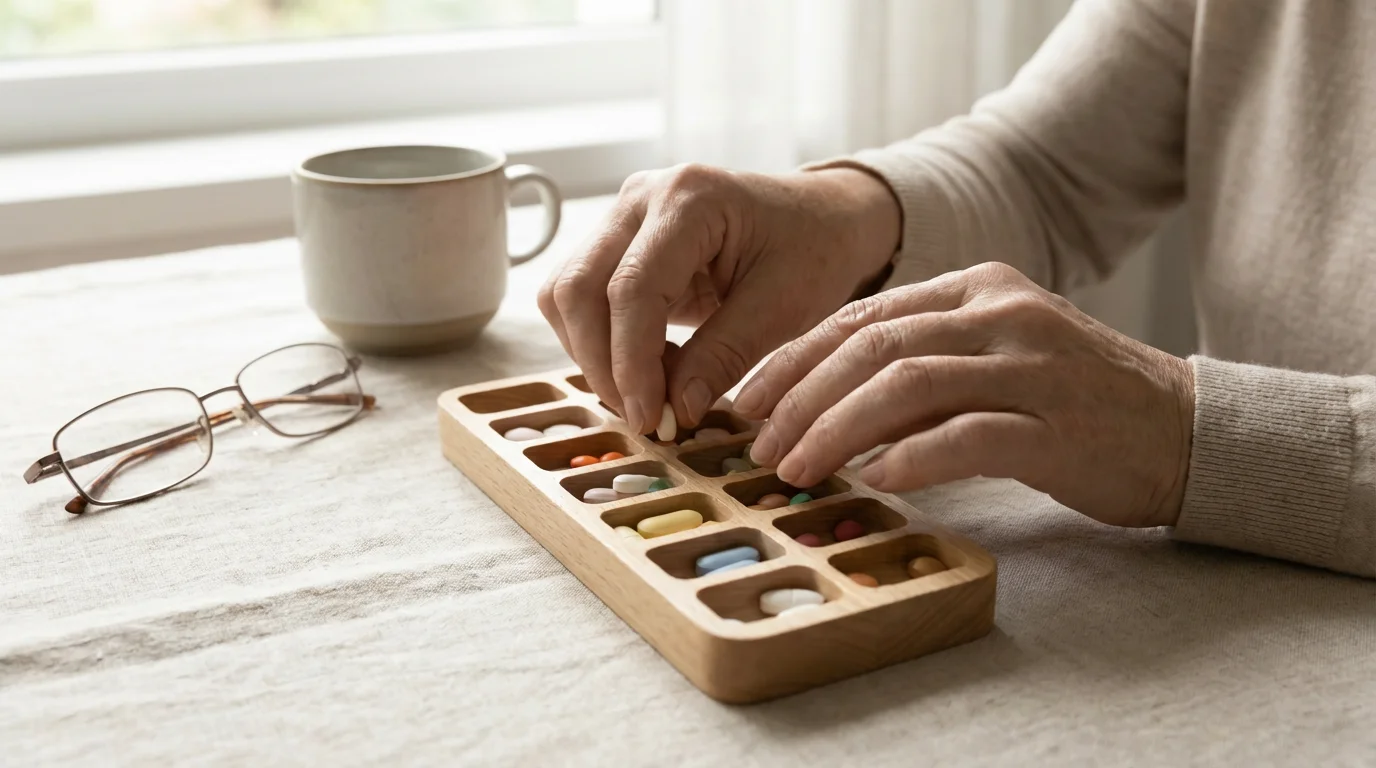
A retiree around age 70 returning home after a hospital stay with discharge papers and old bottles on the counter faces an immediate trap. Dumping pills into a weekly plastic organizer on day one often causes dosing errors.
Sorting too soon puts stopped drugs back in rotation and spoils moisture-sensitive capsules outside their bottles. Reconciling paperwork first, screening fragile medicines second, and setting up organizers and reminders afterward prevents those mistakes.
Reconcile discharge papers against home bottles before your first dose
First, compare every bottle at home before your next scheduled dose. This touches your hospital discharge summary, pre-stay bottles, and one written reconciliation sheet.
Gather every prescription, over-the-counter drug, vitamin, and herbal product. The National Institute on Aging recommends keeping an up-to-date list and sharing it with every doctor and pharmacist.
Sample filled-out discharge reconciliation sheet
Log brand and generic names, strength and amount, timing with food, purpose, prescriber, and refill date side by side. This completed sheet contrasts discontinued doses with active home prescriptions:
- Discontinued hospital dose: Temporary inpatient blood pressure tablet; stopped on hospital discharge summary by hospital team, so do not fill or sort.
- Stopped pre-stay bottle: Old brand blood pressure pill (20 mg, one tablet at 8 a.m.); replaced by generic 20 mg, one tablet bottle, so bag old bottle off counter.
- Shifted home dose: Water pill (generic, one tablet at 1 p.m. with lunch); hospital team moved fluid control to midday, so log new refill date.
- Continued home dose: Cholesterol pill (one tablet at 8 p.m. with dinner); primary doctor kept unchanged, so copy refill date for evening slot.
- New discharge blood thinner: Dabigatran (Pradaxa) capsule (brand and generic on label, discharge schedule); hospital team added for clot prevention, keep tightly closed in original bottle.
- As-needed rescue drug: Sublingual nitroglycerin (chest pain as needed, heart prescriber); leave in original glass container, never a daily box.
- Vitamin or herbal product: Daily supplement from cabinet; log strength, purpose, and timing, holding until pharmacist checks interactions.
Keep copies of your finished sheet in your wallet and at home. With an emergency lockbox for paramedics, note on the door or refrigerator where the list stays.
Before moving on, verify active bottles match your discharge summary and update the sheet the day any prescription changes.
Screen out moisture-sensitive and hazardous drugs before touching a pillbox
Second, check every active container on day one before any pill enters a tray. This touches your bottle labels, foil blisters, and pharmacy profile.
Plastic organizers are neither airtight nor lightproof, so fragile hospital additions lose strength quickly. Ask your pharmacist before moving these items out of original packaging:
- Dabigatran (Pradaxa): the capsules are sensitive to moisture and must stay tightly closed in their original bottle, never in a pillbox.
- Sublingual nitroglycerin: for chest pain, it must be kept tightly closed in its original glass container, so carry that bottle.
- Dissolving and effervescent tablets: keep orally disintegrating tablets sealed in foil blisters until dosing, and leave fizzy tablets in their tube or foil.
- As-needed medicines: keep pain pills, sleep aids, and rescue drugs in labeled bottles to count doses, and lock up opioids.
- Oral chemotherapy and hazardous drugs: capecitabine and similar drugs should stay in the original container; ask how handlers stay protected.
- Refrigerated, liquid, or inhaled products: leave them in original containers.
When several prescriptions belong here, pharmacy pre-sorting helps. PillPack by Amazon Pharmacy, for example, describes pre-sorting prescriptions into packets printed with the date and time of each dose, and local pharmacies offer blister cards.
Before moving on, confirm exclusions with your pharmacist and place original-container bottles in one basket so only stable tablets advance.
Match your organizer or pharmacy pack to your post-discharge schedule
Third, pick an organizer format before your first full week of home dosing starts. This touches your updated schedule, pharmacy dispensing options, and hand or vision limits.
Compare the four formats by daily dose count, hand strength, and whether hospital changes are still shifting:
- 7-day AM/PM box: 14 morning and evening compartments; simple for two daily doses and steady hands, though small lids resist stiff fingers and midday slots are missing.
- 28-slot four-times-a-day tray: morning, noon, evening, and bedtime across seven days with removable strips; fits three or four daily doses, though extra lids make mis-filling rows easier.
- Multi-dose pharmacy packs: pharmacist-sealed pouches or blisters labeled by date and time; skips home sorting for many drugs, though some cannot be repackaged and dose changes require new packs.
- Locked automatic dispenser: opens one scheduled slot with an alarm and optional family alerts to prevent double-dosing; costs more, needs power, and some charge a monthly fee.
Why a shifted 1 p.m. pill breaks a 14-slot box
Taking a blood pressure pill at 8 a.m., a water pill at 1 p.m., and a cholesterol pill at 8 p.m. equals 3 doses x 7 days = 21 filled slots weekly.
A 7-day AM/PM box holds only 14 slots, forcing the 1 p.m. pill out of place. A 28-slot tray fits cleanly with the bedtime row empty.
For stiff hands, pick wide sliding lids, see our guide to adaptive tools for arthritic hands, and request easy-open caps. Before moving on, test every latch and confirm every dose window has a slot.
Fill stable daily tablets one bottle at a time
Fourth, fill your organizer on one fixed day weekly after screening finishes. This touches your empty tray, active daily bottles, and reconciled sheet.
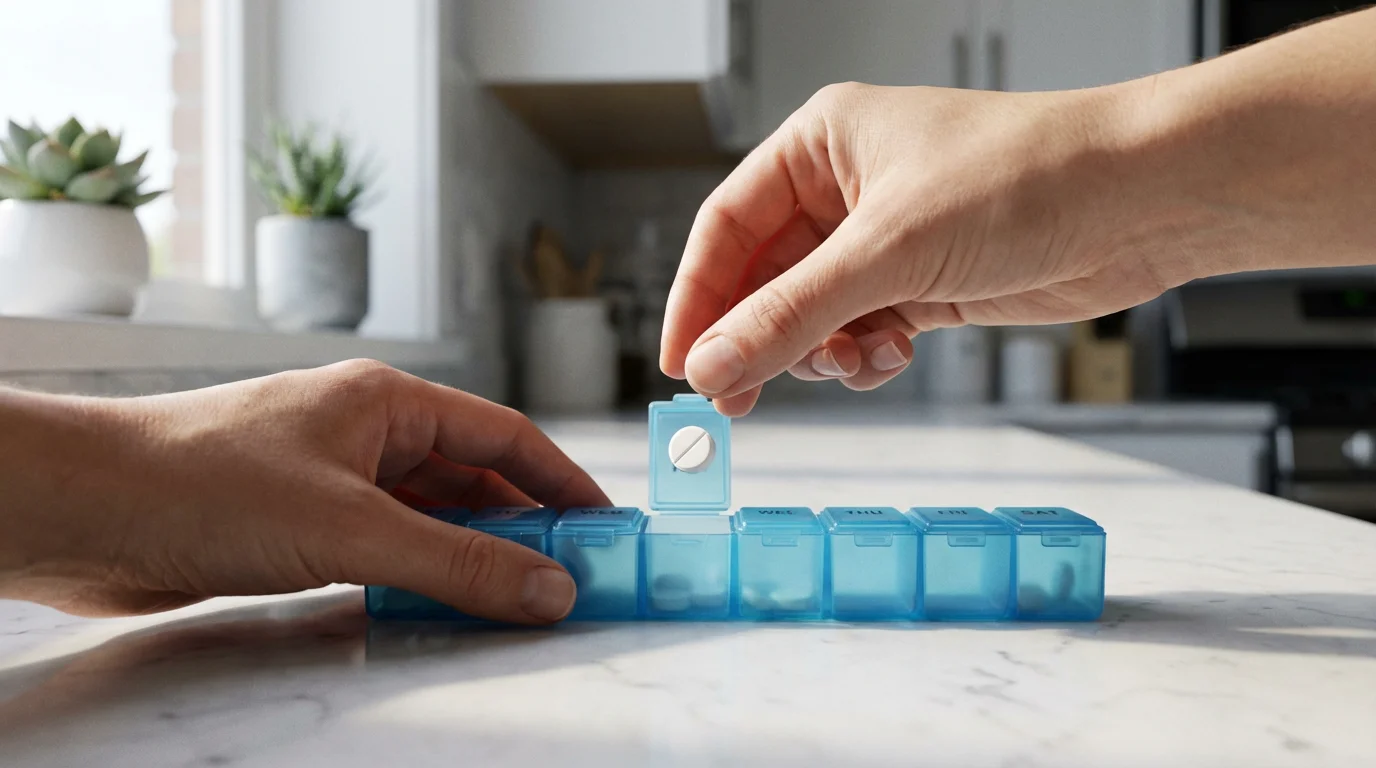
Follow these six steps so look-alike hospital generics never mix:
- Pick one weekly fill day in a bright, quiet spot without TV or phone calls.
- Lay out the tray, sheet, and bottles, calling the pharmacy if any pill or label looks unfamiliar.
- Fill one medicine across all seven days, then close and set aside that bottle before opening the next.
- Read every label rather than working from memory.
- Count every slot against your sheet, asking family to double-check the first few weeks and after any change.
- Note low bottles and order refills that day.
Store the tray and bottles somewhere cool and dry, away from sunlight, grandchildren, pets, and humid bathroom cabinets. Set any unknown loose pill aside for your pharmacist.
Before moving on, verify every slot count matches your sheet and place needed refill orders.
Set spoken smart-speaker reminders for new and shifted dose windows
Fifth, program spoken reminders on your first evening home so recovery fatigue never hides a shifted dose time. This touches your smartphone settings and Alexa or Google Home account.
The American Heart Association estimates about half of medicines for chronic conditions are not taken as directed. Speakers in main rooms reach you when your phone stays elsewhere.
Alexa: turn on follow-up so reminders repeat
In the Alexa app, create a daily reminder such as “Evening heart pills, with dinner” on your nearest Echo. Switch on “Requires follow-up,” which repeats the reminder hourly until confirmed.
Keep the first alert at the exact dose time as your main cue. An Alexa Routine can also announce once across your “Everywhere” group without waiting for confirmation.
Google Nest: add a second check-in broadcast
In the Google Home app, a household automation broadcasts your reminder across every Nest speaker. Add a second broadcast 15 minutes later saying, “Check that today’s 1 p.m. slot is empty.”
Continued Conversation only keeps the microphone open briefly and never repeats reminders or logs replies. Your tray remains the record because an empty slot proves the dose was taken.

If you live alone, family can verify critical doses on daily check-in calls. Before moving on, run a test alert to confirm clear volume in every room.
Book a Part D pharmacist review while hospital changes are fresh
Sixth, schedule a medication review within your first few weeks home and before your yearly doctor visit. This touches your Medicare Part D card, pharmacy profile, and doctor notes.
Adding discharge drugs raises risks of interactions, duplicates, and side effects mimicking new illnesses. With several chronic conditions and drugs, your Part D plan may enroll you in a Medication Therapy Management program at no cost.

Call your Part D card number to ask whether you qualify for that free pharmacist review. Bring your sheet and every bottle, including supplements, to ask what can be combined or stopped.
Cost also causes skipped doses after discharge. In 2026, Part D caps out-of-pocket spending on covered drugs at $2,100 a year, covered alongside Extra Help in our guide to Part D coverage.
For brand-name drugs, manufacturer assistance programs may lower prices further. Your pharmacist and prescriber decide with you what can be repackaged, combined, or stopped, so never quit a medicine alone.
Report new symptoms promptly after any dose change. Before closing out this sequence, confirm both your doctor and pharmacy hold matching copies of your updated medication sheet.



2 Comments
Comments are closed.