

An uninsured retiree aged 60 to 64 on a fixed income faces a coverage trap right before Medicare starts at 65. Starting primary care at a charitable free clinic can force an abrupt change of doctors once Part B takes effect.
Free clinics under federal malpractice coverage cannot bill Medicare, while community health centers serve you before and after 65. Tracing a $1,500 outpatient procedure and a $209.40 monthly Part B premium in 2027 shows how to protect your budget across that transition.
Free clinics versus community health centers when Medicare starts at 65
Many retirees aged 60 to 64 pick the nearest free clinic assuming the same doctor can keep seeing them at 65. Federal malpractice rules draw a sharp line between charitable clinics and Federally Qualified Health Centers.
Clinics operating under federal free clinic malpractice coverage cannot accept payment from Medicare, Medicaid, or private insurers, so most bar Medicare enrollees. Community health centers receive HRSA funding to serve everyone and apply sliding-fee discounts to Medicare deductibles and coinsurance.
| Comparison area | Free and charitable clinics | Community health centers (FQHCs) |
|---|---|---|
| Medicare billing rules | Usually no; federal free clinic malpractice coverage bars payment from Medicare or any insurer | Yes; HRSA-funded centers bill Original Medicare, Medicare Advantage, Medicaid, and private plans |
| Sliding-scale coinsurance coverage | Not available for Medicare bills, since enrollees are typically turned away | Income-based sliding-fee discounts lower Part B deductibles and 20% coinsurance |
| Income eligibility cutoffs | Clinic-set income limit, often tied to federal poverty guidelines, plus local residency | Open to everyone; sliding-fee tiers set by household income and size |
| Continuity at age 65 and extra care | Care ends once Medicare starts; primary care, chronic checkups, labs, and medication help | Same care team stays past 65; many add dental, behavioral health, and pharmacy help |
| Where to find one | Find a Clinic at nafcclinics.org | findahealthcenter.hrsa.gov |
For a retiree expecting checkups or a $1,500 outpatient procedure after 65, starting at a community health center avoids rebuilding records. It also preserves sliding-fee discounts once Medicare starts.
Covering checkups and hospital bills at 60 to 64 before Part B begins
If nearby community health centers have waitlists at 60 to 64, a charitable free clinic can bridge basic care. Volunteer doctors, nurses, and pharmacists provide chronic disease checkups, basic labs, and medication help.
Each free clinic sets an income limit tied to federal poverty guidelines and requires residency in its service area. Search the National Association of Free & Charitable Clinics at nafcclinics.org and call ahead, since many keep set hours and waitlists.

Free clinics do not handle emergencies. For chest pain, stroke signs, or a serious injury, call 911 or go to the nearest emergency room.
Treat a free clinic as a stopgap before 65. Check whether you qualify with your state Medicaid office and check HealthCare.gov for premium help.
Hospital financial assistance if a major bill hits before 65
An emergency bill at 60 to 64 can far exceed a $1,500 outpatient bill. Federal tax rules require nonprofit hospitals to have a written financial assistance policy and publicize it.
Hospitals must limit charges for eligible patients to amounts generally billed to insured patients. Apply before care or for at least 240 days after the first post-discharge bill.
Hospitals must check financial assistance eligibility before starting extraordinary collections such as credit reporting. Some facilities still owe free or reduced-cost care under the Hill-Burton program, listed by HRSA.
Establishing at a community health center before 65 to keep your care team
Starting at a community health center at 60 to 64 lets you keep one care team after Medicare begins. Staff set your sliding-fee discount at registration using household income and size.
Ask how income tiers work before arriving, since each center sets its own fee schedule. Once Part B starts, that sliding-fee discount can lower your share on a $1,500 outpatient procedure.

Search by address at findahealthcenter.hrsa.gov and call before booking. Ask whether the center takes new Medicare patients, whether sliding fees cover Medicare coinsurance, and what income proof it needs.
Watch your enrollment calendar while bridging care into 65. Your Medicare Initial Enrollment Period runs seven months around your 65th birthday, so review Medicare enrollment periods and late penalties early to avoid a lifelong Part B penalty.
How QMB wipes out the $533.60 bill and $2,512.80 annual premium in 2027
Even with a sliding-fee clinic, Original Medicare without a supplement leaves steep early-year bills. State help can remove both outpatient cost-sharing and monthly premiums.
The Qualified Medicare Beneficiary program, run by state Medicaid offices, pays Part A and Part B premiums, deductibles, coinsurance, and copays. Higher-income Medicare Savings Program tiers called SLMB and QI pay only the Part B premium.
QMB also blocks balance billing. Providers are barred from billing QMB enrollees for Medicare cost-sharing under Original Medicare or Medicare Advantage.
Here is what QMB means in 2027 for this household on Original Medicare, with no supplement, facing a $1,500 Medicare-approved outpatient procedure early in the year:
- Part B deductible: $292
- 20% coinsurance on the remaining $1,208: $241.60
- Your share without help: $533.60
- Your share with QMB: $0, and the $209.40 monthly Part B premium ($2,512.80 a year) is paid for you
Eliminating a $526.40 procedure bill and $2,434.80 in annual premiums protects a tight fixed income. Federal rules set minimum income and asset limits, though some states allow more and count income differently.
Check the 2026 Medicare Savings Program income and resource limits and apply if you are close. Any Medicare Savings Program automatically qualifies you for Extra Help with Part D drugs, and very low incomes may qualify for full Medicaid.
A free SHIP counselor can screen your household for QMB and help with the application. Your state Medicaid office makes the decision.
Paying for routine dental care, eye exams, and drugs Medicare excludes
Even when QMB cuts your $1,500 outpatient share to $0 and pays the $209.40 monthly premium in 2027, other gaps remain at 65. Original Medicare does not cover most routine dental care, including cleanings, fillings, extractions, and dentures.
Some Medicare Advantage plans add limited dental benefits, so check the annual cap first. Many community health centers run on-site dental clinics that apply your household sliding-fee discount to routine care.
Federal dental researchers point to dental schools, dental hygiene programs, and community health centers for lower-cost care. Students work under faculty supervision at reduced fees, though visits take longer.
Donated Dental Services matches adults 65 or older, permanently disabled, or medically fragile who cannot afford care with volunteer dentists. Apply through Dental Lifeline Network; availability and wait times vary by state.
For larger dental bills, our guide to paying for major dental work on a fixed income compares payment plans and discount options. Eye exams also follow separate rules after 65.
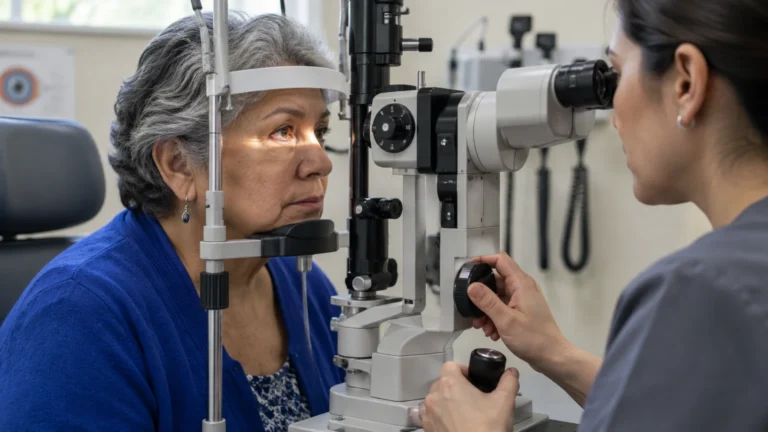
EyeCare America connects adults 65 and older who have not seen an ophthalmologist in three or more years with volunteer eye doctors who accept Medicare or other insurance as payment in full. Glasses are not included.
Our article on free eye exams through EyeCare America covers eligibility and referrals. For prescriptions, Extra Help and drugmakers’ patient assistance programs lower monthly costs, often with help from a health center pharmacist.
What to bring and ask before registering at a clinic or health center
Bringing complete documents to registration lets a community health center set your sliding-fee discount before any $1,500 procedure is billed. The same packet also speeds up QMB screening and hospital financial assistance.
- Photo ID and proof of your address, such as a utility bill or lease
- Proof of income: your Social Security benefit letter, pension statements, or last tax return
- Your Medicare card and any Medicaid, Medicare Savings Program, or Advantage plan card
- A list of every medication and supplement, with doses
- Recent test results or medical records if you are moving your care
Ask these questions when calling a clinic or health center desk:
- Whether the first visit has a fee
- Whether sliding-fee discounts apply to the 2027 $292 Part B deductible and 20% coinsurance
- Whether labs, dental care, and specialist referrals are handled on site
- What happens to your care if you later gain Medicare or Medicaid
For Medicare and QMB questions, a SHIP counselor is the person to decide with before you apply. For a hospital bill, ask the billing office for the hospital’s financial counselor.


6 Comments
Comments are closed.