
Renting out a spare bedroom helps you cover rising local property taxes without leaving the home you love. Dividing utility bills down to the cent keeps utility repayments completely separate from taxable rental income.
Most homesharing guides suggest a flat-rate rental fee that covers all utilities. That bundled approach turns simple expense reimbursements into taxable rental income on IRS Schedule E, unnecessarily raising your federal tax bill.
A precise square-footage and appliance-wattage allocation protects your fixed income, satisfies federal tax rules, and keeps your monthly living costs fair for both retirees.
In this guide8 sections
- The Tax Trap of Bundled Utility Payments
- Calculating Base Heating and Cooling by Square Footage
- Tracking High-Draw Bedroom Appliances by Wattage
- Worked Example: A Real-World Monthly Allocation
- Comparing Utility Allocation Methods
- Protecting SSI and Supplemental Benefits
- Establishing a Bulletproof Monthly Billing System
- Frequently Asked Questions

The Tax Trap of Bundled Utility Payments
When you rent a bedroom to another retiree to offset local property tax hikes, billing mechanics matter. The Internal Revenue Service draws a sharp line between business profits and shared personal expenses.
If you charge a flat rent figure like $800 monthly with utilities included, the IRS treats the entire $800 as gross rental income. You must report all of it on Form 1040, Schedule E.
Charging fixed rent plus actual utility reimbursement changes the calculation completely. Direct reimbursement for an adult roommate’s actual share of existing household bills does not count as taxable rental profit.
The reimbursement simply repays an existing, shared personal living expense. Splitting utility bills home sharing senior arrangements depend on this exact accounting separation to avoid taxable bracket creep.
To maintain this legal barrier, you must keep separate payment streams. Your roommate should write one check or bank transfer for bedroom rent and a separate payment for utility reimbursement.
Keep these three records in your home files every month:
- The original monthly utility statements showing total billing amounts.
- The written allocation formula showing your roommate’s exact mathematical share.
- A separate bank deposit slip or electronic receipt matching that calculated utility total.
Calculating Base Heating and Cooling by Square Footage
Whole-house utilities like natural gas heating, central air conditioning, and water service depend largely on your home’s total footprint. A simple per-person split can create friction if living areas differ dramatically.
If winter heating costs still stretch your budget, look into LIHEAP assistance for seniors to help offset seasonal utility bills.
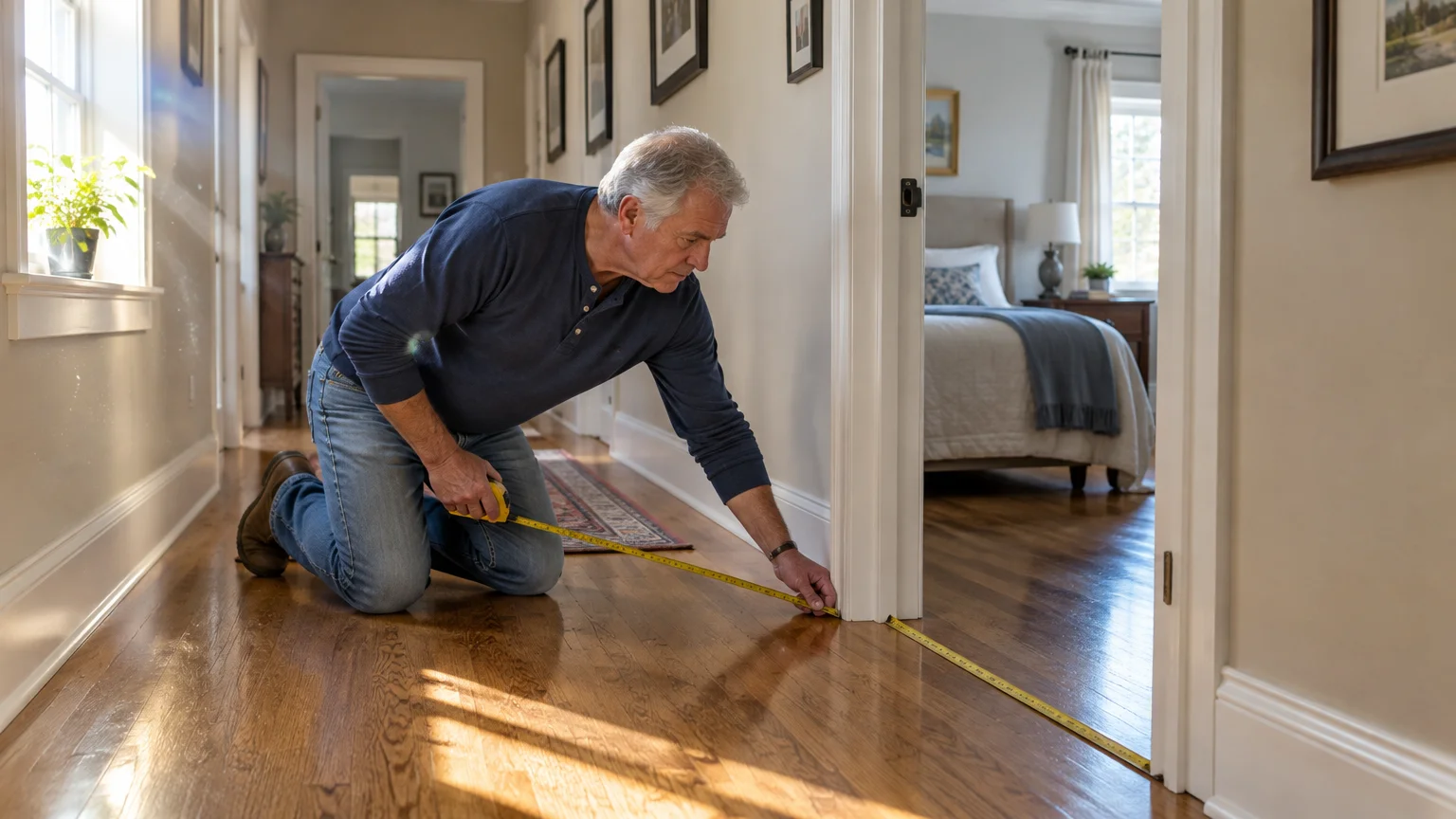
Square-footage allocation establishes an objective baseline. Measure private spaces and shared common rooms with a standard tape measure or laser distance meter.
Do not count unfinished basements, attics, or exterior garages when measuring your living area. These unconditioned spaces skew proportions without reflecting actual daily heating or water consumption.
Your floor plan naturally divides into three distinct categories:
- Exclusive Tenant Space: The rented bedroom and dedicated private bathroom.
- Shared Living Areas: The kitchen, living room, laundry area, and shared hallways.
- Exclusive Owner Space: Your primary master suite, private den, or personal storage closets.
Assign 100% of the tenant’s exclusive square footage directly to them. Then, divide the shared common area square footage equally between the two of you.
Add those two figures together to determine their base allocation percentage. This calculation gives you a defendable ratio for senior roommate utility division that stands up to family or legal scrutiny.
Tracking High-Draw Bedroom Appliances by Wattage
Square footage handles central HVAC well, but bedroom-specific appliances can drastically distort your electric bill. An extra space heater running eight hours a day can add $40 to $70 to monthly bills.
Managing these cold-weather costs is essential, especially when budgeting for winter heating on a fixed income alongside another resident.
Personal cooling and heating devices pull substantial electrical power. A standard 1,500-watt ceramic portable space heater consumes 1.5 kilowatt-hours (kWh) for every continuous hour of operation.
According to the U.S. Energy Information Administration, residential electricity rates average roughly 16 cents per kWh across the nation. At that rate, running that heater 8 hours daily costs $57.60 monthly.
Common bedroom appliances require specific wattage monitoring:
- Portable Space Heaters (1,500 watts): Consumes roughly 12 kWh per 8-hour day ($57.60 per month at $0.16/kWh).
- Window Air Conditioners (5,000 BTU, 500 watts): Consumes roughly 4 kWh per 8-hour day ($19.20 per month at $0.16/kWh).
- Mini-Fridges (compact, 2.5 cu ft, ~60 watts active): Consumes roughly 0.8 kWh per 24-hour day ($3.84 per month at $0.16/kWh).
- CPAP Medical Machines (30–60 watts): Consumes roughly 0.4 kWh per 8-hour night ($1.92 per month at $0.16/kWh).
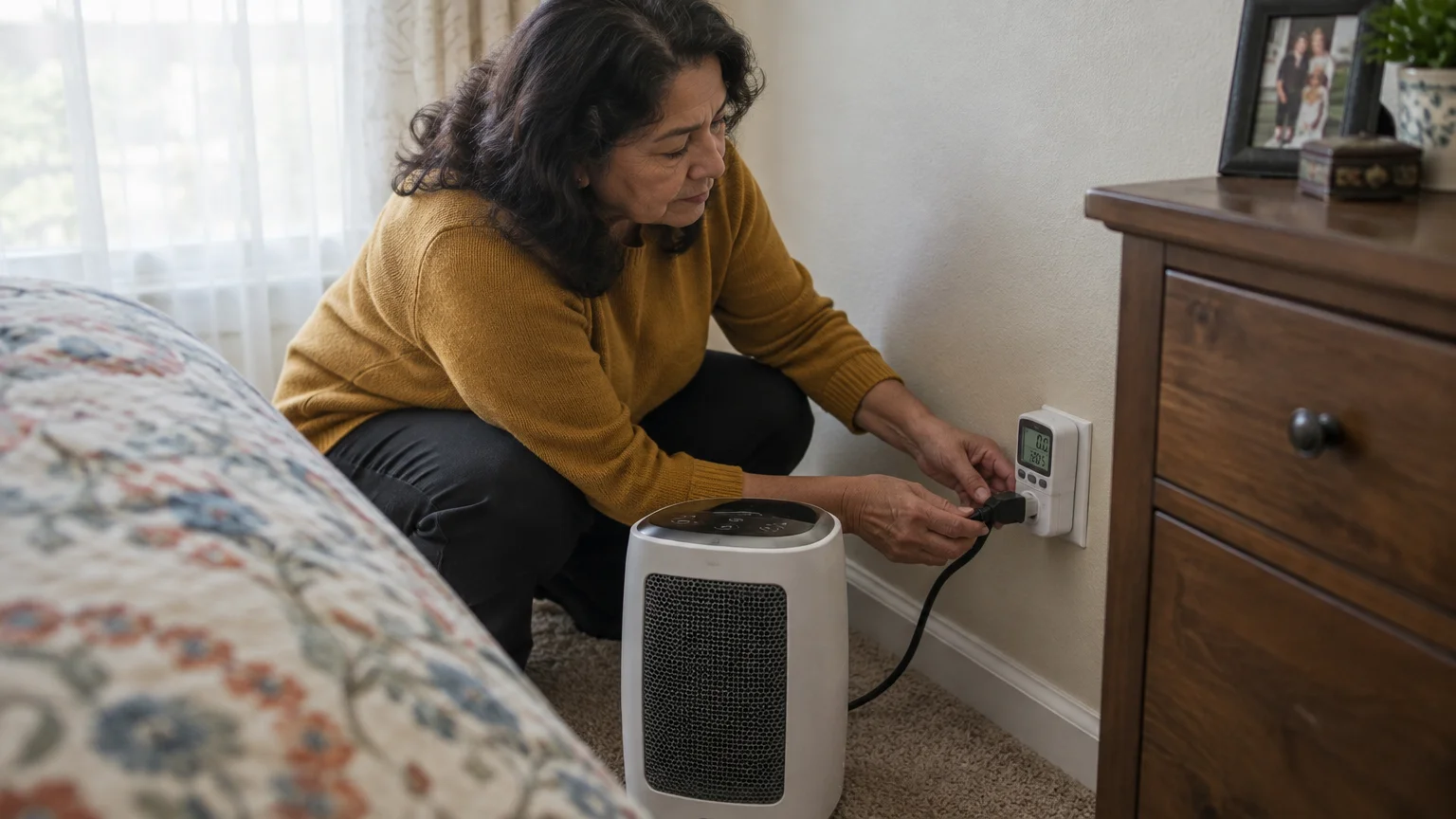
Install an inexpensive plug-in energy monitor like a Kill A Watt meter directly into the bedroom outlet. This tool records actual kilowatt-hours used over a thirty-day billing cycle without any guesswork.
Multiply the recorded kilowatt-hours by your utility company’s per-kWh rate. Add this specific appliance total directly to the tenant’s base utility invoice.
Worked Example: A Real-World Monthly Allocation
Consider a 1,800-square-foot single-story home owned by a 66-year-old retiree living on Social Security and modest retirement savings. The owner rents a 240-square-foot guest suite to another retiree.
To streamline these monthly figures, consider using free budgeting spreadsheets for retirees to log your roommate splits automatically.
The house features 760 square feet of shared common space, including the kitchen, living room, and laundry room. The owner’s private master bedroom and home office occupy the remaining 800 square feet.
Calculate the tenant’s base space percentage using these exact steps:
- Divide the 760 square feet of common space by 2, yielding 380 shared square feet per resident.
- Add the tenant’s private 240 square feet to their 380 square-foot shared portion for a total of 620 square feet.
- Divide 620 square feet by the total 1,800 square feet, which establishes a baseline share of 34.4%.
- Round this share to 35% in your written rental agreement for simple monthly math.
Suppose the household receives the following monthly utility bills: $145 for electricity, $110 for natural gas heating, $65 for municipal water and sewer, and $70 for high-speed fiber internet.
The internet service split is simple. Because both adults stream television and browse independently on a shared router, divide the $70 bill equally at $35 per person.
Next, apply the 35% base percentage to the natural gas ($110) and water ($65) bills. The roommate’s share of gas is $38.50, and their water share is $22.75.
Now examine the electric bill. The plug-in monitor reveals the roommate ran a supplemental electric space heater consuming 150 kWh during an unseasonably cold month, costing $24.00 at $0.16/kWh.
Subtract that $24.00 from the $145 electric bill to find the baseline household electric cost of $121.00. Multiply $121.00 by the 35% base rate, which equals $42.35.
Add the roommate’s $24.00 direct appliance charge to their $42.35 baseline share for a total electricity reimbursement of $66.35. Their total utility reimbursement for the month is $162.60.
That $162.60 total breaks down into: $35.00 internet, $38.50 gas, $22.75 water, and $66.35 electricity. Your roommate pays that exact figure separately from bedroom rent.

Comparing Utility Allocation Methods
Choosing how to divide your bills impacts both your tax filing and your daily household harmony. Renting room fixed income utility split choices come down to three standard frameworks.
Many of these same utility-sharing principles apply when budgeting when adult kids move back home to avoid household financial friction.
Review how these allocation strategies perform across legal clarity, fairness, and bookkeeping effort:
| Allocation Method | IRS Tax Implication | Monthly Time Needed | Fairness on High-Use Days |
|---|---|---|---|
| Bundled Flat-Fee Rent | 100% of payment taxable on Schedule E | 0 minutes | Poor (owner absorbs price spikes) |
| Equal 50/50 Split | Tax-exempt reimbursement | 5 minutes | Moderate (ignores unequal room size) |
| Square-Footage Plus Wattage | Tax-exempt reimbursement | 15 minutes | High (exact match to usage) |
The square-footage and wattage method requires roughly fifteen minutes of arithmetic each month. However, it completely eliminates arguments when power rates jump during extreme summer or winter weather.

Protecting SSI and Supplemental Benefits
If you or your roommate receives Supplemental Security Income (SSI), utility divisions demand strict legal compliance. The Social Security Administration enforces rigid living-arrangement guidelines.
Keeping these shared reimbursements distinct also helps ensure you understand how Social Security benefits are taxed without unnecessary income misclassifications.
Under SSA regulations, an SSI recipient must pay their pro-rata share of household shelter expenses. Shelter expenses specifically include rent, mortgage, electricity, natural gas, water, sewer, and garbage collection.
If a roommate on SSI pays less than their proportional share of utilities, SSA treats the discount as In-Kind Support and Maintenance (ISM). This triggers a Presumed Maximum Value penalty against their benefits.
That ISM penalty can slash a monthly SSI check by up to one-third of the federal benefit rate plus $20. In 2026, that reduction can exceed $350 monthly.
Effective September 30, 2024, the SSA removed food from ISM calculations under federal rule 89 Fed. Reg.
25507. Because food is excluded, shelter and utility reimbursements face the most scrutiny during benefits audits.
Federal utility assistance programs also handle roommate households differently:
- SNAP (Food Assistance): Roommates can apply and qualify independently as separate households if they purchase and prepare their meals separately.
- LIHEAP (Energy Grants): Because grants apply to the home’s single utility meter, federal rules evaluate the combined income of all residents living under that roof.
According to research from AARP, older adults increasingly choose home-sharing to maintain housing stability. Preserving your public benefits requires documenting every dollar shared between households.
Establishing a Bulletproof Monthly Billing System
“A penny saved is a penny earned.” — Benjamin Franklin
A repeatable monthly routine prevents awkward money conversations between friends or roomies. Treat the billing process like a standard household administrative task on the same day each month.
Designate an agreed reconciliation day, such as the fifth or tenth day after your primary electric bill arrives. Provide clear physical or digital copies of every utility invoice.
Follow these practical billing procedures every month:
- Assemble your monthly bills for electricity, heating fuel, water, sewer, and internet in a dedicated folder.
- Write the base percentage math on an invoice summary sheet, adding any measured plug-in appliance wattage.
- Deliver the itemized calculation sheet alongside copies of the original utility statements to your roommate.
- Collect reimbursement via a separate check, direct bank transfer, or payment app clearly marked “Utility Reimbursement.”
- Store the bills and paid reimbursement receipt together in an annual tax binder for at least three full years.
Clear records protect you if the IRS questions whether deposits into your personal account represent unreported rental income. The paper trail proves every dollar was a genuine reimbursement for actual household utility expenses.
Frequently Asked Questions
Does roommate utility reimbursement count as taxable income on my federal tax return?
No. When an adult roommate reimburses you directly for their fair share of actual household utility expenses, the IRS treats that payment as a non-taxable expense repayment rather than rental profit.
Should I include utilities in a single flat rent check each month?
No. Bundling rent and utilities into one flat payment requires you to report the entire sum as gross rental income on IRS Schedule E, which can unnecessarily increase your taxable income.
How do we split internet service if one person works from home or streams constantly?
Most broadband internet plans charge an unlimited flat monthly rate regardless of bandwidth. Unless one person orders dedicated high-speed tiers for heavy usage, splitting the base bill 50/50 remains the fairest approach.
Can an uneven utility split reduce an adult roommate’s Supplemental Security Income check?
Yes. If an SSI recipient pays less than their proportional pro-rata share of household shelter expenses, the Social Security Administration can reduce their monthly benefit check under In-Kind Support and Maintenance rules.
What is the easiest way to track electricity for a roommate’s portable heater or air conditioner?
Plug the appliance into a Kill A Watt electrical usage monitor plugged directly into the wall outlet. The monitor tracks the exact kilowatt-hours consumed, allowing you to bill actual electrical usage accurately.
Disclaimer: This article is for informational purposes only; benefits, programs, and regulations can change. We encourage readers to verify current information with official government sources and consult with qualified professionals for personalized advice.