
If you are 71 and facing a $2,200 per-eye quote for toric lenses, your eye clinic is not charging you for the cataract surgery itself. Medicare covers the full cataract extraction and a standard replacement lens under Part B.
Careful research and maximizing your Medicare benefits can help you protect your healthcare budget from unnecessary elective upgrade costs.
The steep surcharge pays solely for astigmatism correction shaped directly into the plastic implant. Your clinic receives full Medicare reimbursement for the baseline operation regardless of which lens you pick.
That out-of-pocket fee buys convenience from reading glasses rather than safer surgery or clearer baseline vision. Knowing how billing works prevents you from overpaying thousands on a fixed budget.
In this guide9 sections
- How Original Medicare Covers Cataract Surgery
- Standard Monofocal Lenses Versus Premium Toric Implants
- CMS Billing Rules: Why Clinics Charge Upgrades Out of Pocket
- Worked Financial Example: A 71-Year-Old Patient’s Real Costs
- Comparing Cataract Lens Options and Out-of-Pocket Costs
- The Overlooked Medicare Eyeglasses Benefit
- Specific Questions to Ask Your Eye Surgeon Before Consenting
- Practical Steps to Avoid Surprise Bills on Surgery Day
- Frequently Asked Questions

How Original Medicare Covers Cataract Surgery
According to the National Eye Institute, surgeons perform roughly 3.7 million cataract procedures in the United States annually. More than half of all Americans develop cataracts by age 80.
Although cataract surgery is performed on an outpatient basis, understanding what Medicare Part A actually covers clarifies why hospital room charges do not apply to standard lens replacement.
While the procedure itself falls under Part B, post-operative antibiotic and anti-inflammatory eye drops are processed through your Medicare Part D prescription drug coverage.
While routine exams are often excluded, learning how Medicare handles vision care helps clarify what diagnostic and surgical services qualify for benefits.
Medicare treats cataract removal as a medically necessary outpatient procedure under Part B. The program pays to restore your functional vision when clouded natural lenses interfere with daily activities like driving or reading.
The baseline coverage includes the surgical procedure, local anesthesia, surgical facility costs, and one standard intraocular lens (IOL). Standard guidelines on Medicare.gov confirm that Part B pays 80% of the approved amount once you meet your annual deductible.
For 2025, the Medicare Part B deductible is $257. After satisfying that deductible, you owe a 20% coinsurance on all Medicare-approved medical charges.
Your actual coinsurance expense depends partly on where your surgeon operates. Ambulatory surgery centers (ASCs) charge lower facility rates than hospital outpatient departments (HOPDs).
- Surgeon professional fees for removing the clouded crystalline lens
- Operating room and specialized nursing care in an approved outpatient setting
- Pre-operative A-scan ultrasound measurements to size your basic replacement lens
- One basic monofocal intraocular lens implant per operated eye
- Standard post-operative clinical exams during the 90-day global surgical period
If you carry a Medigap supplemental policy, your plan picks up some or all of the 20% coinsurance. A patient with Medigap Plan G pays only the Part B deductible for standard surgery.
Without Medigap, standard surgery typically requires $300 to $600 out of pocket per eye for coinsurance. The lens implant itself adds zero extra cost because Medicare includes standard monofocal optics in its facility payment.
Standard Monofocal Lenses Versus Premium Toric Implants
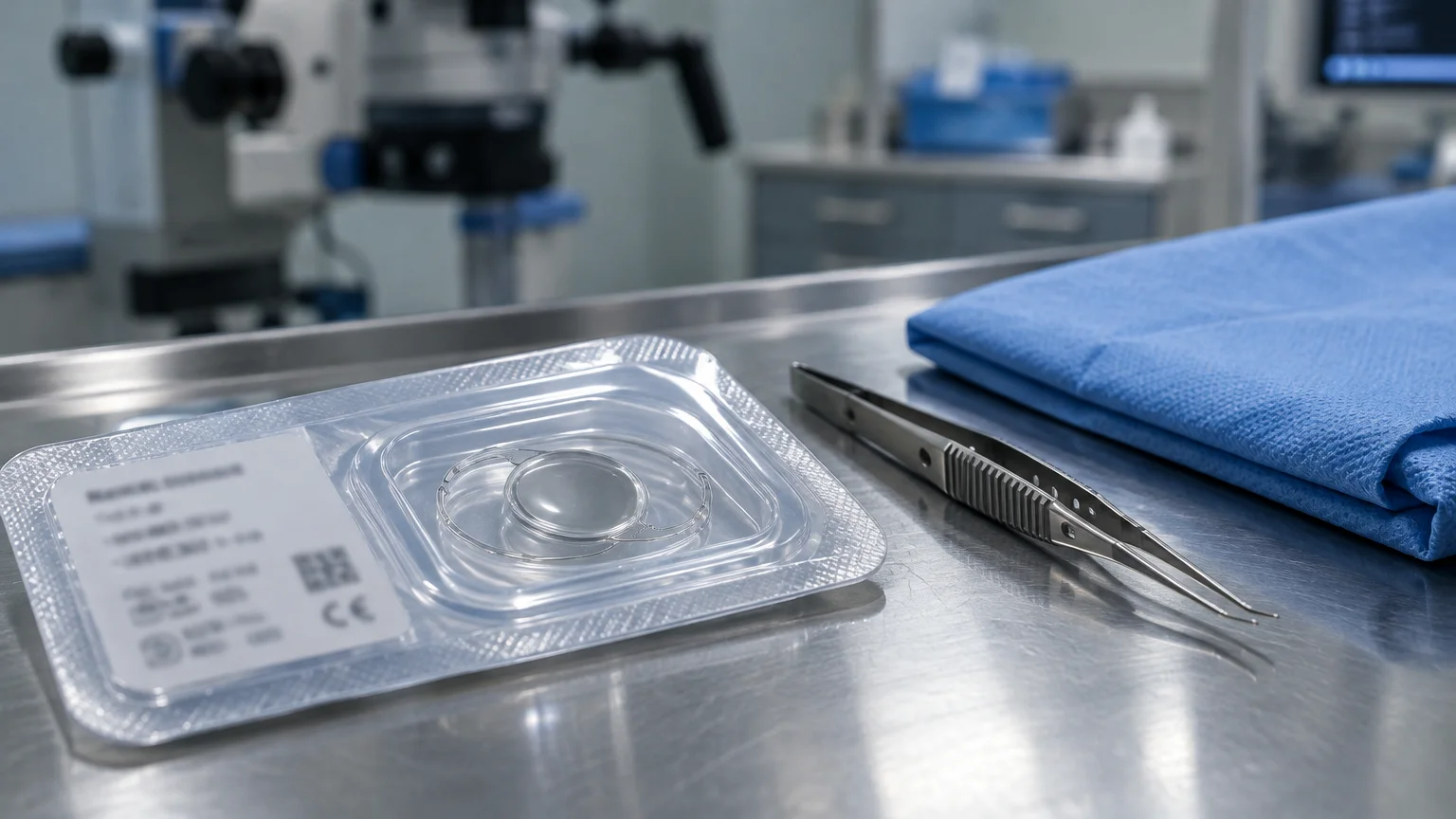
A standard monofocal IOL is a clear, fixed-focus synthetic lens. It replaces your clouded natural lens and delivers sharp focus at one specific distance—almost always set for clear distance vision.
Much like budgeting for hearing aid costs outside Medicare, evaluating out-of-pocket optical upgrades requires weighing personal convenience against long-term retirement savings.
Seniors seeking an initial screening before scheduling surgery can look into programs offering free comprehensive eye exams for qualifying older adults.
With a standard monofocal lens, you will likely wear inexpensive reading glasses for near tasks. You will also wear prescription glasses if you have corneal astigmatism that needs correction.
Corneal astigmatism occurs when your cornea curves like a football rather than a basketball. This uneven curve bends light unevenly, blurring vision at all distances unless corrected.
A toric lens incorporates a custom cylindrical shape directly into the optic. During surgery, the doctor aligns this cylinder with your cornea’s steep axis to cancel out your astigmatism.
- Standard monofocal lenses: Treat the cataract completely and restore light transmission, leaving any residual astigmatism for external glasses to correct.
- Toric monofocal lenses: Treat the cataract and correct pre-existing corneal astigmatism internally, reducing your need for external distance glasses.
- Presbyopia-correcting lenses: Multifocal or extended depth of focus (EDOF) optics that attempt to give distance, intermediate, and reading vision simultaneously.
Many patients assume a $2,200 toric quote indicates superior surgical safety or clearer optical materials. In reality, both lenses use identical medical-grade acrylic or silicone materials.
The toric lens does not make your surgery safer or protect against future eye disease. It simply shifts your astigmatism correction from outside your eye into the implant.

CMS Billing Rules: Why Clinics Charge Upgrades Out of Pocket
Under federal statute, Medicare strictly prohibits doctors from balance billing patients for covered medical procedures. A clinic cannot arbitrarily charge an extra $2,200 for performing standard cataract surgery.
If an eye clinic attempts to charge you for standard surgical components covered by Part B, familiarizing yourself with filing a claim with Medicare ensures you can dispute unauthorized expenses.
To accommodate newer optical technology, the Centers for Medicare & Medicaid Services issued CMS Ruling 1536-R. This administrative ruling created a unique split-billing framework for astigmatism-correcting lenses.
Under Ruling 1536-R, CMS considers astigmatism correction an elective refractive service rather than a medical necessity. Medicare pays its standard allowance for the cataract removal and standard monofocal lens.
The eye clinic then bills you directly for the non-covered upgrade costs. Because Medicare excludes these elective services, supplemental Medigap plans cannot pay them either.
- The wholesale price difference charged by the manufacturer for toric optical tooling
- Specialized pre-operative diagnostics like corneal topography and optical coherence biometry
- Intraoperative aberrometry used to verify lens alignment during surgery
- Surgeon fees for intraoperative axis marking and rotational lens alignment
- Femtosecond laser surgical access fees if the clinic pairs toric insertion with laser incisions
Before you undergo surgery with a premium lens, your clinic must give you an Advance Beneficiary Notice of Noncoverage (ABN) or custom financial agreement. This document itemizes exactly what Medicare pays and what you owe out of pocket.
If you decline the toric lens, your clinic must still provide the standard cataract operation. They cannot refuse standard treatment simply because you decline a premium upgrade.

Worked Financial Example: A 71-Year-Old Patient’s Real Costs
Consider the situation of Margaret, a 71-year-old retiree enrolled in Original Medicare and Medigap Plan G. Margaret has moderate cataracts and 1.75 diopters of corneal astigmatism in each eye.
Retirees evaluating managed care options should also review Medicare Advantage plan networks and referrals to determine how surgical copays and ambulatory facility rules apply to their care.
Understanding the differences between supplemental Medigap plans and Medicare Advantage can also help anticipate cost-sharing rules for specialist operations.
Her ophthalmologist offers standard monofocal implants or premium toric implants with a $2,200 out-of-pocket upgrade fee per eye. Margaret wants to know her exact financial obligations under each path.
The following calculations assume Margaret has already satisfied her 2025 Medicare Part B deductible ($257) earlier in the year. The surgical center is an accredited ambulatory surgery center (ASC).
- Evaluate Option A (Standard Monofocal Lenses with Medigap Plan G):
- Surgeon fee per eye: $650 (Medicare pays 80%, Plan G pays 20%). Margaret pays $0.
- ASC facility fee per eye: $1,150 (Medicare pays 80%, Plan G pays 20%). Margaret pays $0.
- Standard monofocal lens implant: Included in ASC facility payment. Margaret pays $0.
- Total out-of-pocket surgery cost for both eyes: $0.
- Post-surgery prescription glasses: $280 for progressive lenses correcting residual astigmatism.
- Total out-of-pocket expense for Option A: $280.
- Evaluate Option B (Standard Monofocal Lenses with Original Medicare Only):
- Surgeon coinsurance per eye (20% of $650): $130.
- ASC facility coinsurance per eye (20% of $1,150): $230.
- Total coinsurance per eye: $360.
- Total surgery cost for both eyes: $720.
- Post-surgery prescription glasses: $280.
- Total out-of-pocket expense for Option B: $1,000.
- Evaluate Option C (Premium Toric Lenses with Medigap Plan G):
- Surgeon and facility base fees: Covered 100% between Medicare and Plan G. Margaret pays $0.
- Toric upgrade fee (eye 1): $2,200 paid directly to clinic.
- Toric upgrade fee (eye 2): $2,200 paid directly to clinic.
- Over-the-counter reading glasses: $40 for two pairs.
- Total out-of-pocket expense for Option C: $4,440.
By choosing standard monofocal lenses, Margaret saves $4,160 across both eyes. She achieves sharp 20/20 vision by wearing glasses to manage her astigmatism.
Consumer budget reports published by AARP highlight that elective surgical add-ons are among the largest surprise medical expenses for retirees. Evaluating these numbers ahead of time keeps your retirement savings intact.

Comparing Cataract Lens Options and Out-of-Pocket Costs
Eye clinics offer several intraocular lens models, each with distinct billing classifications under Medicare Part B. The table below outlines how coverage and expenses compare across modern lens types.
| Lens Category | Visual Focus Target | Typical Patient Upgrade Fee | What Medicare Part B Reimburses | Expected Eyewear Need Post-Surgery |
|---|---|---|---|---|
| Standard Monofocal IOL | Single fixed distance (usually far distance) | $0 per eye | 100% of approved fee (after Part B deductible & 20% coinsurance) | Reading glasses; glasses for distance astigmatism |
| Toric Monofocal IOL | Single distance plus internal astigmatism correction | $1,000 to $2,200 per eye | Reimburses equivalent of standard lens; upgrade excluded | Inexpensive over-the-counter reading glasses only |
| Multifocal / Trifocal IOL | Simultaneous far, intermediate, and near focal zones | $1,800 to $3,500 per eye | Reimburses equivalent of standard lens; upgrade excluded | Rarely requires glasses; potential night glare or halos |
| Extended Depth of Focus (EDOF) | Continuous range from distance through computer intermediate | $1,500 to $3,000 per eye | Reimburses equivalent of standard lens; upgrade excluded | Minimal glasses for distance/computer; readers for fine print |
Notice that every lens category receives the exact same financial reimbursement from Medicare Part B. You pay 100% of the incremental fee for anything beyond the standard monofocal baseline.
Your surgeon can also combine different powers using standard lenses in a technique called monovision. The doctor sets your dominant eye for distance and non-dominant eye for intermediate vision at no extra charge.

The Overlooked Medicare Eyeglasses Benefit
Medicare Part B notoriously excludes routine vision care, eye exams, and prescription glasses. However, Congress created a permanent statutory exception for patients recovering from cataract surgery.
Taking advantage of this specialized eyewear rule is just one of many ways to maximize your Medicare benefits throughout the year.
Under Section 1861(s)(8) of the Social Security Act, Medicare covers corrective eyewear following cataract surgery with an intraocular lens implant. This benefit applies after each cataract surgery with an IOL insertion.
Medicare pays 80% of the approved amount for one pair of standard eyeglasses or one set of contact lenses. You are responsible for the remaining 20% coinsurance plus your Part B deductible if unmet.
- The optical provider must be formally enrolled in Medicare as a durable medical equipment (DME) supplier.
- Medicare covers standard plastic or glass single-vision, bifocal, or trifocal lenses.
- The program covers basic frame allowances up to the Medicare-established fee schedule.
- Elective upgrades like anti-reflective coating, progressive transition lenses, and designer frames require extra payment.
- You must obtain the eyewear after surgery; you cannot claim glasses ordered before your operation.
Many private optometry shops do not participate as Medicare DME suppliers. You must ask the optician directly if they bill Medicare Part B for post-cataract eyewear.
If you pair standard monofocal IOLs with this benefit, your post-surgical glasses cost drops significantly. Federal benefit resources on Benefits.gov offer additional details on navigating senior healthcare assistance.

Specific Questions to Ask Your Eye Surgeon Before Consenting
Eye clinics often present toric lenses during rushed consultations using marketing brochures. Ask these direct questions to determine if a toric lens is clinically worthwhile for your eyes.
- What is my exact corneal astigmatism measurement in diopters? If your corneal astigmatism measures below 1.0 diopter, the visual benefit of a toric lens is often negligible. Residual astigmatism below this threshold rarely justifies spending thousands out of pocket.
- Is my astigmatism corneal or lenticular? Cataracts themselves cause temporary astigmatism inside the natural lens (lenticular astigmatism). Removing the cataract eliminates lenticular astigmatism automatically, meaning only corneal astigmatism requires correction.
- Can I see an itemized fee breakdown for the $2,200 upcharge? Ask the billing coordinator to separate the physical lens cost from femtosecond laser use or specialized testing fees. Knowing the exact breakdown helps you reject unwanted elective testing packages.
- What happens if the toric lens rotates after surgery? Toric lenses must stay aligned within a few degrees of the target axis to work correctly. Ask if the surgeon charges additional operating room fees if they must surgically rotate the lens back into place.
- What visual acuity should I expect with standard monofocal lenses and glasses? Ask the surgeon what your best-corrected vision will be with basic lenses once you put on regular glasses. In healthy eyes, standard lenses paired with glasses deliver identical optical sharpness to premium lenses.

Practical Steps to Avoid Surprise Bills on Surgery Day
Medical billing errors and aggressive clinic upselling can derail your retirement budget. Follow these practical steps before scheduling your procedure.
- Confirm that both the eye surgeon and the surgical facility accept Medicare assignment. Accepting assignment means providers agree to Medicare’s approved payment rates and cannot balance-bill you.
- Choose an accredited ambulatory surgery center rather than a hospital outpatient department whenever possible. Facility coinsurance rates at hospital clinics run noticeably higher for the exact same procedure.
- Read every page of your surgical consent packet carefully before signing. Watch for embedded clauses that bundle elective dry-eye treatments or laser surgery packages into your lens bill.
- Request an itemized Advance Beneficiary Notice (ABN) at least one week prior to surgery. Never sign an ABN on the morning of surgery while seated in the pre-operative staging area.
- Contact your Medigap carrier to verify their claims process for outpatient cataract care. Confirm that your supplement covers secondary coinsurance for the surgical center you selected.
Opting for a standard monofocal lens is never a compromise on surgical quality. It is a proven, safe choice that millions of retirees use to restore crisp, healthy vision without debt.
Frequently Asked Questions
Does Medicare cover astigmatism cataract lenses under any circumstances?
No. Medicare never covers the incremental cost of toric or astigmatism-correcting intraocular lenses. Under CMS Ruling 1536-R, Medicare classifies astigmatism correction as an elective refractive service, leaving all upgrade charges to the patient.
What is the average out-of-pocket cost for standard cataract surgery with Medicare?
Under Original Medicare without supplemental insurance, patients typically pay between $300 and $600 per eye for standard surgery. Patients with a Medigap policy like Plan G pay $0 once they meet their annual Part B deductible.
Can I use my Health Savings Account or Flexible Spending Account for toric lens copays?
Yes. The Internal Revenue Service treats toric lens upgrade fees and astigmatism correction as qualified medical expenses under IRC Section 213(d).
You can use pre-tax HSA or FSA funds to pay the clinic’s out-of-pocket fee.
Will my Medigap supplement pay for the toric lens upgrade fee?
No. Medigap policies only pay coinsurance, copayments, and deductibles for Medicare-approved services. Because Medicare excludes the toric lens upgrade fee by regulation, supplemental insurers cannot legally cover any part of the upcharge.
How long do I have to use the Medicare post-cataract eyeglasses benefit?
Medicare does not set a strict expiration date, but you must complete your cataract surgery before ordering the glasses. Most providers recommend ordering your prescription eyewear 4 to 6 weeks post-surgery once your cornea stabilizes.
Disclaimer: This article is for informational purposes only. Benefits, programs, and regulations can change.
We encourage readers to verify current information with official government sources and consult with qualified professionals for personalized advice.