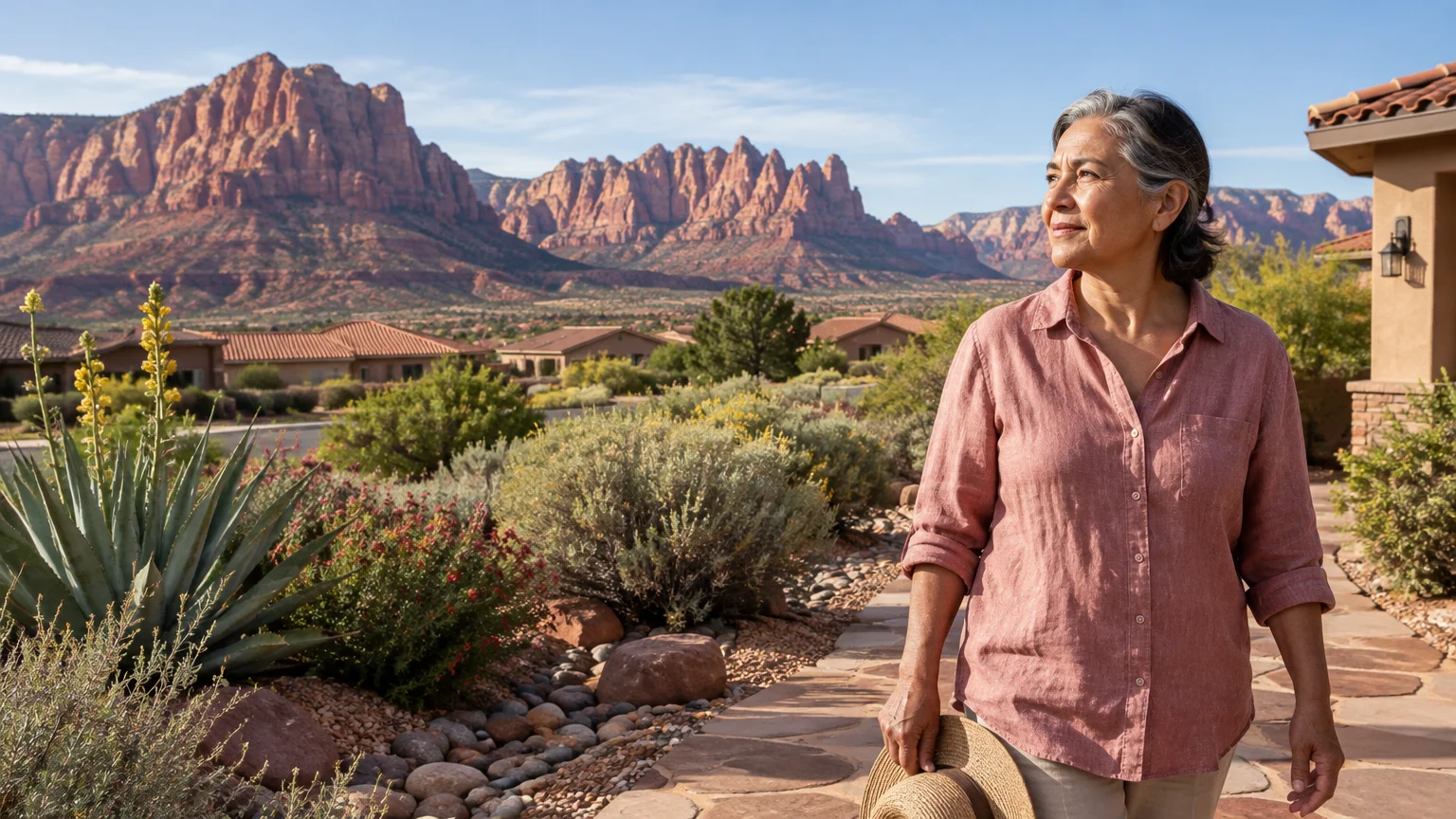
A married couple, both age 67, planning to retire on $48,000 of Social Security and $32,000 of IRA distributions faces an important choice in St. George. Relocating with a $530,000 home purchase requires looking past standard advice about tax-friendly retirement states.
Conventional wisdom suggests moving to zero-income-tax Nevada instead. However, Utah’s 45% primary residence property tax exemption and targeted Social Security credit bring the actual state tax burden surprisingly close to Nevada for an $80,000 budget.
Daily climate and seasonal routines on an $80,000 budget
St. George sits in the Mojave Desert at an elevation under 3,000 feet. National Weather Service climate normals for St. George show average January highs in the mid-50s and July highs around 102 degrees.
For this retired couple, mild winters mean low home heating bills and outdoor activity throughout January. Snow rarely sticks in town, and low humidity prevents the damp chill common in northern states.
Summer heat presents the main seasonal compromise. From late June through August, daily highs run past 100 degrees, pushing morning walks and outdoor exercise into the early hours.
Spring and fall offer long, comfortable seasons. Roughly October through May creates ideal conditions for pickleball, cycling, and walking without running heavy air conditioning.
Testing the climate through an RV snowbird season or a winter rental provides firsthand experience before purchasing real estate. Visiting in July is equally sensible, as intense summer heat changes some newcomers’ plans.

Comparing St. George with Las Vegas and Phoenix on an $80,000 income
Many retirees consider Phoenix or Las Vegas alongside St. George for warm winters. The differences that matter are city size, summer heat, state income tax, and distance to major hospitals and airports.
Nevada charges no state income tax on pensions or distributions. Arizona applies a flat income tax rate lower than Utah’s and exempts Social Security entirely.
Utah levies a flat 4.45% tax for 2026, which applies to traditional IRA withdrawals. For households with large tax-deferred balances, that rate can tilt decisions toward neighboring states.
Yet city scale creates an everyday difference. Phoenix and Las Vegas are large metropolitan areas with heavy highway traffic, longer drives to basic services, and more intense summer heat in Phoenix.
St. George remains a compact small city where most errands take short drives. Las Vegas is about two hours southwest down Interstate 15 when international flights or urban amenities are required.
Calculating Utah income tax on $48,000 Social Security and $32,000 IRA distributions
Utah taxes personal income at a flat 4.45% for 2026 without an automatic blanket exclusion for retirement income. The tax calculation begins with federal adjusted gross income.
The federally taxable share of benefits is determined using the worksheet in IRS Publication 915. Our guide explains how Social Security benefits are taxed across federal brackets.
On $48,000 of benefits and $32,000 of IRA distributions, federally taxable Social Security equals $16,200. This produces a federal adjusted gross income of $48,200.
Applying Utah’s flat 4.45% rate to $48,200 yields an initial state tax figure of about $2,145. However, this couple does not pay that full amount.
Utah grants a Social Security benefits credit, claimed on Schedule TC-40A. This credit eliminates state tax on benefits for married couples with modified adjusted gross income at or below $90,000.
The income cutoff is $54,000 for single filers and $45,000 for married taxpayers filing separately. Above those thresholds, the credit phases out as income rises.
Because this couple’s income sits below $90,000, the state tax on their $16,200 of benefits (about $721) is completely erased. That leaves $1,424 in state tax on their $32,000 IRA withdrawals.
Utah’s separate taxpayer tax credit can reduce that remaining $1,424 even further. For everyday retail spending, the combined state and local sales tax in St. George is 6.75% for 2026.
Property tax bills on a $530,000 St. George primary residence
Utah’s property tax rules provide substantial savings for primary homeowners. The state exempts 45% of a primary residence’s market value, so property tax applies to only 55% of it.
Second homes, vacation properties, and rentals do not qualify and are taxed on their full value. For this couple’s $530,000 primary home, the 55% taxable portion equals $291,500.
Local levies from the county, school district, city, and special districts combine to set the final rate. Applying a combined levy of about 0.78% or 0.782% produces an annual bill of about $2,279.
That $2,279 tax bill reflects an effective property tax rate of roughly 0.43% on the full $530,000 market value. Homeowners should verify with the county assessor whether filing a primary residence declaration is required.
Adding $2,279 in property taxes to $1,424 in income taxes produces an annual Utah tax total of roughly $3,700. That equals about $310 a month for this retired household.
Some households with lower income qualify for additional relief described in our overview of property tax exemptions for seniors. A local tax preparer can verify exact levy rates before purchase.
Hospital care, Medicare transitions, and specialist access
Healthcare is an essential consideration for two 67-year-olds settling into Washington County. The primary regional medical facility is Intermountain St. George Regional Hospital.
The hospital features 284 licensed beds and a Level II trauma designation. It serves patients throughout southern Utah and adjacent areas of Nevada and Arizona.
Routine medical visits and emergency needs are managed locally. However, highly complex conditions or Level I trauma care require a four-hour drive north to Salt Lake City or two hours to Las Vegas.
Primary care clinics in St. George often have new-patient waiting lists running several weeks. Contacting providers a few months before moving and reviewing Medicare’s Care Compare tool on Medicare.gov ensures timely care.
Original Medicare covers medical services nationwide, and Medigap supplemental coverage travels with you, though monthly premiums may change. In contrast, Medicare Advantage and Part D prescription drug plans are tied to specific regional service areas.
Relocating provides a Special Enrollment Period to join a new plan. Giving advance notice opens the window the month before moving and extends two full months after your relocation date.
Free insurance guidance is available through Utah’s State Health Insurance Assistance Program. SHIP counselors can help this couple compare Washington County plans before finalizing their enrollment.
Buying a $530,000 home: 55-plus communities, soil, and water
The local real estate inventory consists largely of single-story houses designed for low maintenance. Downsizing retirees should review the financial side of downsizing to align equity proceeds with relocation costs.
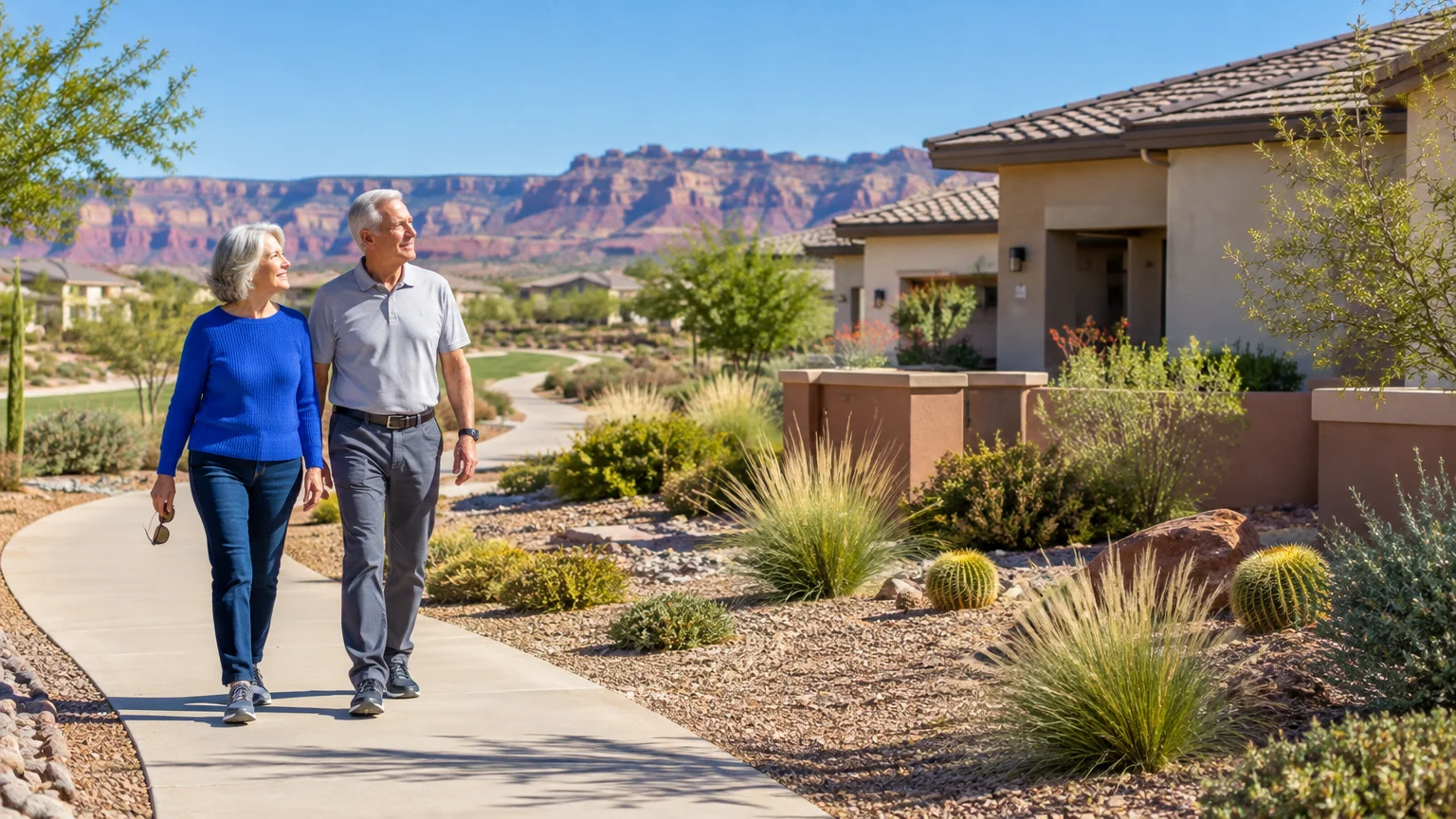
For this couple, SunRiver St. George provides one example of an established 55-plus deed-restricted community centered on a clubhouse and golf course. Other master-planned subdivisions in Washington County welcome residents of all ages.
Before placing an offer on a $530,000 property, examine homeowner association covenants and monthly fee structures. Clarify whether dues cover exterior home maintenance, yard care, community facilities, or high-speed internet.
Buyers should also review association rules regarding trailer storage and recreational vehicle parking. Additionally, requesting a geotechnical report confirms whether the foundation rests on expansive clay or gypsum soil prone to shifting.
Managing monthly utility costs requires understanding regional water rules. Because the region relies on groundwater and the Virgin River basin, local cities and the Washington County Water Conservancy District enforce strict conservation standards.
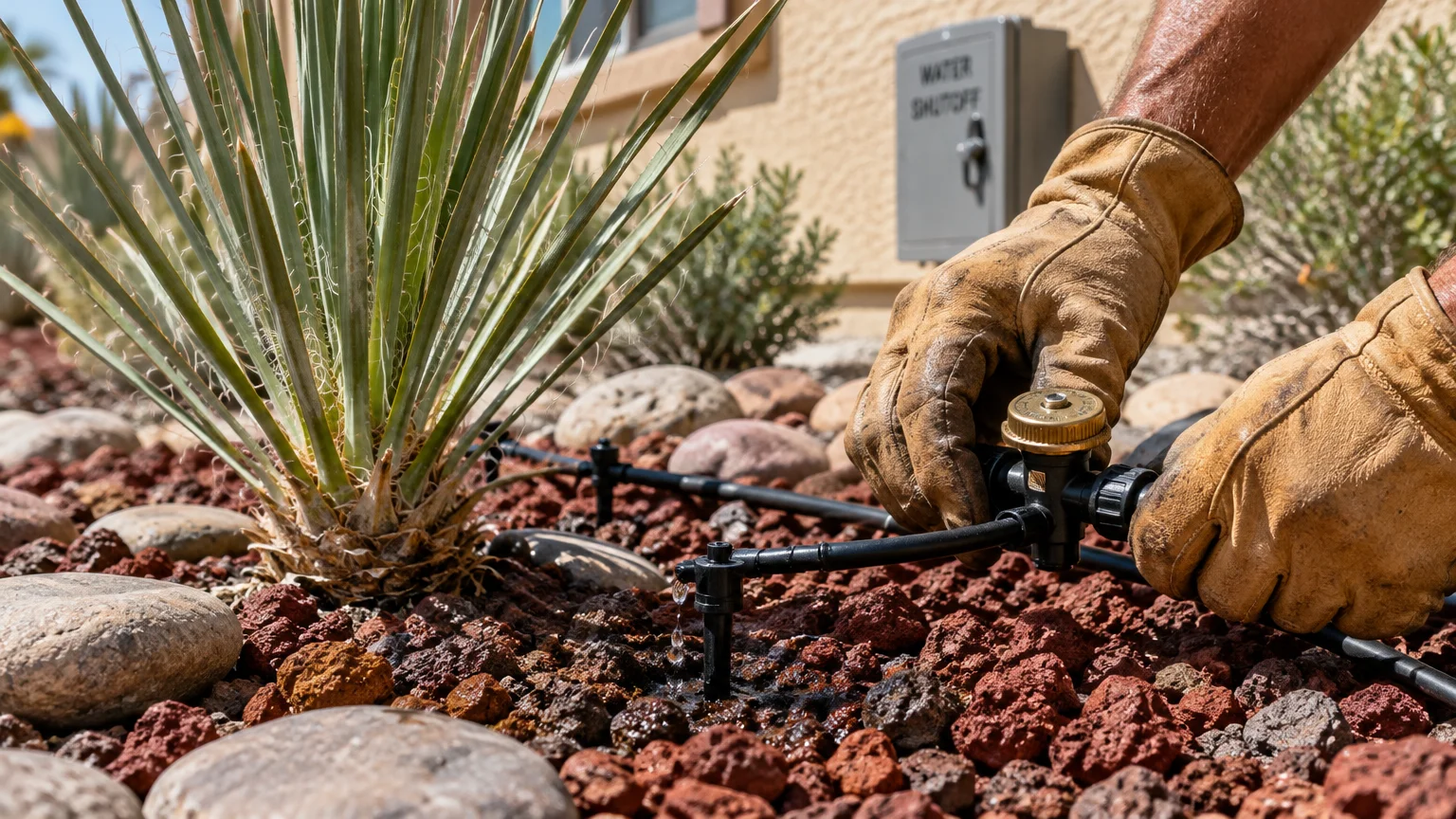
New residential builds face strict limits on front yard turf, and municipal water providers bill culinary water in ascending tiers. Drip-irrigated desert plants keep outdoor water bills manageable throughout hot summers.
The local water district provides cash rebates when homeowners replace existing sod with approved water-wise landscaping. Verifying rebate terms with your municipal utility ensures you capture eligible savings before removing lawn.
Outdoor life, national parks, and travel from St. George
Daily recreation is a major benefit for active retirees in southern Utah. Snow Canyon State Park lies roughly 10 miles from downtown St. George, offering paved multi-use trails among red sandstone and volcanic rock.
Zion National Park is situated about 40 miles east, allowing convenient day visits in under an hour. Exploring Zion on winter weekdays lets local retirees enjoy iconic canyon scenery without seasonal tourist congestion.
For frequent park visits, the America the Beautiful Senior Pass covers entrance and discounts some campground fees. Deciding between the lifetime and annual Senior Pass secures substantial recreation savings over retirement.
Within St. George, municipal golf courses operate throughout the winter with discounted resident green fees. The city’s parks and recreation department also oversees active pickleball programs, including popular community courts at Little Valley.
Travel connections are accessible from two convenient options. St. George Regional Airport offers commercial flights to several hub airports, while Harry Reid International in Las Vegas sits 120 miles southwest for expanded flight schedules.