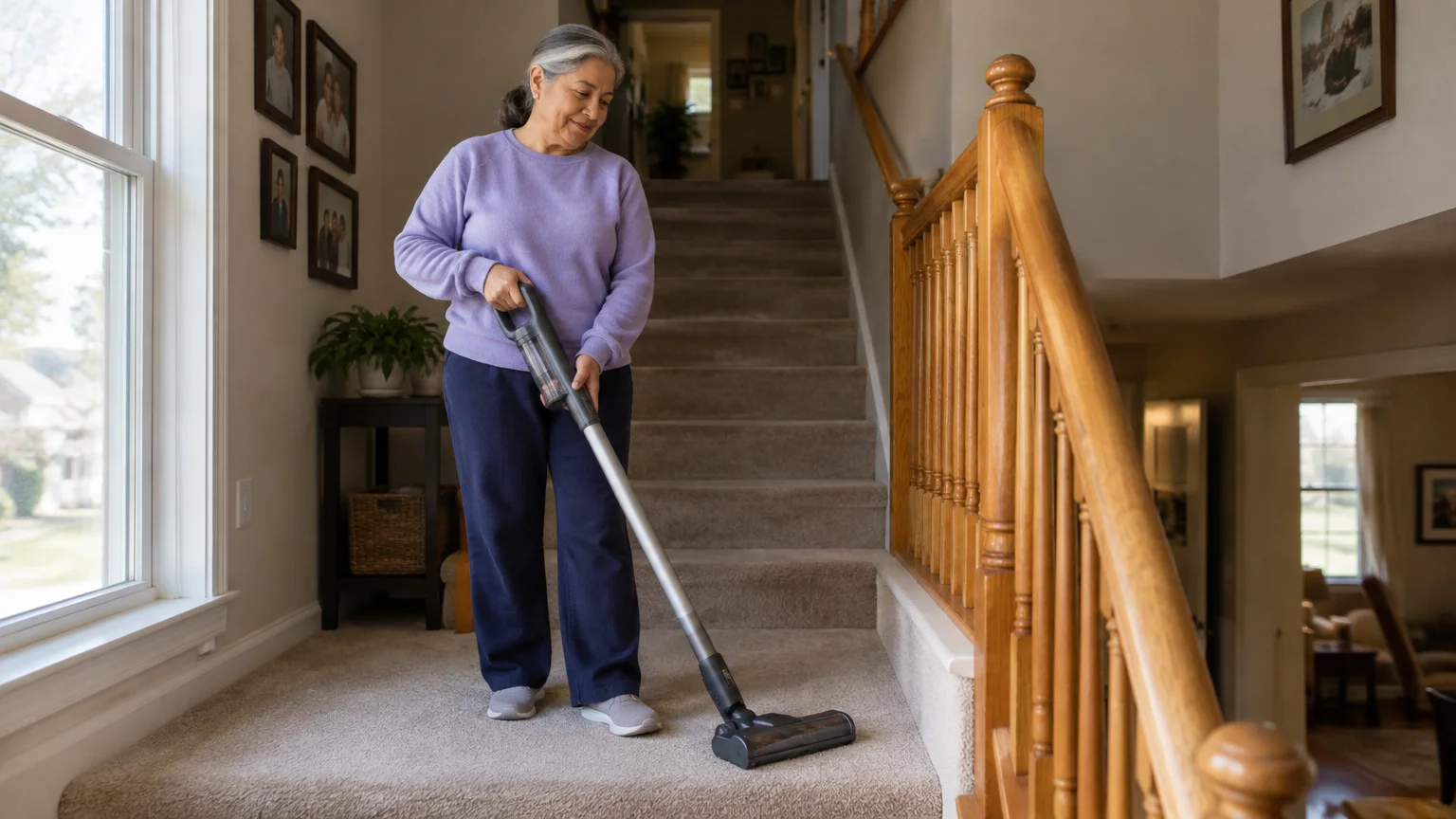
For an older adult living alone with lumbar spinal stenosis or arthritic hands, vacuuming carpeted stairs turns a weekly chore into a fall risk. Carrying an upright well over 10 pounds strains your back while taking one hand off the rail.
Generic lightweight guides rank cordless sticks by total box weight and max suction, which backfires on narrow treads. Avoiding stair injuries means catching six equipment and routine failures early, from detached hand weight and switches to battery runtime and climbing direction.
Shopping by total stick weight instead of detached hand weight
The first failure strikes when shoppers buy a stick vacuum from its floor weight. On stairs, carrying heavy machinery raises the odds of both a serious fall and an acute back flare.
CDC researchers found that stairs account for 22.9% of at-home fall-related emergency department visits among adults 65 and older. Lumbar spinal stenosis adds further danger because it is a narrowing of the spinal canal that compresses nerve roots in the lower back.
That nerve compression can bring leg numbness, weakness and balance problems onto narrow treads. Standard guidance for chronic back pain is to avoid heavy lifting and bending at the waist, yet a full upright demands both.
The cause: Manufacturers advertise total floor weight while hiding how top-heavy stick vacuums behave in handheld stair work. Angling a long wand toward a vertical riser creates leverage that bends your wrist back and pulls on your lower spine.
The fix: Judge only the detached handheld unit, aiming for a cordless stick whose motor unit weighs about 2 to 3 pounds. Riding close to your body in one relaxed hand, that lighter load leaves your other hand free for the rail.
Check exact stair weights across model designs before deciding, because total stick figures mislead shoppers:
- Dyson V12 Detect Slim: Dyson lists the V12 Detect Slim at 5.2 pounds total, while independent testing puts its detached hand unit at about 3.1 pounds.
- Shark Wandvac System (WS620 series): Shark specs list the full stick at about 5.8 pounds and the detachable hand vac at about 2.1 pounds.
- Black+Decker Dustbuster: This basic handheld has no wand, so you carry the entire compact unit directly in one hand.
- Miele Classic C1: With this corded canister, you hold only the hose and wand while the canister rests on a step and moves up as you climb.
Test balance in a store by holding the detached hand unit at arm’s length for about 30 seconds. If your wrist or forearm tires before then, a full flight will feel worse.
If you have stenosis, a disc problem or recent back surgery, ask your doctor or physical therapist how much weight you should lift on stairs.
Picking a trigger switch that wears out arthritic fingers
The second failure occurs when a vacuum runs only while you hold down a spring-loaded trigger. Squeezing continuously across every tread and riser quickly exhausts forearms and triggers pain in arthritic fingers.
When hand cramps flare mid-flight, people instinctively shift their grip or grab the machine with both hands. Letting go of the handrail for even a moment leaves you unsupported on a narrow step.
The cause: Trigger switches are built for short floor bursts rather than sustained vertical cleaning. Even light units feel awkward when your finger cannot relax between steps.
The fix: Pick a push-button or slide switch that stays on after one press so your hand relaxes around the grip. Stay-on power buttons on models like the Dyson V12 Detect Slim, Shark Wandvac System WS620, and Black+Decker Dustbuster avoid constant squeezing.
Corded canisters like the Miele Classic C1 place a foot switch on the canister instead. Also check the power-mode selector, because stiff buttons hurt sore thumbs.
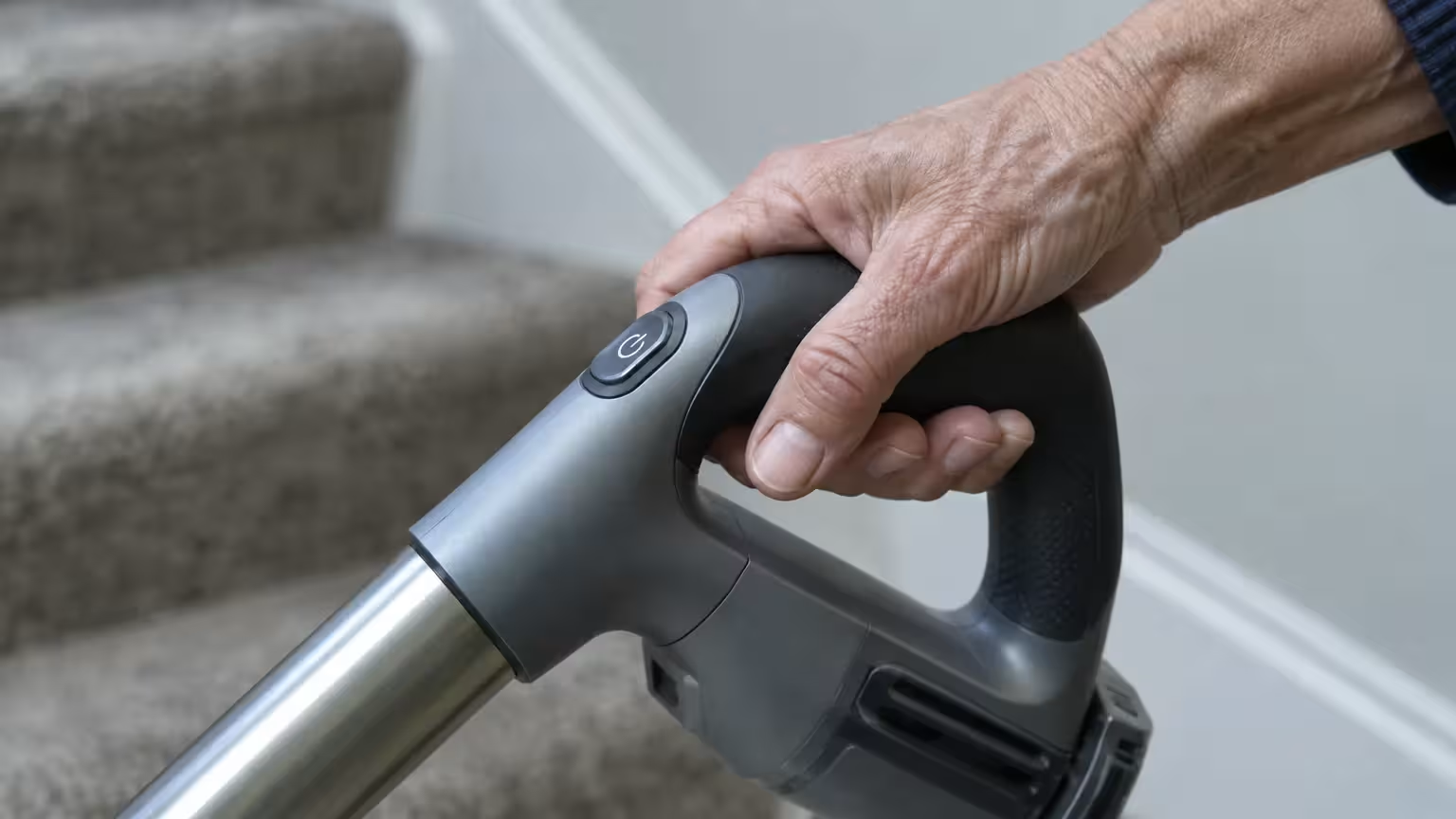
Switch styles differ between models and even between versions of the same product line. Always confirm the exact power switch design on the product page or in a store before buying.
Draining the battery mid-flight with boost suction on carpet
The third failure hits when a cordless battery dies halfway up your staircase. Getting stranded mid-flight forces exhausting extra trips up and down the steps carrying a dead machine back to its charger.
The cause: Boost mode drains batteries fast because carpet pile makes motorized brushes work harder. Short-runtime models leave little cushion, like one tested Shark Wandvac running around 12 minutes on standard power, barely covering a single flight if you pause.
The fix: Clean on standard power paired with a motorized mini-brush rather than cranking up max suction. The rotating brush lifts embedded hair and grit from carpet fibers without burning through battery life.
Before shopping, time how long your stairs take using your current vacuum at a steady, safe pace. Choose a model whose published standard-power runtime for the motorized stair attachment sits comfortably above your benchmark.
Recharge the battery after each cleaning session instead of storing it empty. Consistent recharging helps the battery hold capacity over time.
Leaving power cords or wheeled canisters on active treads
The fourth failure turns cheap plug-in power into a tripping hazard across narrow carpeted steps. While lightweight corded vacuums cost less and never lose suction, trailing wires endanger your footing.
The CDC home safety checklist advises keeping stairs clear of objects. A loose cord trailing across lower treads acts as a trip wire where even a light snag can pull you off balance.
The cause: Downstairs outlets drag cords behind your heels, while wheeled canisters like the Miele Classic C1 require moving the heavy base upward, inviting lower-back twisting.
The fix: Choose cordless power for stairs whenever possible. If you use a corded vacuum, plug into an upper landing outlet so the cord stays behind you as you climb.
Gather the cord before walking back down. With a canister vacuum, set the body on a step above you, never on the tread where you stand.
Bending over a low trash can to pry open a twist-off bin
The fifth failure hits after cleaning, during dust bin disposal. Bending over a low wastebasket to force open a stubborn cup strains a lower back already fatigued from climbing.
The cause: Twist-off bowls and pull-out filters usually take two hands and a deep waist bend. On a Black+Decker Dustbuster, detaching the bowl usually requires two hands.
The fix: Pick a point-and-empty bin opened with one hand, like the lever on the Dyson V12 Detect Slim or the button on the Shark Wandvac System WS620. Bagged canisters such as the Miele Classic C1 skip bin emptying altogether.
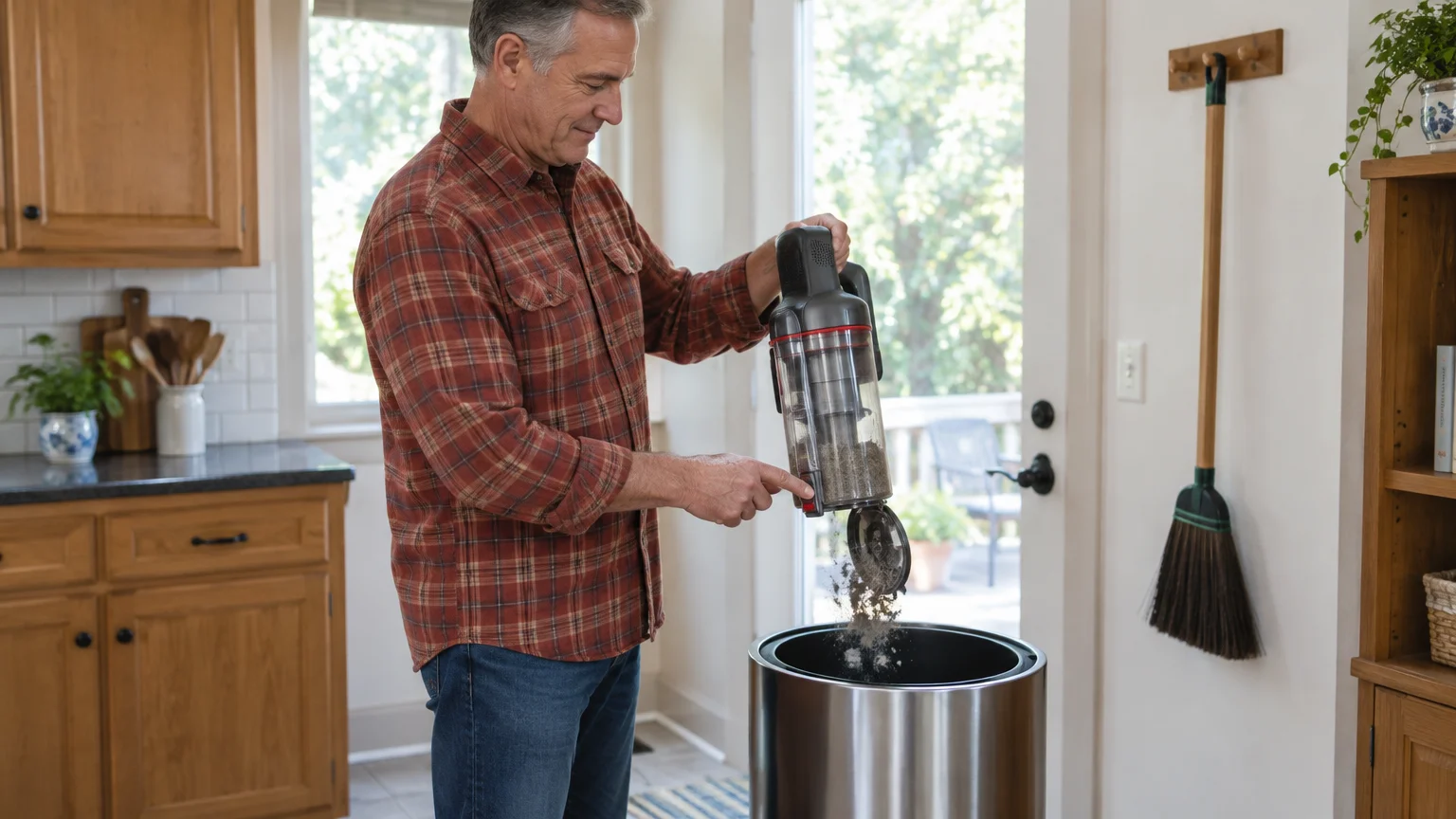
Press the latch in a store to make sure stiff springs will not hurt sore thumbs. Empty into a tall kitchen can after every flight to stay upright and keep the machine light.
Backing down the stairs instead of climbing upward behind the rail
The final failure is cleaning from the top landing downward while stepping backward. Backing down narrow treads hides step edges and pulls your free hand off the handrail.
National Institute on Aging guidance is to hold the handrail on stairs, even when carrying things. Cleaning downward sacrifices steady support and clear sightlines.
The cause: Starting at the top to sweep grit downward forces blind backward steps over narrow risers.
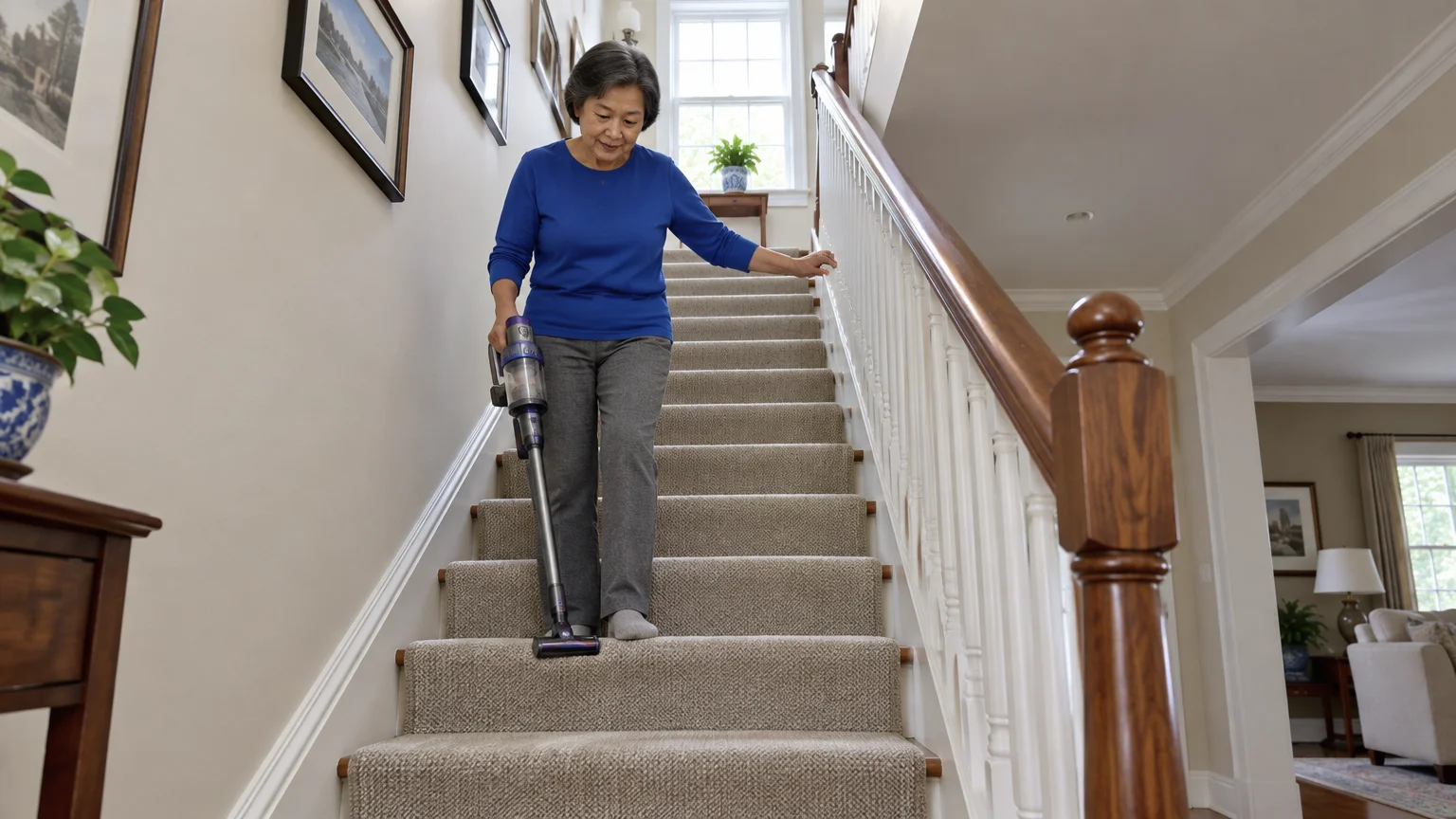
The fix: Follow an upward routine using handheld mode and a motorized stair tool:
- Clear the stairs first. Pick up shoes, bags and clutter, and check that carpet edges and the rail feel secure.
- Use handheld mode with the stair tool. Leave the long wand off so it cannot add awkward leverage on your wrist.
- Start at the bottom and work upward. Facing the steps keeps your eyes on your footing the whole time.
- Keep one hand on the rail. Stand with both feet flat on a tread rather than on the front edge.
- Do the tread, then the riser, then step up. Work only within comfortable reach without bending at the waist.
- Pause every few steps. Stand upright briefly, and sit down on a step if you feel dizzy or your back flares.
If you clean alone, wearing a monitored or unmonitored fall alert during chores keeps help reachable if you slip. When stairs stay unsafe, your local Area Agency on Aging can locate local chore and homemaker services.
For longer-term housing updates, review stair lift costs and installation options alongside our guide to home modifications for aging in place.