
Stacks of sweepstakes “winner” letters, official-looking notices and donation pleas on a parent’s counter usually mean their name is on mailing lists that senders buy and trade. You can cut most of that mail within about three months without taking over their checkbook.
The main tools are a $7 DMAchoice caretaker registration, a free opt-out from prescreened credit offers, free USPS Form 1500 orders against repeat mailers, and a report to the Postal Inspection Service for anything fraudulent. Do them with your parent, not around them.
How scam mail finds an older parent and keeps coming
Most of this mail starts with one reply. A small check for a “processing fee” or a $10 donation marks your parent as a responsive name, and list brokers rent that name to other mailers.
The losses add up. In the Federal Trade Commission’s Protecting Older Consumers 2025–2026 report, adults 80 and older who lost money to fraud reported a median loss of $2,000.
Signs that a letter is predatory rather than ordinary junk mail:
- A prize or sweepstakes win that requires a fee, tax or handling payment first. The Postal Inspection Service warns that you should never have to pay to collect a legitimate prize.
- Envelopes made to look official: fake seals, “Final notice,” “Open immediately,” or warnings that Social Security or Medicare benefits are at risk.
- Small “gifts” such as address labels, coins or religious tokens tucked into a donation request to create a sense of obligation.
- Instructions to keep the matter private or to reply quickly in the enclosed envelope.
The same schemes also arrive by phone and email, which our guide to scams targeting seniors covers.
Letters claiming to be from Medicare deserve their own check, explained in our guide to avoiding Medicare scams. The Senior Medicare Patrol takes reports at 1-877-808-2468.
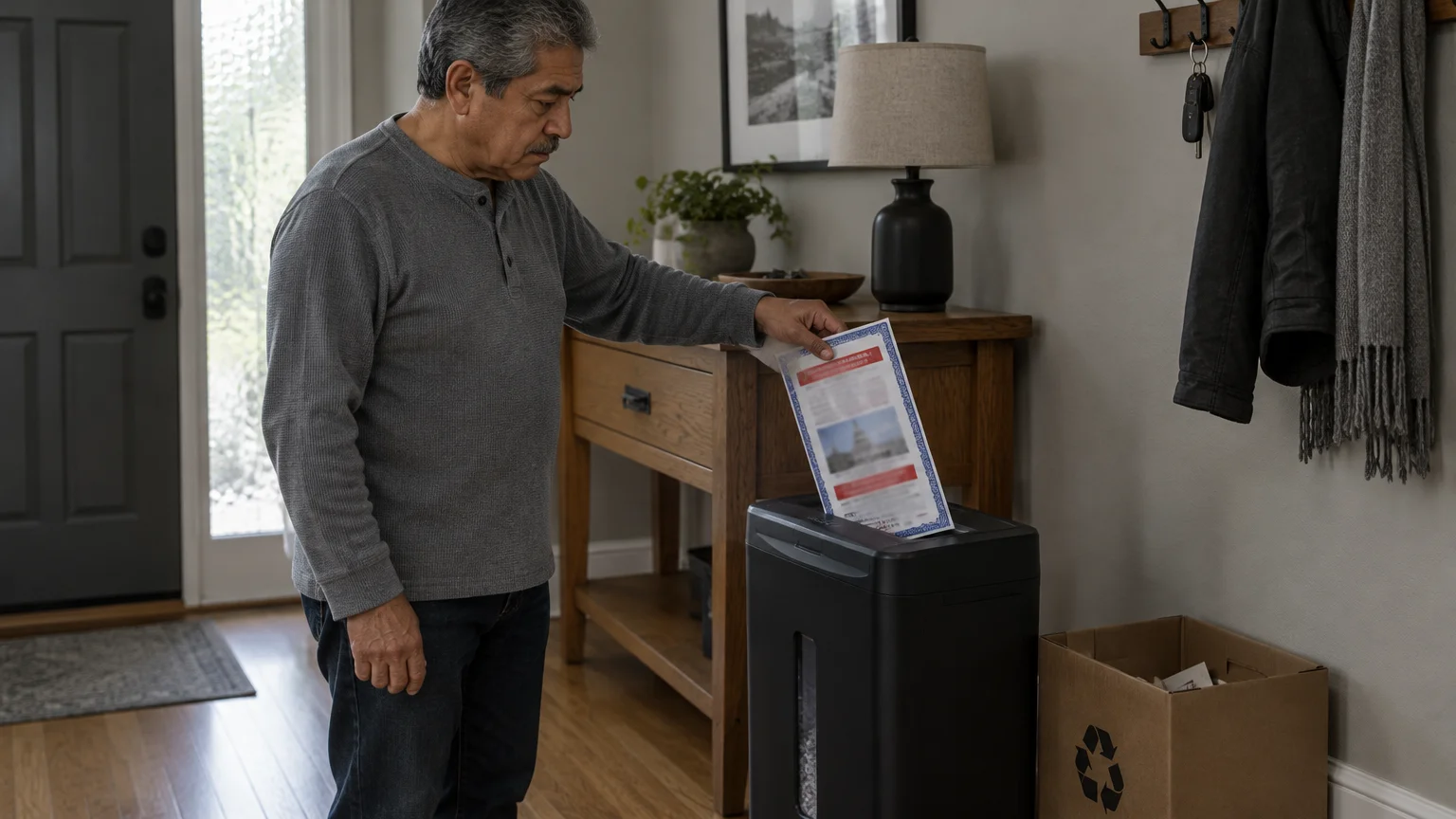
Step 1: Register your parent on the DMAchoice caretaker list ($7)
DMAchoice is the mail-preference service run by the Association of National Advertisers. Marketers and nonprofits that use it remove registered names before mailing to prospect lists they buy or rent.
The standard consumer registration costs $8 online or $9 by mail and lasts 10 years. It is meant for adults registering themselves.
The Do Not Contact for Caretakers registration is for someone acting for a dependent adult. It costs a one-time $7 processing fee and the suppression is permanent.
- Open the caretaker registration page and enter your own details as the caretaker.
- Enter your parent’s name and mailing address exactly as they appear on the junk mail, including apartment numbers. If mail arrives under a nickname or misspelling, have those versions at hand too.
- Pay the $7 fee by card and keep the confirmation.
Expect about 90 days before volume drops, because mailers buy lists months ahead of each print run.
The list does not stop mail from groups your parent already gives to or buys from, and outright scammers ignore it. The next steps handle those.

Step 2: End prescreened credit and insurance offers for free
“Pre-approved” credit card and insurance offers are built from credit bureau files. A parent with memory problems may sign one believing it is a required update, and a stolen offer can help a thief open an account.
The Fair Credit Reporting Act lets consumers opt out of these lists. Equifax, Experian, TransUnion and Innovis run one site for it, OptOutPrescreen.com.
- Five-year opt-out: done online or by phone. It asks for your parent’s name and address and may ask for date of birth and Social Security number.
- Permanent opt-out: start online, print the Permanent Opt-Out Election form, have your parent sign it and mail it. A 1-ounce letter needs one First-Class Forever stamp, $0.82 since July 2026.
Opting out does not change your parent’s credit score, existing accounts or ability to apply for credit. Offers already printed can keep arriving for several weeks.
Step 3: Use USPS Form 1500 to make a repeat mailer stop
When a sweepstakes company keeps mailing after you have opted out, federal law offers a stronger tool. PS Form 1500 asks the Postal Service to issue a prohibitory order under 39 U.S.C.
3008, and filing it is free.
The law was written for sexually oriented ads. In Rowan v. Post Office Department (1970), the Supreme Court held that the recipient alone decides which advertisements are offensive, and the Postal Service does not second-guess that judgment.
The order covers advertisements that offer goods or services for sale. Pure charity or political appeals may fall outside it, so ask at the post office if you are unsure.
- Keep the whole mail piece: outer envelope, letter and reply envelope.
- Fill in your parent’s name and address and the sender’s name and address as printed on the mail.
- Have your parent sign as the addressee.
- Hand the form and the mail piece in at the post office, or mail them as the form’s instructions direct.
Once the order is issued, the sender has 30 days to remove your parent’s name and stop mailing.
If more mail from that sender arrives after that, take it to the post office. The Postal Service can ask the Justice Department to seek a court order against a sender who ignores the order.
If your parent can no longer sign or manage their affairs, ask the post office whether someone holding a power of attorney or a court-appointed guardian can file for them.

Refusing unopened mail and asking charities to drop the name
Unopened mail can be marked “Refused” and handed back to the carrier, under the USPS rules for refusing mail. First-Class and Priority Mail goes back to the sender.
Most bulk marketing mail is discarded rather than returned, and refusing any piece does not remove your parent’s name from a list. Treat it as a quick fix for single letters.
For real charities your parent has supported, call or write to the donor office. Ask them to remove the name, or at least to stop renting or trading it to other organizations.
Which opt-out tool stops which kind of mail
| Tool | What it stops | Cost | How long it lasts |
|---|---|---|---|
| DMAchoice caretaker registration | Prospect mail from marketers and nonprofits that use the list | $7 one time | Permanent |
| DMAchoice standard registration | The same, for an adult registering themselves | $8 online, $9 by mail | 10 years |
| OptOutPrescreen | Prescreened credit and insurance offers | Free; $0.82 stamp for the permanent form | 5 years online, permanent by signed form |
| PS Form 1500 | Advertisements from one named sender | Free | An order against that sender |
| Refusing mail | One unopened piece | Free | That piece only |
A 90-day mailbox cleanup, with the costs added up
Consider a widowed 83-year-old getting about 42 solicitations a week, including 11 credit offers, and writing checks averaging $180 a month in “fees” and gifts to repeat senders.
- Day 1: register on the DMAchoice caretaker list, including two misspellings seen on envelopes. Cost: $7.
- Day 3: mail the signed permanent OptOutPrescreen form. Cost: $0.82.
- Day 14: hand in Form 1500 at the post office counter for the four most aggressive sweepstakes senders. Cost: $0.
- Days 30 to 90: credit offers taper off first, then prospect mail from list buyers. Refuse or shred what still comes, and file Form 1500 against any new repeat sender.
Total out of pocket: $7 + $0.82 = $7.82. If the $180 monthly checks stop, that is $180 × 12 = $2,160 a year kept.
New senders can still appear. A routine such as a daily check-in call, where your parent mentions any letter asking for money, catches them early.
Where to report mail fraud and fake prize letters
Report sweepstakes, lottery and fake-fee mail to the U.S. Postal Inspection Service through its online mail fraud report or at 1-877-876-2455. Keep the envelopes and any canceled checks as evidence.
Playing a foreign lottery by mail is illegal, so any letter announcing a foreign lottery win is a scam. Report it rather than replying.
The Justice Department’s National Elder Fraud Hotline also helps families report losses; its number is listed on the department’s Office for Victims of Crime site.
If someone is actively taking money from your parent, adult protective services in their county can investigate. Your local Area Agency on Aging can connect you with that office.
Bank settings that limit losses while the mail slows
- Text or email alerts for checks or withdrawals above an amount you agree on, such as $100.
- View-only online access for you, with your parent’s permission, to spot recurring payments to unfamiliar names.
- A trusted contact on the account, so the bank or brokerage can reach you if it suspects exploitation.
- A lower daily debit limit, or a separate small account for everyday spending.
Options differ by bank, so ask at the branch together. If your parent’s ability to manage money is in question, an elder law attorney can explain powers of attorney and other arrangements.