You can receive your full U.S. Social Security retirement check every month while living along the shores of Lake Chapala. The Social Security Administration deposits benefits directly into Mexican bank accounts without penalty.
Moving your benefit across the border without financial loss hinges on using the Federal Reserve’s direct institutional exchange pipeline instead of commercial bank transfers. Avoid the costly wire fees that trap unwary retirees.
As a 65-year-old American citizen establishing Mexican residency, you must balance exchange mechanisms, mandatory proof-of-life paperwork, and U.S. tax compliance to protect your monthly cash flow.
In this guide10 sections
- Title II Eligibility and the 30-Day SSI Rule in Mexico
- Direct Deposit Options: U.S. Bank Versus Mexican Bank
- Setting Up International Direct Deposit With Form SSA-1199-OP2
- Currency Conversion Mechanics and Institutional Exchange Rates
- Worked Example: Annual Banking Costs in Lake Chapala
- Form SSA-7162 Instructions and the Proof-of-Life Mailing Cycle
- U.S. Tax Rules and Non-Resident Alien Withholding Realities
- Managing Medicare Part B Premiums While Residing Abroad
- Working With Federal Benefits Units in Mexico
- Frequently Asked Questions
Title II Eligibility and the 30-Day SSI Rule in Mexico
American citizens retain full rights to their earned Title II Social Security benefits regardless of where they live globally. Your retirement, spousal, or disability payments continue indefinitely as you settle into Mexican communities like Ajijic or Chapala.
Dispelling common Social Security misconceptions is essential, as many mistakenly believe that moving abroad forfeits their hard-earned retirement checks.
However, you must distinguish between earned Social Security retirement benefits and Supplemental Security Income (SSI). SSI is a needs-based welfare program funded by general tax revenues rather than Social Security payroll taxes.
Federal law prohibits sending SSI payments to beneficiaries residing outside the fifty states and the District of Columbia. If you leave the United States for 30 consecutive days, your SSI payments stop immediately.
Your SSI benefits will not resume until you return to the United States and remain physically present for 30 consecutive days. Do not rely on SSI payments to fund your life in Mexico.
Retirees frequently ask whether their Mexican work history affects their U.S. payments. The United States and Mexico signed a bilateral Social Security Totalization Agreement in 2004.
However, this agreement never took effect because the U.S. Congress never ratified the treaty. You cannot combine credits from Mexico’s Instituto Mexicano del Seguro Social (IMSS) with U.S. Social Security work credits.
- Title II Social Security retirement payments continue for U.S. citizens without geographic interruption.
- Social Security Disability Insurance (SSDI) and survivor benefits continue under the same rules as retirement payments.
- Supplemental Security Income (SSI) ceases permanently after 30 consecutive days abroad.
- Work credits earned under the Mexican IMSS system do not transfer to qualify you for U.S. benefits.
Direct Deposit Options: U.S. Bank Versus Mexican Bank
Choosing where your monthly benefit arrives represents your first major financial decision when relocating to Mexico. You have three primary options for receiving your monthly funds.
Taking time to integrate benefits into your retirement strategy helps ensure predictable cash flow across international borders.
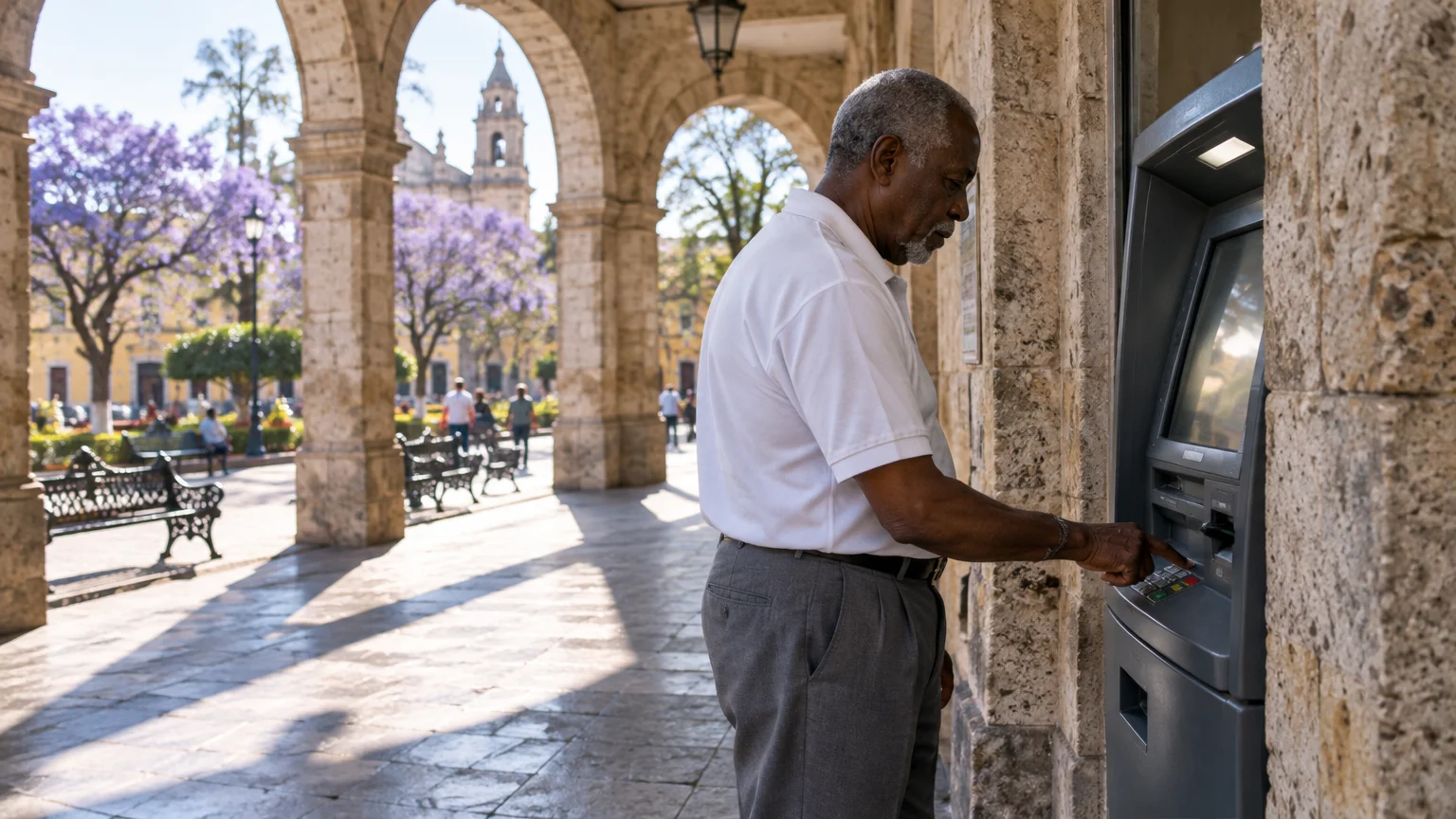
First, you can maintain a domestic U.S. checking account and withdraw cash from Mexican ATMs. Second, you can wire funds manually each month through private transfer services.
Third, you can establish International Direct Deposit directly into a Mexican financial institution. According to guidance on international remittance transfers from the Consumer Financial Protection Bureau, hidden currency conversion spreads and third-party fees quickly erode fixed incomes.
The following table compares the three primary payment delivery paths available to American retirees in Mexico.
| Transfer Method | Monthly Processing Fee | Exchange Rate Margin | Delivery Schedule |
|---|---|---|---|
| SSA International Direct Deposit (Mexican Bank) | $0.00 | Near-interbank rate (under 0.20%) | Third business day of each month |
| U.S. Bank Account With Mexican ATM Withdrawals | $0.00 to $5.00 per ATM transaction | 1.0% to 3.0% network retail spread | Immediate domestic posting date |
| Monthly Commercial Wire (SWIFT Transfer) | $25.00 to $45.00 per outgoing wire | 2.0% to 4.5% commercial bank spread | 1 to 3 business days after transfer request |
Maintaining a U.S. account gives you access to domestic bill pay for U.S. credit cards. However, commercial Mexican ATM withdrawal limits often cap daily cash at 7,000 to 10,000 pesos.
Relying solely on local ATMs forces multiple monthly trips and exposes you to card skimmers. Direct deposit into a Mexican bank eliminates foreign transaction surcharges entirely.

Setting Up International Direct Deposit With Form SSA-1199-OP2
Enrolling in direct deposit for a Mexican bank requires official paperwork submitted directly to federal administrators. You must use Form SSA-1199-OP2, titled the International Direct Deposit Signup Form for Mexico.
You cannot execute this signup using the standard domestic direct deposit screens found on common bank portals. The form establishes a processing link through Banco de México.
Before filling out the form, open an account at a major Mexican bank such as BBVA Mexico, Banamex, or Santander. You will need your temporary or permanent resident card and a local utility bill to open the account.
Every Mexican checking account includes an 18-digit Clave Bancaria Estandarizada, known colloquially as a CLABE. You must record this 18-digit number precisely on Form SSA-1199-OP2.
- Open a checking or savings account in person at your chosen bank branch in Mexico.
- Request an official bank statement (estado de cuenta) displaying your full legal name and 18-digit CLABE.
- Download the official Form SSA-1199-OP2 from the Social Security Administration website.
- Fill out Section 1 with your U.S. Social Security number, claim number, and Mexican residential address.
- Have your Mexican bank officer complete and stamp Section 2 to certify your 18-digit CLABE.
- Mail or deliver the completed form to the nearest U.S. Federal Benefits Unit for formal processing.
Processing typically takes 30 to 60 days from the date of submission. Maintain your existing U.S. deposit instructions until you confirm the first peso deposit in your Mexican account.
Currency Conversion Mechanics and Institutional Exchange Rates
Many retirees assume that sending U.S. dollars into a Mexican bank account triggers terrible retail retail exchange rates. When using official International Direct Deposit, this assumption is incorrect.
Fortunately, annual Social Security cost-of-living adjustments still apply automatically to foreign deposits, helping preserve your baseline income over time.
The U.S. Treasury clears international benefit payments through the Federal Reserve Bank of Kansas City. The Federal Reserve batches all monthly Mexican benefit obligations into a single institutional currency transfer.
Banco de México converts this combined pool at the wholesale interbank rate on the business day prior to payment. The spread between the market rate and your converted payment is negligible.
Retail wire services and storefront remittance shops regularly charge markup spreads between 2% and 5% above interbank rates. The Federal Reserve system bypasses retail markups completely.
Your benefit arrives in your Mexican bank account denominated entirely in Mexican pesos (MXN). The funds become available on the third business day of each month without incoming wire fees.
Because the conversion happens automatically, your monthly peso balance fluctuates alongside global foreign exchange markets. You must build a currency buffer in your local budget to absorb exchange swings.

Worked Example: Annual Banking Costs in Lake Chapala
Consider a realistic financial scenario for a 65-year-old American retiree living in Ajijic on Lake Chapala. This worked example illustrates the exact numbers over a full 12-month calendar year.
The retiree receives an earned Social Security retirement payment of exactly $2,250.00 USD per month. We assume an average benchmark interbank exchange rate of 18.00 Mexican pesos per U.S. dollar.
At the interbank benchmark rate, $2,250.00 converts to an unadjusted gross total of 40,500.00 pesos per month. Let us compare two routing pathways.
Under Scenario A, the retiree deposits funds into a domestic U.S. account and wires the money monthly to Mexico. The U.S. bank charges a $35.00 outgoing wire fee, and the Mexican bank charges a $15.00 incoming wire fee.
Furthermore, the commercial bank applies a 2.50% retail currency conversion markup against the transfer. On a $2,200 net transfer, that conversion markup costs $55.00 in lost purchasing power each month.
The total monthly fee burden under Scenario A equals $105.00 ($35 outgoing + $15 incoming + $55 markup). Over 12 calendar months, this routing strategy destroys $1,260.00 USD in retirement capital.
Under Scenario B, the retiree uses Form SSA-1199-OP2 for International Direct Deposit straight to a Mexican bank. The monthly administrative fee is $0.00, and the incoming bank fee is $0.00.
The Federal Reserve institutional exchange spread consumes less than 0.15%, which equals roughly $3.38 per monthly transaction. Over 12 calendar months, total currency costs equal $40.56 USD.
Routing funds through the institutional pipeline saves this retiree $1,219.44 USD every year. In Lake Chapala, that savings covers nearly two months of average residential utilities and groceries.
Form SSA-7162 Instructions and the Proof-of-Life Mailing Cycle
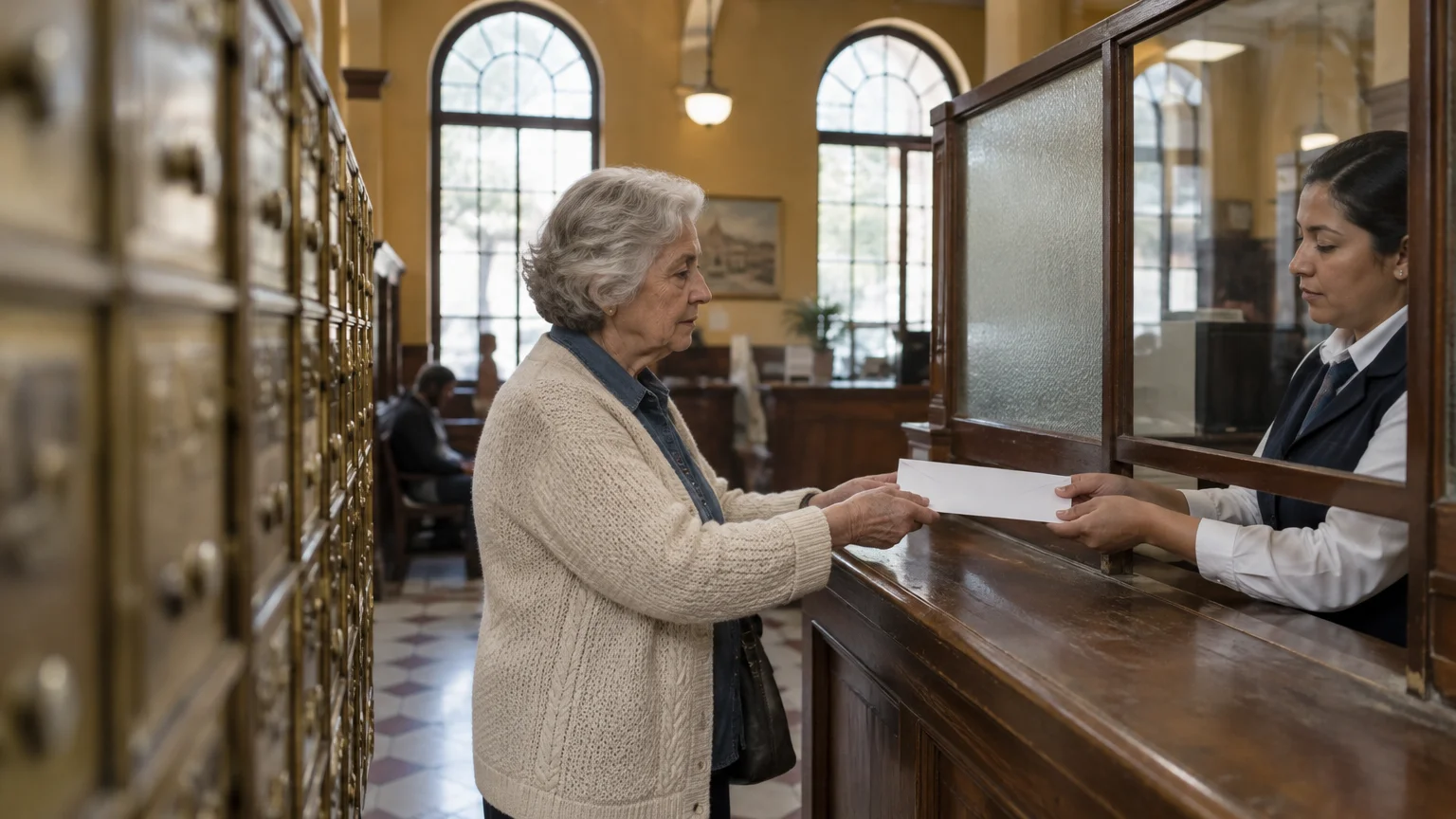
Living abroad requires compliance with federal verification programs designed to prevent post-death benefit payments. The agency enforces this rule through Form SSA-7162, officially named the Report to Social Security Administration.
Retirees commonly call this document the proof-of-life questionnaire. If someone else manages your money as an appointed representative payee, the agency sends Form SSA-7161 instead.
The mailing cycle operates on a predictable two-year alternating schedule based on your Social Security number (SSN). Understanding this schedule ensures you never miss a critical filing window.
- Beneficiaries with SSNs ending in 00 through 49 receive Form SSA-7162 in even-numbered calendar years.
- Beneficiaries with SSNs ending in 50 through 99 receive Form SSA-7162 in odd-numbered calendar years.
- Beneficiaries aged 90 and older receive Form SSA-7162 every year, regardless of their SSN ending digits.
- Forms are typically mailed out from Pennsylvania between June and July of your designated year.
The agency grants you 60 calendar days from the date of receipt to return the questionnaire. If you fail to respond, a second notice is issued in late autumn.
If you fail to return the questionnaire by early February of the following year, the agency automatically suspends your payments. Restoring suspended benefits can take several months of consular intervention.
Complete the form in dark blue or black ink. Confirm your physical address in Mexico, report any changes in marital status, and certify that you have not taken foreign employment.
Do not mail this form through standard Mexican domestic postal services (Correos de México), which frequently lose mail. Send the document via tracked private courier to the central processing center.
Address your envelope to: Social Security Administration, P.O. Box 7162, Wilkes-Barre, PA 18767-7162, USA.
Keep a photographic copy of your signed form and your courier delivery tracking receipt.

U.S. Tax Rules and Non-Resident Alien Withholding Realities
Tax obligations follow American citizens no matter where they establish physical residency. Moving to Lake Chapala does not relieve you of your federal filing duties with the IRS.
Some retirees incorrectly believe they face Non-Resident Alien (NRA) tax withholding on their Social Security checks. NRA withholding requires federal agencies to withhold a flat 30% from benefit payments sent abroad.
However, NRA withholding applies exclusively to foreign citizens living outside the United States. As an American citizen, your benefit checks are completely exempt from mandatory 30% non-resident alien withholding.
You receive your gross payment without automatic international tax deductions. Your taxable benefit percentage remains governed entirely by standard domestic rules based on combined income thresholds.
- Individual filers with combined income between $25,000 and $34,000 pay federal tax on up to 50% of benefits.
- Individual filers with combined income exceeding $34,000 pay federal tax on up to 85% of benefits.
- Married couples filing jointly with income over $44,000 pay federal tax on up to 85% of benefits.
- You must file Form 1040 annually reporting worldwide income, including your Social Security earnings.
Mexican tax rules treat foreign pensions favorably under bilateral tax treaty guidelines. The U.S.-Mexico Income Tax Treaty gives the United States primary taxation rights over U.S. Social Security benefits.
Consequently, you do not pay Mexican income taxes on your Social Security payments. Consult an experienced cross-border tax accountant to properly structure your annual declarations in both jurisdictions.

Managing Medicare Part B Premiums While Residing Abroad
At age 65, American retirees must make crucial choices regarding Medicare enrollment. Medicare provides zero coverage for medical treatment, prescriptions, or hospitalizations received inside Mexico.
Understanding the interplay of Social Security and Medicare coverage becomes especially critical when managing healthcare deductions while living outside the United States.
Understanding the direct link between Social Security and Medicare is essential when planning whether to maintain domestic health coverage while living abroad.
Official policy published on Medicare.gov confirms that Medicare pays claims only within the fifty United States and U.S. territories. Emergency care across the border is not reimbursable.
Despite this lack of foreign utility, your Medicare decisions directly impact your monthly Social Security check. The standard Medicare Part B monthly premium automatically deducts from your retirement payment.
If you drop Medicare Part B to keep that premium cash, you face significant future penalties. If you return to live in the United States later, you must pay a permanent 10% late-enrollment penalty.
That 10% penalty accumulates for each full 12-month period you were eligible for Part B but remained unenrolled. Over five years abroad, your penalty permanently raises your future Part B premium by 50%.
Many retirees living in Lake Chapala maintain Part B deductions while using Mexican healthcare options locally. The private healthcare infrastructure in nearby Guadalajara offers affordable out-of-pocket specialists and modern hospitals.
- Evaluate whether you intend to return to the United States for future medical interventions.
- Keep Medicare Part B if you plan to move back permanently or visit family for surgeries.
- Disenroll using Form CMS-1763 only if you are certain you will never live in the United States again.
- Purchase local Mexican private health insurance or pay out of pocket for local clinical care.
Working With Federal Benefits Units in Mexico
When bureaucratic complications arise, you do not need to call the domestic toll-free Social Security number. Domestic phone representatives frequently lack training in foreign direct deposit and international treaties.
Instead, contact the Federal Benefits Units (FBUs) operating inside U.S. diplomatic missions in Mexico. Consular staff at these units specialize in assisting overseas beneficiaries.
Mexico hosts three regional Federal Benefits Units positioned across the country. Each unit manages benefit services for specific geographic territories.
- U.S. Embassy in Mexico City serves central, southern, and eastern states.
- U.S. Consulate General in Ciudad Juárez serves northern border communities.
- U.S. Consulate General in Guadalajara serves western Mexico, including the Lake Chapala expat region.
For retirees living in Chapala, Ajijic, or Jocotepec, the Guadalajara FBU is your primary administrative hub. You can submit initial benefit claims, deliver Form SSA-1199-OP2, or resolve suspended payments directly through them.
You can also oversee your account online using your personal portal. If you lack a domestic residential address, establish your account using the international identity verification flow.
The agency uses the ID.me verification service to confirm identities for expatriates. Select the specific option stating that you do not live in the United States to upload identity documents.
This digital access allows you to track annual benefit adjustments and download your Form SSA-1099 tax statement every January. Combining digital tools with consular resources keeps your monthly payments secure.
Frequently Asked Questions
Can I collect U.S. Social Security while living in Mexico as an American citizen?
Yes, U.S. citizens can collect their full Social Security retirement, survivor, and disability benefits indefinitely while residing in Mexico. The funds can be sent directly to a Mexican bank or to an existing U.S. account.
What happens to my Social Security payments if I forget to mail Form SSA-7162?
The Social Security Administration will issue a second warning questionnaire in late autumn. If you do not return the document, the agency will automatically suspend your payments early the following year.
Does Mexico tax my U.S. Social Security benefits?
No, Mexico does not tax U.S. Social Security benefits under the terms of the U.S.-Mexico Income Tax Treaty. The United States retains sole taxing authority over these retirement disbursements.
Can I use Medicare to pay for hospital care in Lake Chapala or Guadalajara?
No, Medicare does not cover healthcare services received outside the United States and its territories. You must pay for medical treatment in Mexico using private insurance or personal funds.
How does the Social Security Administration calculate the exchange rate for direct deposit in Mexico?
The Federal Reserve clears payments through Banco de México at daily institutional interbank rates. This process bypasses retail wire charges and provides higher conversion values than commercial retail banks.
Disclaimer: This article is for informational purposes only. Benefits, programs, and regulations can change.
We encourage readers to verify current information with official government sources and consult with qualified professionals for personalized advice.