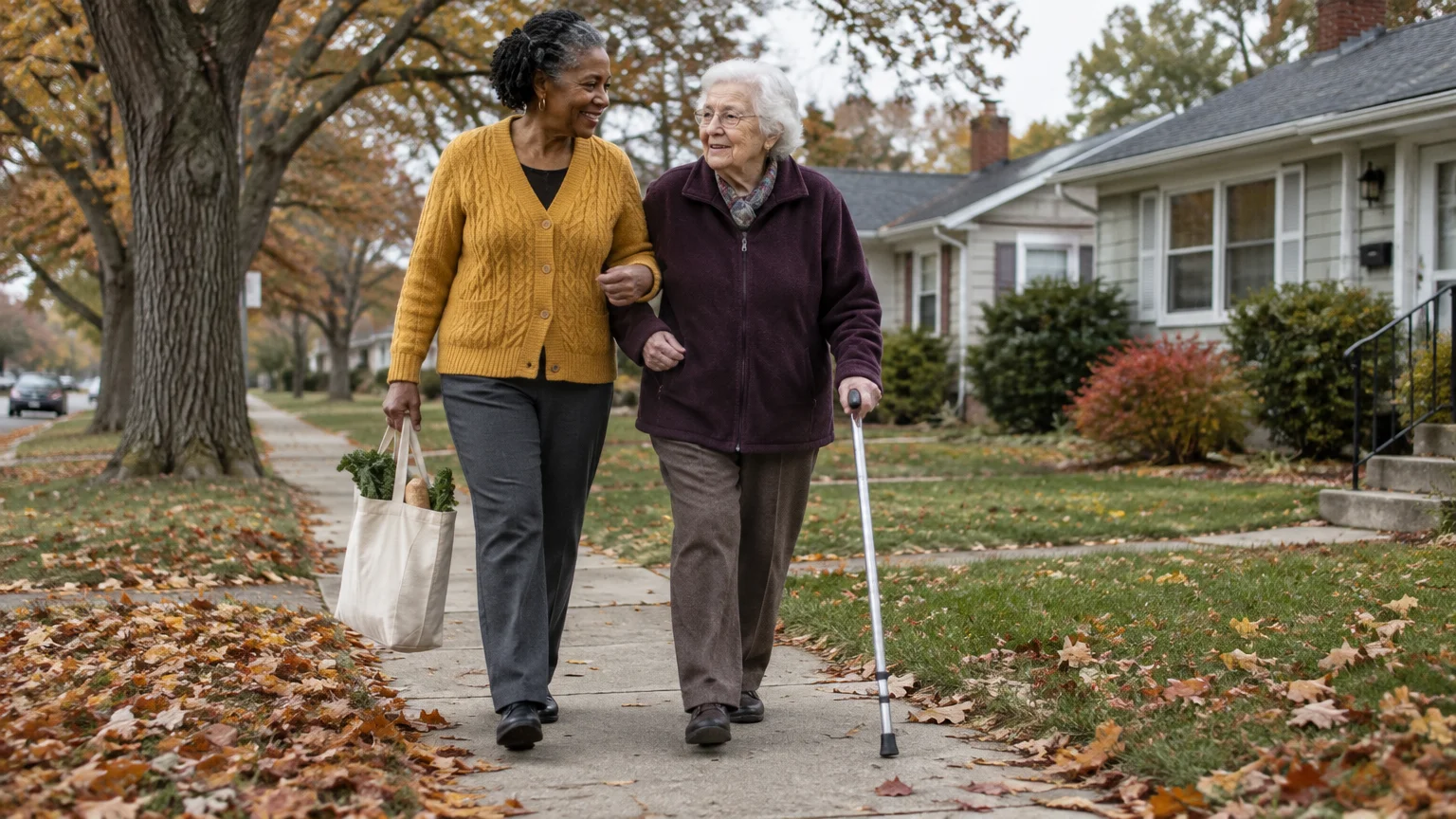
If you are a single retiree age 55 or older on Social Security and receive SNAP, SSI, or subsidized housing, a regular paycheck can shrink those benefits. The Senior Companion Program pays a $4.00 hourly stipend that federal law shields from taxes and benefit cuts.
Because the Domestic Volunteer Service Act protects this stipend, $300 in stipends can leave you ahead of $300 in part-time wages. You apply through a local sponsor, not a federal office, by following an ordered sequence from income screening through benefit verification.
Compare the stipend with SCSEP and part-time wages
First, compare protected stipends with taxable wages before touching any application form. This decision affects your SNAP allotment, SSI check, subsidized rent, and Social Security account.
Standard part-time wages are taxed and counted by assistance programs. Higher countable income can reduce SNAP benefits, raise subsidized rent typically set at about 30% of adjusted income, and trigger Social Security withholding before full retirement age.
By contrast, the federal rule on Senior Companion stipends and reimbursements excludes stipends from taxes and public assistance income. Under the Domestic Volunteer Service Act, these payments are not treated as wages.
Because the stipend is not wages, it should not count toward Social Security’s earnings limit ($25,560 in 2027 before full retirement age). Confirm with SSA if you also hold a paying job before full retirement age.
If you want paid job training to re-enter the workforce, the Senior Community Service Employment Program (SCSEP) fits better. Unlike Senior Companion stipends, SCSEP pays wages that benefit programs generally count as earnings.
Before moving on, confirm you are at least 55, can serve weekly, and want benefit-shielded income rather than job retraining.
Find a local Senior Companion sponsor and check for openings
Second, locate your local sponsor before gathering paperwork. AmeriCorps Seniors through local sponsors runs enrollment through senior centers, community action agencies, county offices, and nonprofits.
Search the AmeriCorps Seniors Pathfinder by state and county for nearby projects. You can also ask your local Area Agency on Aging which local organization manages stipended slots.
Call the sponsor’s coordinator before filling out any form, especially near January when HHS updates poverty guidelines. Ask these questions on your call:
- Whether stipended slots are open now or on a waitlist
- What hourly rate the sponsor pays, since some add non-federal funds above the $4.00 federal rate
- Whether mileage or transit fare is reimbursed
- Which 12-month period and guideline year the coordinator applies
Before moving on, confirm open stipended slots exist and note the sponsor’s intake deadline and 12-month proof window.
Subtract medical expenses to meet the 2026 income limit
Third, gather your income and health records to test eligibility before applying. This step uses your Social Security award letter, pension or annuity statements, retirement withdrawal records, and your spouse’s income records if living together.
The federal income rule for stipended Senior Companions sets the limit at 200% of the 2026 HHS poverty guidelines after medical deductions. HHS updates guidelines each January, and Alaska and Hawaii use higher limits.
In the 48 contiguous states and D.C., 100% of the 2026 guideline is $15,960 for one person ($21,640 for two). That puts the 200% stipend limit at $31,920 for one person and $43,280 for two.
Out-of-pocket medical costs often bring Social Security recipients under the limit. The medical deduction is capped at 50% of the limit, or $15,960 for one person ($21,640 for two) in 2026.

Collect past-year receipts and premium statements for unreimbursed costs that no insurer repaid:
- Medicare Part B premiums, including amounts taken from Social Security
- Part D, Medicare Advantage, and Medigap premiums you pay
- Prescription copays and out-of-pocket medications
- Unreimbursed doctor, dental, vision, and hearing costs, including dentures, glasses, or hearing aids
For example, a widowed 67-year-old living alone on $2,700 a month ($32,400 a year) in Social Security sits $480 over the $31,920 limit. Her unreimbursed medical costs over the past year total:
- Medicare Part B premiums at the 2026 standard rate of $202.90 a month: $2,434.80 (the 2027 standard rate is $209.40 a month)
- Prescription copays at $85 a month: $1,020.00
- Dental cleanings and new prescription glasses: $600.00
Those costs total $4,054.80, well under the $15,960 cap. Subtracting $4,054.80 from $32,400 drops her countable income to $28,345.20, qualifying her for the stipend.
If your income still exceeds the limit, sponsors usually let you serve as a non-stipended volunteer. Before moving on, verify every receipt matches the sponsor’s 12-month window and brings countable income at or below the limit.
Submit your sponsor application and pass background screening

Fourth, submit your sponsor application with your income and medical file. This step touches the sponsor’s intake form, your financial verification packet, and federal and state background screening portals.
During the interview, the coordinator calculates your countable income, reviews program rules, and discusses your schedule, transportation, and client preferences. The sponsor’s project director makes the formal income eligibility decision.
If a medical expense was missed, ask the project director to recalculate using your receipts. National service rules also require a National Sex Offender Public Website check plus state and FBI criminal history checks, usually via fingerprinting.
Before moving on, confirm the project director approved your stipended eligibility and your fingerprint and criminal background clearances are complete.
Complete orientation and lock in your weekly stipend schedule
Fifth, finish pre-service orientation before your first client visit. This step touches your training record, weekly timesheet form, and volunteer insurance enrollment with the sponsor.
Orientation covers client safety, boundaries, and how to submit hours on time for stipend payment. Afterward, the coordinator matches you with two or three clients for regular weekly visits.

Volunteers commit to a set schedule, typically between 5 and 40 hours a week. At 20 hours a week and $4.00 an hour, you log 1,040 hours and earn $4,160 a year, or about $347 a month.
You help with conversation, errands, shopping, appointment rides, and caregiver breaks, not hands-on medical care. Sponsors provide accident, personal liability, and excess auto insurance, and may offer paid training time, service-day meals, or mileage.
Before moving on, confirm your timesheet deadline and request a signed verification letter on sponsor letterhead citing the Domestic Volunteer Service Act.
Present your statutory exclusion letter at benefit renewals
Sixth, hand benefit caseworkers written proof of your stipend’s legal protection at every application or renewal. Caseworkers do not always know these exclusions unless you submit verification for your SNAP, SSI, housing, or Medicaid file.
Federal rules exclude Domestic Volunteer Service Act stipends across each senior benefit program:
- SNAP: the USDA SNAP income regulation excludes Domestic Volunteer Service Act payments, leaving food benefits unchanged; see our guide to SNAP benefits for seniors for other rules.
- SSI: SSA’s operating instructions on national service program payments direct caseworkers to exclude these stipends.
- Public housing and Section 8: HUD’s list of federally mandated income exclusions prevents stipends from raising rent; our overview of housing assistance programs for seniors covers rent rules.
- Medicaid and Medicare Savings Programs: these generally follow SSI income rules for people 65 and older, though you should confirm with your state Medicaid office.
On federal tax returns, you do not report the stipend or reimbursements, and no Social Security or Medicare tax is withheld. Ask a tax professional if a state tax form requests those figures.
Copyable verification letter template for SNAP and housing caseworkers
Ask your sponsor to copy this template onto organization letterhead, fill in the bracketed details, and sign it before your next recertification:
To: [Caseworker Name, SNAP Office / Public Housing Authority / SSA Office]
From: [Project Director Name and Title], [Sponsor Organization Name]
Subject: Excluded Senior Companion Program Stipend Verification for [Volunteer Full Name]
[Volunteer Full Name] serves as an enrolled AmeriCorps Seniors Senior Companion volunteering approximately [Weekly Hours] hours weekly and receiving a non-wage stipend of [Hourly Stipend Rate] per service hour plus approved reimbursements.
Under the Domestic Volunteer Service Act and federal Senior Companion stipend and reimbursement regulations, these payments are not wages, are exempt from federal income tax, and must be excluded from public assistance income.
Specifically, these stipends are excluded under the USDA SNAP income regulation, HUD’s federally mandated income exclusions for public housing and Section 8 rent, and SSA operating instructions on national service payments for SSI.
Please exclude these payments when calculating [Volunteer Full Name]’s household income, SNAP allotment, SSI benefit, or rent share, and contact [Project Director Name] at [Sponsor Phone or Email] to confirm service.
Check your updated SNAP notice, SSI letter, or rent worksheet after filing to verify the agency recorded the stipend as excluded and kept your benefits intact.